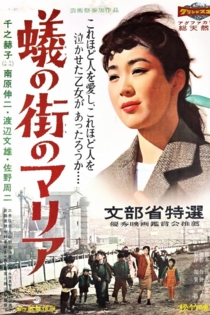
Kakuko Chino
1934 - 1985
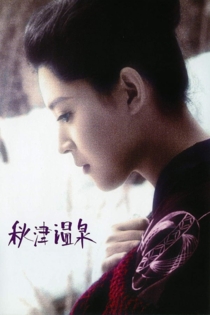
Akitsu Springs
Yoshishige Yoshida
Mariko Okada, Hiroyuki Nagato
Yoshida’s first big-budget production and colour film is a haunting tale of unrequited love and postwar disillusion. The story of the fatal attraction between a spineless intellectual and a strong woman is conventional, but its enactment is radically new.
Akitsu Springs
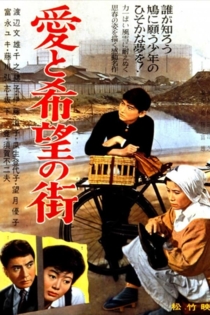
愛と希望の街
Nagisa Ōshima
Fumio Watanabe, Yuki Tominaga
A young man runs a scam selling pigeons that always return to his home. He falls under the wing of Kyoko, an older student whose heart is touched after Masuo sells his pigeons to her. However, after his scam is revealed, can these feelings truly remain the same?
Street of Love and Hope
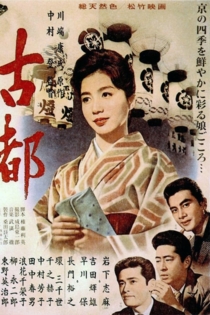
古都
Noboru Nakamura
Shima Iwashita, Hiroyuki Nagato
In this Japanese drama, a dry goods merchant's daughter is surprised to discover that she has a twin sister. In rural Japan it was thought that twins bring bad luck, so the sister was abandoned at birth. Later her parents tell her that her sister was kidnapped. The woman doesn't believe this and when she eventually meets her twin, both women are involved in love affairs. The merchant's daughter is seeing an educated fellow. Trouble ensues when she begins suspecting that he may be more interested in her sister.
Twin Sisters of Kyoto
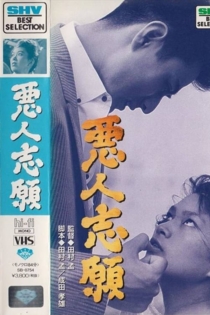
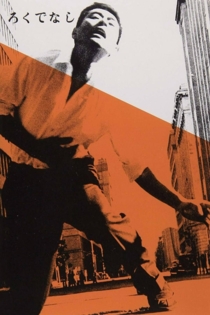
ろくでなし
Yoshishige Yoshida
Masahiko Tsugawa, Yūsuke Kawazu
Yoshida's first feature follows the lives of young students against a background of jazz, emptiness and boredom. The plot is fairly simple: a "good-for-nothing" from a poor background falls in love with the young secretary of his rich friend's father. The woman senses good in him and tries to lead him on the right path.
Good-for-Nothing
蟻の街のマリア
Heinosuke Gosho
Kakuko Chino, Kôji Nanbara
Alongside Tokyo's Sumida River is a ragpickers' settlement known as Ant Village. One night, a young Catholic girl, Satoko Kitahara, who has been baptized under the name of Maria, comes to offer her services. However, Ant Village is not just an ordinary vagrants' community but a fine autonomous organization, and as the municipal authorities have long been demanding that the people of Ant Village leave the site, Satoko is utilized to publicize the Village and win public sympathy. While being utilized in this manner, Satoko is nevertheless glad to be able to help the people of Ant Village, especially the children, and when the summer vacation comes she decides to take the children on an excursion to Hakone. To raise funds for this purpose she becomes a rag-picker herself.
Maria of the Ant Village