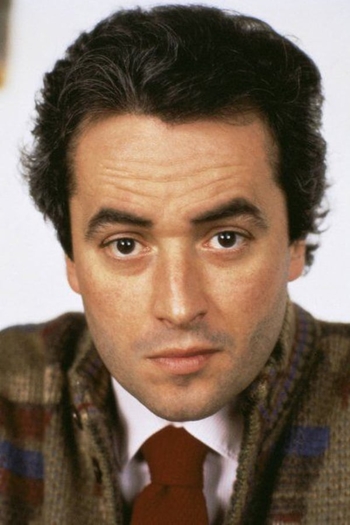
José Carreras
1946 (79 лет)Born in Barcelona, he made his debut on the operatic stage at 11 as Trujamán in Manuel de Falla's El retablo de Maese Pedro, and went on to a career that encompassed over 60 roles, performing in the world's leading opera houses and on numerous recordings. He gained fame with a wider audience as one of the Three Tenors, with Plácido Domingo and Luciano Pavarotti, in a series of large concerts from 1990 to 2003. He is also known for his humanitarian work as president of the José Carreras International Leukaemia Foundation (La Fundació Internacional Josep Carreras per a la Lluita contra la Leucèmia), which he established following his own recovery from the disease in 1988.
Carreras was born in Sants, a working-class district in Barcelona. He was the youngest of Antònia Coll i Saigi and Josep Carreras i Soler's three children. In 1951, his family emigrated to Argentina in search of a better life. However, this move abroad proved unsuccessful, and within a year they had returned to Sants where Carreras was to spend the rest of his childhood and teenage years.
He showed an early talent for music and particularly singing, which intensified at the age of six when he saw Mario Lanza in The Great Caruso. The story recounted in his autobiography and numerous interviews is that after seeing the film, Carreras sang the arias incessantly to his family, especially "La donna è mobile", often locking himself in the family's bathroom when they became exasperated with his impromptu concerts. At that point, his parents, with the encouragement of his grandfather Salvador Coll, an amateur baritone, found the money for music lessons for him. At first he studied piano and voice with Magda Prunera, the mother of one of his childhood friends, and at the age of eight, he also started taking music lessons at Barcelona's Municipal Conservatory.
At just eight years old, he also gave his first public performance, singing "La donna è mobile", accompanied by Magda Prunera on the piano, on Spanish National Radio. A recording of this still exists and can be heard on the video biography, José Carreras – A Life Story. On 3 January 1958, at the age of eleven, he made his debut in Barcelona's great opera house, the Gran Teatre del Liceu, singing the boy soprano role of Trujamán in Manuel de Falla's El retablo de Maese Pedro. A few months later, he sang for the last time as a boy soprano at the Liceu in the second act of La Bohème.
Throughout his teenage years, he continued to study music, moving on to the Conservatori Superior de Música del Liceu and taking private voice lessons, first with Francisco Puig and later with Juan Ruax, whom Carreras has described as his "artistic father". Following the advice of his father and brother, who felt that he needed a "backup" career, he also entered the University of Barcelona to study chemistry, but after two years he left the university to concentrate on singing. ...
Source: Article "José Carreras" from Wikipedia in English, licensed under CC-BY-SA 3.0.
Puccini: La Boheme
Kirk Browning, Franco Zeffirelli
Teresa Stratas, Renata Scotto
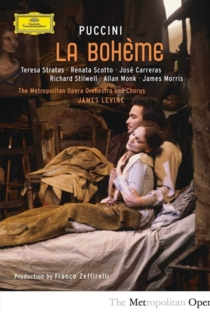
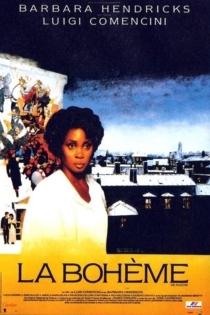
"La Bohème" is one of Giacomo Puccini's most popular and timeless works and the second-most performed opera at New York's Metropolitan Opera. This production, directed by the legendary Franco Zeffirelli, features José Carreras, Teresa Stratas, Renata Scotto and Richard Stilwell. The opera is replete with extraordinary visual beauty as it presents the tragic story of young bohemians struggling to make it in the world.
Puccini: La Boheme
The Original Three Tenors Concert
Brian Large
Plácido Domingo, Luciano Pavarotti
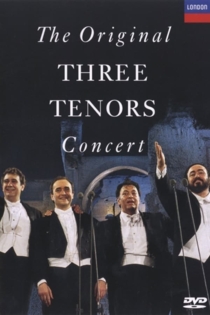
The Three Tenors is a name given to the Spanish singers Plácido Domingo and José Carreras and the Italian singer Luciano Pavarotti who sang in concert under this banner during the 1990s and early 2000s. This is the first collaboration of the trio, with a performance at the ancient Baths of Caracalla, in Rome, Italy, on July 7, 1990 – the eve of the 1990 FIFA World Cup Final. Zubin Mehta conducted the orchestra of Maggio Musicale Fiorentino and the orchestra of Teatro dell'Opera di Roma.
The Original Three Tenors Concert
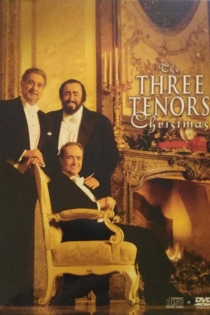
The Three Tenors Christmas
David Mallet
Luciano Pavarotti, Plácido Domingo
The Three Tenors capture the joy and spirit of the season with their first ever Christmas concert, live from Vienna, featuring performances of international seasonal favorites by the best-selling and world-renowned trio. Enjoy the gifts of The Three Tenors and be part of the holiday event of the year.
The Three Tenors Christmas

Carmen
Brian Large
Agnes Baltsa, José Carreras
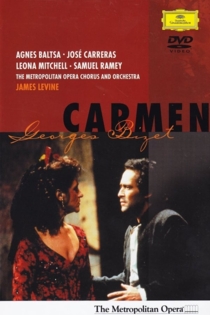
This all-star cast is framed by Peter Hall’s gritty, realistic production and conducted by James Levine, who brings out all the surging emotion and gripping drama in Bizet’s score. At the center of the story is Agnes Baltsa, whose smoky mezzo is tailor-made for the gypsy Carmen, an independent woman who glories in obeying only her own rules, but who is haunted by fate. Superstar tenor José Carreras is Don José, the solider from a small town who catches Carmen’s eye and is destroyed by his growing obsession with her. Samuel Ramey is the charismatic matador Escamillo, who lures Carmen away from Don José with tragic result. Leona Mitchell is Micaëla, the simple girl from Don José’s hometown who cannot save him. March 21, 1987 Matinee Broadcast.
Carmen
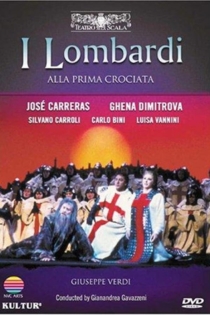
I Lombardi alla Prima Crociata
Brian Large
José Carreras, Ghena Dimitrova
Set during the Crusades, the story of Lombardi opens with the rivalry of two brothers -- Arvino and Pagano -- who vie with one another for the love of Viclinda. Pagano attempts to kidnap Viclinda and commit a fratricide, extinguishing Arvino, but succeeds only in murdering his father in error; circumstances force him into exile in the Holy Land. Thus begins a complex and harrowing series of events that will ultimately lead to the reconciliation of both men, followed by the death of one.
I Lombardi alla Prima Crociata
Romanza final (Gayarre)
José María Forqué
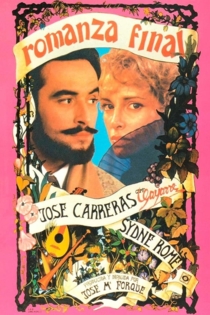
José Carreras, Sydne Rome
Biography of Julian Gayarre (1844-1890), one of the best tenors of all times. At 19, a professor at the Conservatory of Music in Madrid heard him singing for the first time and offered him a scholarship to continue his studies. His artistic life runs between continued success, becoming the world's greatest tenor. But in 1890, while singing at the Teatro Real in Madrid, a failure in his voice is like a cruel reminder of what would happen a few days later: his death at a young age. The doctors gave a diagnosis, but his friends know that Julian Gayarre died because he could not sing anymore.
Romanza final (Gayarre)
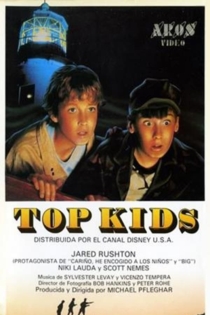
Top Kids
Michael Pfleghar
Anthony Ko, Scott Nemes
A fun journey through the history of the automobile, this film is about a group of future computer hackers that wire an arcade game to work as a time machine. Among appearances in the movie are Henry Ford, Mercedes Benz, and modern race car driver Niki Lauda, as one of the boys becomes trapped within the newly created game. (IMDb)
Top Kids
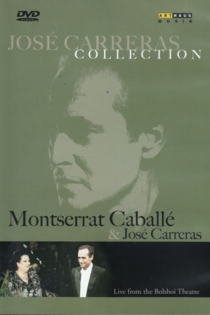
José Carreras Collection: Montserrat Caballé & José Carreras
Montserrat Caballé, José Carreras
Famed tenor José Carreras takes the stage at Moscow's Bolshoi Theatre with soprano and fellow Spaniard Montserrat Caballé in this memorable evening of music filmed live in 1989. Selections include ballads, arias and duets by some of the world's most famous composers, including Giacomo Puccini, Giuseppe Verdi, Gioacchino Rossini, Antonio Vivaldi, Vincenzo Bellini, Alessandro Scarlatti and Alessandro Stradella.
José Carreras Collection: Montserrat Caballé & José Carreras
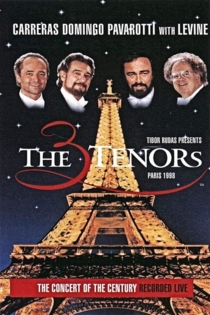
Three Tenors in Paris
Plácido Domingo, José Carreras
The Three Tenors: Paris 1998 (re-released with the subtitle The Concert of the Century) is a live album by José Carreras, Plácido Domingo, and Luciano Pavarotti with conductor James Levine. The album was recorded at a Three Tenors concert on 10 July 1998 during celebrations for the FIFA World Cup. The concert took place in front of the Eiffel Tower on the Champ de Mars in Paris, France. The Orchestre de Paris accompanied the singers. The audience at the live concert numbered around 150,000 people.[2] A sound system and large screens were placed along the Champ de Mars for the crowds further back to see and hear the performance.[2] Producer Tibor Rudas claimed prior to the concert that 2 billion viewers were expected to watch the televised performance worldwide.[3]
Three Tenors in Paris
La Traviata
Allan Altman
Renata Scotto, José Carreras
Few singers have plumbed the depths of the role of Violetta as did she incomparable soprano Renata Scotto. Her interpretation surprises with fresh insights at every turn, illuminating aspects of the character that are latent in the libretto and the schore but rarely dramatized with such completeness. For example, when Germont meets Violetta, he is immediately struck by her strong bearing ( Quai modi! , he exclaims in an aside).
La Traviata