
Martha Rosler
2021
Vital Statistics of a Citizen, Simply Obtained
Martha Rosler
Martha Rosler
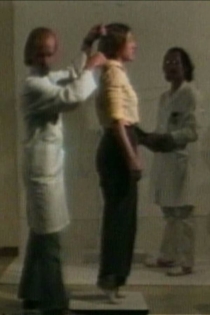
Taking aim at the social standardization enforced particularly on women's bodies, Rosler critiques the politics of "objective" or scientific evaluation that result in the depersonalization, objectification, and colonization of women and Others.
Vital Statistics of a Citizen, Simply Obtained
If it's too bad to be true, it could be DISINFORMATION
Martha Rosler
In a fusion of text and image, Rosler re-presents the NBC Nightly News and other broadcast reports to analyze their deceptive syntax and capture the confusion intentionally inserted into the news script. The artist addresses the fallibility of electronic transmission by emphasizing the distortion and absurdities that occur as a result of technical interference. Stressing the fact that there's never a straight story, Rosler asserts her presence in a character-genererated text that irolls over the manipulated images, isolating excerpts from her sources. In Rosler's barrage of media information, the formal structure is inseparable from her political analysis.
If it's too bad to be true, it could be DISINFORMATION
Martha Rosler Reads "Vogue"
Martha Rosler
Martha Rosler
In this live performance for Paper Tiger Television's public-access cable program in New York, Rosler deconstructs the messages in Vogue and its advertising. Rosler looks at the institutional slants of the magazine industry and the fashion industry's reliance on sweatshops.
Martha Rosler Reads "Vogue"
A Simple Case for Torture, or How to Sleep at Night
Martha Rosler
Martha Rosler, Lyn Blumenthal
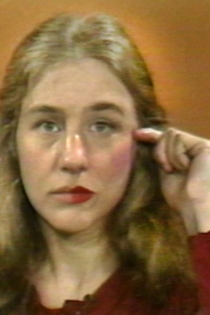
Artist Martha Rosler identifies the totalitarian implications of an argument for torture under certain circumstances, as it appears in the editorial pages of Newsweek magazine.
A Simple Case for Torture, or How to Sleep at Night
Flower Fields
Martha Rosler
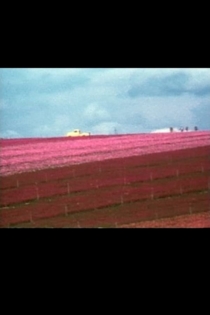
"This short film was intended to create a colour field painting based on the flower fields that provided the living for so many, mostly undocumented, workers in the area. When the camera closes in on the beautiful colour-striped hillside, the laborers in the field can be seen. Later, in a run up Highway 5, we see the immigration police at their mobile roadblock."
Flower Fields
Losing: A Conversation with the Parents
Martha Rosler
Treating the problem of anorexia nervosa from the parents' perspective, Rosler presents a mother and father speaking about the tragedy of their daughter's death as a result of dieting. The conversation turns toward the irony of self-starvation in a land of plenty and toward the international politics of food, where food aid is used as a negotiating tool. Confronting a serious issue, Rosler simultaneously sets into play the confessional form and the ghoulish staginess of talk show dramatics.
Losing: A Conversation with the Parents
Domination and the Everyday
Martha Rosler
In an inquiry into the relation between the corporation, the state and the family, Domination and the Everyday presents a fractured barrage of simultaneous sound tracks, film stills and a crawling text. Questioning the privatized existence of a woman and child, and the role of media information in daily life, this non-narrative tape is structured around the sounds of a woman feeding her small son and readying him for bed, while a radio interview with an art dealer plays in the background. Photographs of family life and corporate ads are juxtaposed with a written text that crawls across the screen, comparing life in Chile with life in the United States. Rosler refers to this layered juxtaposition of fragmented sound, images and text as an "artist-mother's This Is Your Life."
Domination and the Everyday
Pencicle of Praise
Martha Rosler
"Vice President Mike Pence eagerly plays cheerleader in chief for Donald Trump. In accepting the vice-presidential nomination in 2016, Pence proclaimed, 'I'm a Christian, a conservative, and a Republican — in that order,' suggesting how we might understand his role. This ground-breaking, earth-shaking video begins with a pomp-ridden televised press conference, accompanied by uplifting music. Held early in 2017 at the White House Rose Garden, it showcased the president’s announced withdrawal from the historic Paris Climate Accord. As the video proceeds, we witness Pence and other minions enacting pious gratitude on behalf of the president. With the Vice President lurking in the shot, the video finally launches a takeoff. "The renditions of the Battle Hymn of the Republic and the national anthem in this work were part of the Rose Garden broadcast, which both begins and ends the video." — Martha Rosler
Pencicle of Praise
Born to be Sold: Martha Rosler Reads the Strange Case of Baby $/M
Martha Rosler
Martha Rosler
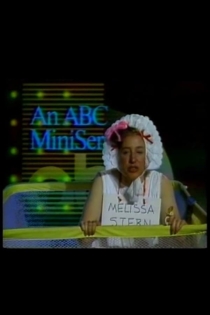
Born to be Sold is Paper Tiger Television and Rosler's acerbic and witty interpretation of the notorious "Baby M" case, in which a natural — "surrogate" — mother and father of a baby fought each other for custody of the child. Rosler assumes various roles of the participants in the controversy, from the baby to the sperm, from the lawyer to the judge, as well as the two women in the case. Reconstructing the story from its trial by media and the court transcripts, Rosler views "surrogate" mother Mary Beth Whitehead's actions as an attempt to defy the identity assigned by her class and gender, and sees the verdict favoring the Sterns as an endorsement of the father's phallic right, his jurisprudential entitlement. Her analysis demonstrates how political, class and ideological systems are played out on the body of the woman.
Born to be Sold: Martha Rosler Reads the Strange Case of Baby $/M
Backyard Economy 1
Martha Rosler
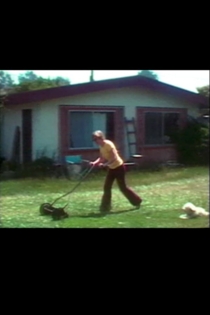
Set in the arch-American "home movie" context of a sunny suburban yard, Rosler's early Super-8 film Backyard Economy I documents the products of mundane domestic chores. Silently depicting scenes of laundry hanging out to dry in a suburban backyard, Rosler points up the labor that allows leisure and interrogates its underlying "economy."
Backyard Economy 1

Secrets From the Street: No Disclosure
Martha Rosler
Secrets From the Street examines the intersection of cultures and classes as exemplified by the street life of San Francisco's Mission District. This videotape, produced for an exhibition held jointly at San Francisco's City Hall and its Museum of Modern Art, argues — against the show's theme and title, Public Disclosure: Secrets from the Street — that accounts of cultural life that omit the question of social power are mythical: The real "secret" is the obscured relation of economic and political domination exercised by one's own culture over the observed subculture. Or, as Rosler states in the tape's voiceover, "The secret is that to know the meaning of a culture you must know the limits of meaning of your own."
Secrets From the Street: No Disclosure