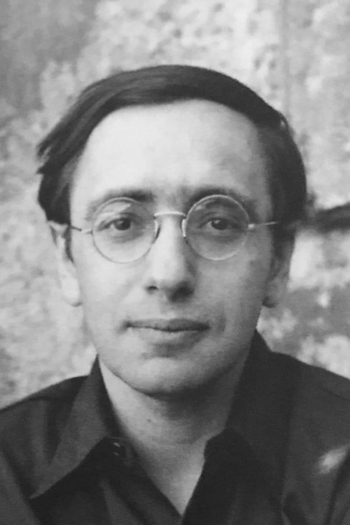
Ernie Gehr
1941 (85 лет)(from NYTimes profile by Manohla Dargis. Full piece here: http://www.nytimes.com/2011/11/13/movies/ernie-gehrs-films-traffic-in-images-and-light.html?_r=0)
Morning
Ernie Gehr
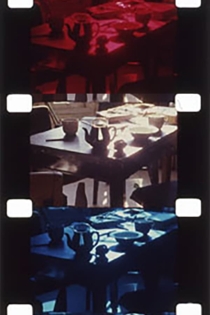
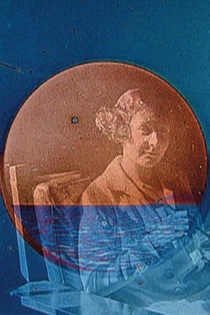
Lyrical debut film of avant-garde/structuralist filmmaker Ernie Gehr. Morning light streams through a window in Gehr's apartment. As Gehr changes the aperture from open to closed and back again, the light pulsates, in turns overwhelmingly bright and almost vanishing in darkness. A beautiful mediation on the essence of cinema and perception.
Morning

Signal - Germany on the Air
Ernie Gehr
The past is never delineated through Gehr‘s film, an unorthodox “city symphony” composed of largely static compositions of West Berlin streets. His refusal to dissertate an active through-line in the sights and sounds opens up a world in which we can identify, through metrical editing and angular snapshots of a city space, universal signifiers coursing through every frame. Combined with an embedded knowledge of the area’s loaded past and Gehr’s recorded, crackling radio broadcasts laid over the images, Signal - Germany on the Air (1985) is a challenging personal work.
Signal - Germany on the Air
Rear Window
Ernie Gehr
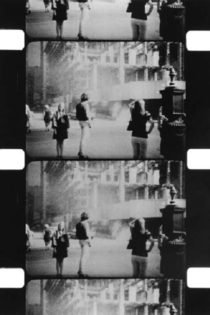
"[A] view from a Brooklyn apartment sublimates Hitchcock's voyeurism into a frenzied engagement with the visible. The film varies exposure or racks focus so that the flickering, spatially ambiguous patterns that press the limits of the frame momentarily dissolve themselves as tree branches or a fire escape or a shadow caught on the screen of someone's laundry rippling in the breeze. 'I cupped one of my hands in front of the camera lens and attempted to make tactile to myself light, color and image,' Gehr explains in his notes, linking the film to his father's death and calling it a 'hopeless attempt' to render the ephemeral tangible." - J. Hoberman, The Village Voice
Rear Window
Transparency
Ernie Gehr
An “action” movie in which the processes of recording and projecting moving images are the protagonists and the field of action is the screen rectangle within which cinematic ripplings and combustions are offered for immediate sensual pleasure and enlightenment.
Transparency
Still
Ernie Gehr
For about sixty minutes, STILL peers through a New York City street level window, watching the storefronts and windows across the way. People come and go, cars pass by, and the space/time are further articulated by the street sounds which are or are not exactly matched to the activity outside. A single tree grows in the sidewalk across the street, rich in foliage - and somehow, the taxi cabs, autos and people who cross the street are sometimes solid, sometimes transparent. ... this very subtle and perplexing interweave of transparency and opaqueness - sends the audience on its way with the feeling they have seen a magician at work. But for me, there are even greater mysteries and secrets in this beautiful film. The basic, root mystery of the evocative object, the evocative mood - which I have been waiting for years to see film come to terms with, and which in my opinion STILL does come to terms with in a significant and important manner.
Still
This Side of Paradise
Ernie Gehr
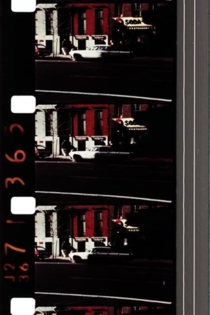
Sounds and images were recorded at the Polish flea-market, Potsdamer Platz, Berlin, autumn 1989, a few days before the Berlin Wall came down. An uneasy, almost sort of carnival atmosphere pervaded the place and like some magical crystal ball, reflected both the past and the future.
This Side of Paradise
Shift
Ernie Gehr
“For Gehr, SHIFT broke new ground, hence perhaps a pun in its title. The film is his first to employ extensive montage. The actors are all mechanical – a series of cars and trucks filmed from a height of several stories as they perform on a three-lane city street. Gehr isolates one or two vehicles at a time, inverting some shots, so that a car hangs from the asphalt like a bat from a rafter, using angles so severe the traffic often seems to be sliding off the earth, and employing a reverse motion so abrupt that the players frequently exit the scene as though yanked from a stage by the proverbial hook. A sparse score of traffic noises accompanies the spastic ballet mecanique...” – J. Hoberman
Shift
Side/Walk/Shuttle
Ernie Gehr
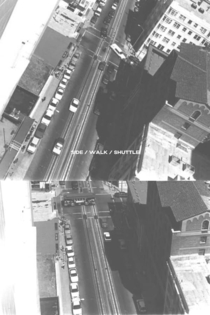
In this infamous structural film, Ernie Gehr takes to the glass elevator attached to San Francisco's Fairmont Hotel and rides its 24 stories up and down, constantly shifting the orientation of his camera to offer images of the city as a zone of constant flux, freed from gravity and in perpetual rearrangement.
Side/Walk/Shuttle
Cotton Candy
Ernie Gehr
Christine Casarsa
Gehr uses a mini-digital recorder to look back on the Machine Age in the form of San Francisco's soon-to-be-shuttered Musee Mecanique. For slightly more than an hour, Cotton Candy documents this venerable collection of coin-operated mechanical toys—including an entire circus—mainly in close-up, isolating particular details as he alternates between ambient and post-dubbed (or no) sound. By treating the Musee's cast of synchronized figures as puppets, the artist is making a show—but is it his or theirs? Gehr's selective take on the arcade renders it all the more spooky. There's a sense in which Cotton Candy is a gloss on the moment in The Rules of the Game when the music-box-collecting viscount unveils his latest and most elaborate acquisition. (It also brings to mind the climax of A.I.: The DV of the future tenderly regards the more human machine of the past.) (J. Hoberman, The Village Voice)
Cotton Candy
Eureka
Ernie Gehr
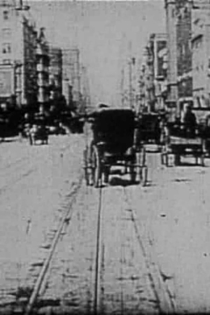
Eureka (1974), which lyrically re-photographs a travelogue shot from a San Francisco streetcar, offers the purest expression of Gehr’s deep love of early cinema as a source of a joyous formal inventiveness-- changing its length from 5 to about 38 minutes.
Eureka