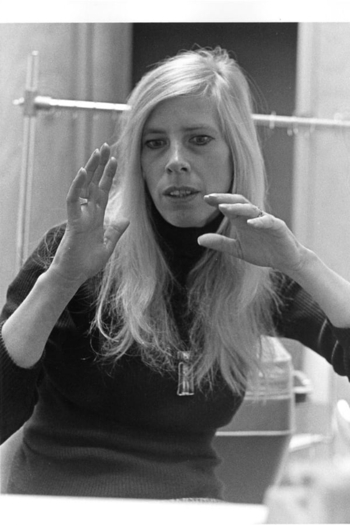
Gunvor Nelson
1931 (95 лет)Natural Features
Gunvor Nelson
“In NATURAL FEATURES Nelson mingles hundreds of still images with 3-D objects and “real” images photographed through glass layerings into a free-associative and playfully bizarre form of animation. Perhaps no film has more successfully blended an evident passion for painting with a sensitivity to filmmaking such as lush pigments alternate with and punctuate the different photographic layerings” – Steve Anker
Natural Features
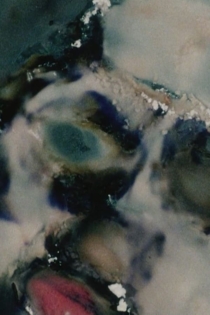
Before Need Redressed
Dorothy Wiley, Gunvor Nelson
After doing Before Need, Gunvor Nelson and Dorothy Wiley embarked on a new creative process. They revisited the film, reworked it and reassembled it creating a shorter new version, called Before Need Redressed. A way to express how the passing time, reflection and accumulating experiences can affect the form and vision of a film. —Ulf Kjell Gür
Before Need Redressed
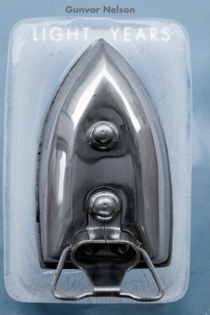
Take Off
Gunvor Nelson
Ellion Ness
Ellion Ness, a thoroughly professional stripper, goes through her paces, bares her body, and then, astonishingly and literally, transcends it. While the film makes a forceful political statement on the image of woman and the true meaning of stripping, the intergalactic transcendence of its ending locates it firmly within the mainstream of joyous humanism and stubborn optimism.
Take Off
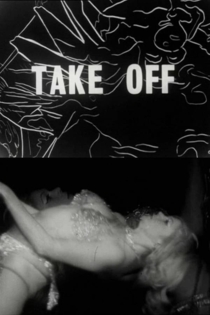
Moon's Pool
Gunvor Nelson
"Moons Pool" is a masterful and lyrical use of the film medium to portray the search for identity and resolution of self. Photographed under water, live bodies are intercut with natural landscapes creating powerful mood changes and images surfaced from the unconscious." – Freude Bartlett
Moon's Pool

Red Shift
Gunvor Nelson
Ulla Moberg, Regine Grundel
This magnus opus is a domestic symphony from a woman's point of view, the portait of a grandmother, monther and child and their home. The women and their personal objects are mostly seen alone or relating to one another (except for touching scenes of the grandmonther and grandfather together). A key aspect of RED SHIFT is the reading of selections from Calamity Jane's "Diaries", the most narrative apsect of the film. The Diaries are read against activities seen through a window, life passing by (people walking in winter, a river flowing). They tell how Jane lost her daughter and had to survive by using her talents to act like a tough and physically competitive man...
Red Shift
Schmeerguntz
Dorothy Wiley, Gunvor Nelson
Schmeerguntz is one long raucous belch in the face of the American Home. A society which hides its animal functions beneath a shiny public surface deserves to have such films as SCHMEERGUNTZ shown everywhere - in every PTA, every Rotary Club, every club in the land. For it is brash enough, brazen enough and funny enough to purge the soul of every harried American married woman.
Schmeerguntz
Time Being
Gunvor Nelson
Gunvor Nelson stares intently at her mother Carin, a woman whose body has been devastated by the challenges of her last days on this earth. In three astute shots, Nelson looks with honesty rather than awe at a woman whose spirit has somehow flown away but whose body still demands a share of our time and our space.
Time Being

Frame Line
Gunvor Nelson
FRAME LINE is a collage film in black and white. Glimpses (both visual and audial) of Stockholm, people, gestures, flags and the Swedish national anthem appear through drawings, paintings and cut-outs. It is a film with an eerie flow between the ugly and the beautiful about returning, about roots and also about reshaping.
Frame Line
True to Life
Gunvor Nelson
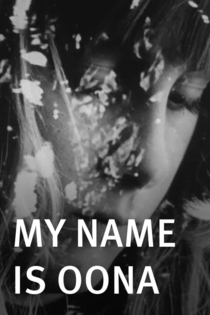
Gunvor Nelson plays freely and naturally in a garden confronting the camera with nature, and nature with the camera to reveal a new life force and cycle. The camera climbs up a dark red stem, across the spiny frost hat outlines the walls of a budding flower. It rummages and rustles among the garden floor. The penetrating lens is heavy on the delicate leaves and on the viewer retina.
True to Life

Carolee, Barbara and Gunvor
Lynne Sachs
Carolee Schneemann, Barbara Hammer
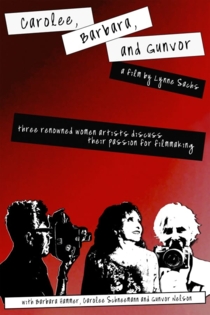
From 2015 to 2017, Lynne Sachs visited with Carolee Schneemann, Barbara Hammer and Gunvor Nelson, three multi-faceted artists who have embraced the moving image throughout their lives.
Carolee, Barbara and Gunvor
Kirsa Nicholina
Gunvor Nelson
David Woeller, Ellis Woeller
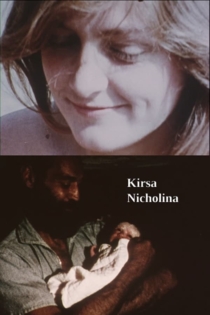
Kirsa Nicholina records the birth of a child at home by the Lamaze method. The father assists in the birth, while a physician guides him. At the moment of birth, the mother reaches down and grasps the hand of the emerging child and guides it out of her body and into her arms.
Kirsa Nicholina
Five Artists: BillBobBillBillBob
Dorothy Wiley, Gunvor Nelson
William T. Wiley, Robert Hudson
A feature-length documentary directed by Dorothy Wiley and Gunvor Nelson about five working San Francisco artists: William T. Wiley, Robert Hudson, William Allan, William Geis and Robert Nelson-- A profile of five friends and their creative processes.
Five Artists: BillBobBillBillBob
Field Study #2
Gunvor Nelson
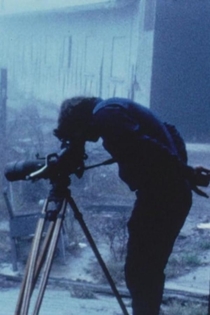
A collage film with sequences of live action with animation using cut-outs, found footage and pouring sands. A dark delicacy lingers. Superimpositions of dark pourings are perceived through the film. Suddenly a bright colour runs across the picture and delicate drawings flutter past. Grunts from animals are heard.
Field Study #2

Trace Elements
Gunvor Nelson
Another feature of the new digital (and visually inferior) medium is that sound plays a much more prominent role than in most of her films. Trace Elements, Nelson’s latest work, is another “sound video”, despite the fact the camera is more active this time. It feels as though only now Nelson has totally come to grips with her new technique. She approaches the moving image again through highlighting the act of shooting. This way she continues the ever-present indexical tradition of her filmmaking despite the fact that the video is based on the idea that the camera never quite finds its target. I believe the active, searching camera in Trace Elements indicates Nelson will continue making movies for many years to come.
Trace Elements