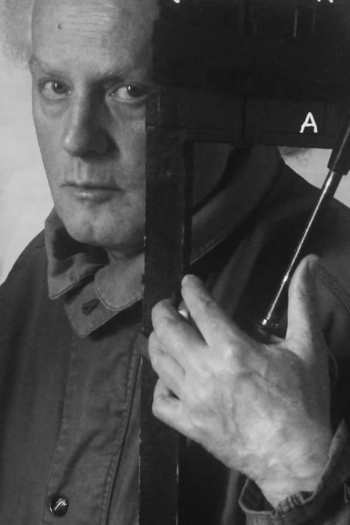
Paolo Gioli
1942 (83 года)Traumatografo
Paolo Gioli
Traumatografo is a film, the principal purpose of which is to comfort those who fear death by the gallows or scaffold. It is divided into three parts: in the first, slaughter by automobile is shown; in the third, by military engagements; in the center section children pantomime syncopated movements from top to bottom. The secret, twilight imaginings of a wreckless character in the horrifying motion of falling or ejection in triplicate from an auto-trauma-mobile, the alternation—through the manipulation—of his original motion, offers us, as a source of comfort, the bicorporeal vision of him as he travels along the parabola of his fall from a residual sequence of a most personal and fatal leap.
Traumatografo

Rothkofilm
Paolo Gioli
This is not a short documentary on Rothko, but rather my reflection on his canvasses, that become so deeply assimilated with the screen, frames of film, the frame line. A film excavated from two books. A silent film that should be a sound film. The rhythms, the inter-pulsations of the frames of film make me think of a sound I do not know.
Rothkofilm
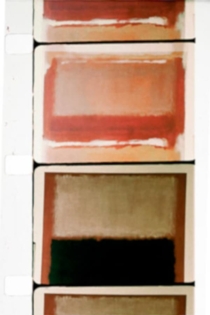
Piccolo film decomposto
Paolo Gioli
This extremely short film is dedicated to chronophotography, which—as is well known—is the prelude to cinema. As with one of my earlier films dedicated to Muybridge (The Naked Killer, 1982), this one was excavated from books and catalogues, that is, from typographic ink. I tried, in a certain sense, to reanimate the inanimable as does the photographer Duane Michals, having only, sometimes, three or four frames. I found older stroboscopic technology as well as more contemporary flicker effects to be very helpful here and there. I attempted to realize the cinematic identification of Skladanowksy with Avedon; contaminations, precisely, between creators of films and creators of photography, contemporary or not. It is surprising to see Michals, a contemporary photographer, bearing such a strong cinematographic resemblance to Londe, the proto-filmmaker. I hope, at least, to have told the story of their direct commingling, as if by a single secret author.
Piccolo film decomposto
Quando l'occhio trema
Paolo Gioli
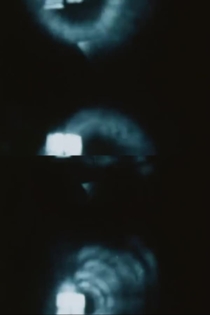
It all started with the notorious Buñuelian sliced eyeball, that surprises us every time. The eye of an ox, but still it's the eye of a woman! The anxiety of the incision is transformed into a saccadic, uncontrolled anxiety precisely of the eye and of its pupil. When subjected to the stroboscopic rhythms of single frame animation—as in some archaic pre-animation—one's gaze at it is thrown off, going in search of a little dramatic action here and there in the face, through the quick cinematic nonsense of saucers and sclera. The eye of an ox, which degenerates in Buñuel's incision, is my own quaking ox eye.
When the Eye Quakes
Anonimatografo
Paolo Gioli
This film was shot a frame at the time using laborious extreme optical close-ups. Anonimatograph: the reanimated image of an unknown amateur at the beginning of the century who becomes middle class as he focuses on friends, movie camera in hand, indoors and outdoors surrounded by war and by his sisters. I have tried to reconstruct an extravagant film diary from which I have painstakingly torn out little pages of frames. These frames were exposed and abandoned on negative on a number of photographic reels, cut together at random in two sixty-meter reels in 35mm and acquired by me for 500 Lire from a flea-market vendor. Many frames were shot vertically, others only partially exposed, sometimes properly developed, sometimes not. I tried to animate these little reels using a flicker technique with light stroboscopic touches; in short, a film that could not be recommended to anyone.
Anonimatografo
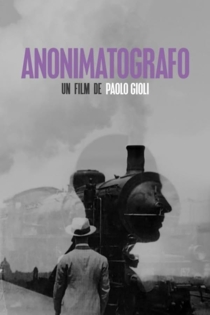
Immagini disturbate da un intenso parassita
Paolo Gioli
Strains of Wagner's Das Rheingold and African tribal ululations collide with bi-/tri-sected television footage while negative-positive visuals smash heedlessly into their mirror images, an unbounded series of “meaningful” artistic fender-benders that amount to little of resonant substance.
Images Disturbed by an Intense Parasite
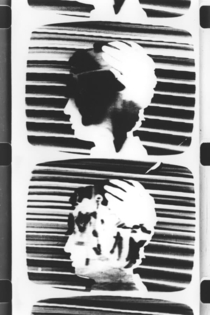
Commutazioni con mutazione
Paolo Gioli
Composed using three different formats, that have been made to co-exist: super-8, 16mm, and 35mm on a single 16mm support, clear leader. The variations in size caused the original frame lines to overlap, subjecting them - and with them their images - to a singular diabolical rhythm. The above-mentioned formats were glued together, one at a time, fragment on top of fragment, using transparent adhesive tape.
Commutations with Mutations
Metamorfòso
Paolo Gioli
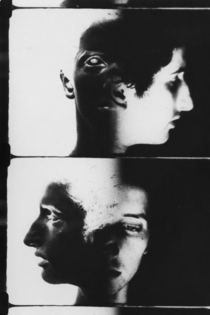
It is well known that the disposition of the images drawn by Escher are neither for animation nor for pre-animation; actually, quite the opposite. His images appear to be the carrying out of metamorphic dissolves. A bird gives way to the recognition of a house, which turns into fish, which turns into birds, and so on. Not a single flapping of wings takes place; everything is reiterated and fixed, becoming immersed in and re-emerging from a static continuum. All of Escher is an homage to one of the major animating forces of the cinema: the cross-dissolve. Precisely there, I found cinematic attitudes: in the house which turns into fish and in everything that transforms into something else. I gradually managed to figure out various types of non-existent sequences and then finally found myself dissolved, crossing over metamorphically. —P.G.
Metamorphic
Filmarilyn
Paolo Gioli
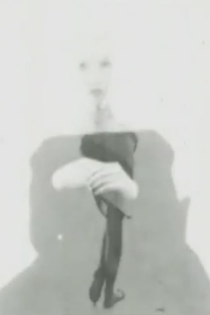
Composed of still images from several photographs of the actress and pop icon Marilyn Monroe that have been manually transferred to film frame by frame, and animated through intermediate gradations within a series of successive, rapid fire montage visual "chapters", Gioli resurrects the vitality, captivating charm, and exuded sensuality of the voluptuous, iconic Hollywood superstar through the sequencing of the manipulated images - modulated object framing, subtle displacement, photographic blow-ups or visual recessions that simulate dimensionality and varying depths of focus - into a bold, risqué, and tantalizing "new" film starring the late actress.
Filmarilyn
L'operatore perforato (il macchinatore)
Paolo Gioli
Paolo Gioli
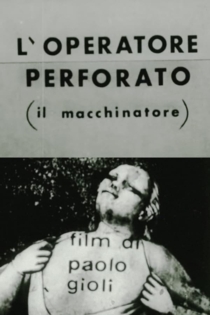
In L’operatore perforato (1979) that plump sprocket hole comes into its own. It multiplies like a virus, riding serenely on the surface, nearly obliterating the images trembling underneath it. Near the close of the film, we watch another cameraman, perhaps shooting a Fatty Arbuckle imitator, cope with the invasion of perforations, not only from the top and center but from the edge. By now, when we can hardly tell the difference between frame and perforations, cinema’s two round-cornered rectangles, the image can be anything—a picture, or a zone of blank white.
The Perforated Cameraman
Del tuffarsi e dell’annegarsi
Paolo Gioli
The film relates the beliefs the author held for a certain time concerning water and diving into it. It all begins with a dive and with a whirlpool that never existed; two visual prototypes on the basis of which the mischievous view of the author created a filmic inversion of water and its flow, of the diver and of the imaginary whirlpools. This expansion, unforeseen in spontaneous natural phenomena is, however, foreseen by the very little spontaneous nature of the diver, who, after repeated efforts, ends by realizing a plunge which is at once fatal and desired.
Of Diving and of Drowning
Immagini travolte dalla ruota di Duchamp
Paolo Gioli
"Duchamp is certainly as complex as Joyce and to do something about him, I tried to dedicate to him this small film poem, using only a few images of images of his work, taken always from books and catalogues (that are made of typographic ink). For example, blackening in the spokes of a wheel, allowing regular slits, transforming it in this way into a true external shutter, that came to substitute for the missing one of my movie camera. A bicycle wheel that becomes cinema and vice versa. For example, his black window that is transformed into a number of tv screens, etc. With Duchamp I think I could make a film for every one of his works because intelligence, irony and alchemy are all proper to the cinema."
Images Overtaken by the Wheel of Duchamp
Filmfinish
Paolo Gioli
This film was constructed using the so-called “photo-finish” technique employed in sporting events. The same principle was applied, precisely, to the motion picture camera. The subjects are explored and self-explored using a thin slit arranged horizontally halfway along the aperture plate as they enter the motion picture camera itself. The images then are formed as an extremely dense series of lines as in a primitive video screen, such as the Nipkow. The cinematic rhythms of the film vary with the accelerations and decelerations imposed beyond the synchronism between movie camera and subject: with motion from top to bottom, or else with the movie camera lying sideways, (in that case the line is vertical) then, from left to right and vice versa. Of course without a shutter or claw [in the camera]. This filmic technique is well known in scientific cinematography, and it is this very combination that I most urgently desired to encompass in my graphic compositional concerns.
Filmfinish