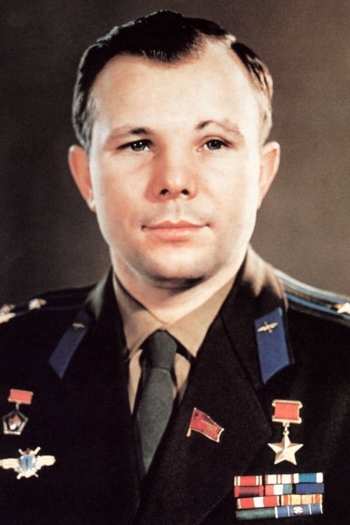
Yuri Gagarin
1934 - 1968Destination Titan
Stephen Slater
John Zarnecki, Ralph Lorenz
A story about four British scientists who have created a probe which will take a seven year long trip to the largest moon orbiting Saturn, Titan. Designing and building a vehicle that will travel more than 2 billion miles across space is not an easy task as it is shown in Destination Titan. The documentary follows the story behind the creation of a probe that is the culmination of a lifetime endeavor which will be strapped onto what is essentially a giant bomb and hurled out of earths atmosphere on a seven year long journey. will they succeed? This documentary is presented by John Zarnecki and features the famous TV host and astronomer Patrick Moore.
Destination Titan

El viaje más largo
Manuel H. Martín
José María Madiedo, Jordi Boixaderas
Spain, 1519. Ferdinand Magellan, Portuguese navigator in the service of King Charles I, undertakes, at the command of five ships, a commercial expedition to the Moluccas. The story of the first circumnavigation of the world, completed by Juan Sebastián Elcano in 1522.
The Longest Voyage

Die Stadt unter dem Eis
Peter Bardehle
Tanja Dohse, Kristian Havidtfelt Nielsen
How in 1959, during the heat of the Cold War, the government of the United States decided to create a secret military base located in the far north of Greenland: Camp Century, almost a real town with roads and houses, a nuclear plant to provide power and silos to house missiles aimed at the Soviet Union.
Camp Century: The Secret City Under the Ice
La rabbia
Giovanni Guareschi, Pier Paolo Pasolini
Giorgio Bassani, Renato Guttuso
Documentary footage (from the 1950s) and accompanying commentary to attempt to answer the existential question, Why are our lives characterized by discontent, anguish, and fear? The film is in two completely separate parts, and the directors of these respective sections, left-wing Pier Paolo Pasolini and conservative Giovanni Guareschi, offer the viewer contrasting analyses of and prescriptions for modern society. Part I, by Pasolini, is a denunciation of the offenses of Western culture, particularly those against colonized Africa. It is at the same time a chronicle of the liberation and independence of the former African colonies, portraying these peoples as the new protagonists of the world stage, holding up Marxism as their "salvation", and suggesting that their "innocent ferocity" will be the new religion of the era. Guareschi's part, by contrast, constitutes a defense of Western civilization and a word of hope, couched in traditional Christian terms, for man's future.
La Rabbia

Lune : le huitième continent
Véronique Préault
Véronique Préault, Xavier Pasco
July 20, 1969. Apollo 11 lands on the surface of the Moon. Such a feat was apparently performed to the greater glory of all mankind, but actually it marked the end of the space race disputed by the two great superpowers of the time in their eagerness to arrive before and the beginning of the spread of the Cold War into space. Nowadays, the struggle continues, but the main competitors and their purposes are others.
Moon: The Battles of Space

Chasing the Moon
Neil Armstrong, Yuri Gagarin
“Chasing the Moon,” a film by Robert Stone, reimagines the race to the moon for a new generation, upending much of the conventional mythology surrounding the effort. The series recasts the Space Age as a fascinating stew of scientific innovation, political calculation, media spectacle, visionary impulses and personal drama. Utilizing a visual feast of previously overlooked and lost archival material — much of which has never before been seen by the public — the film features a diverse cast of characters who played key roles in these historic events.
Chasing the Moon