Joe Gerhardt
2021Earthworks – Installation
Joe Gerhardt, Ruth Jarman
The earth never sleeps. The duo Semiconductor distils research data on earth movements and animates them in a five-channel installation. In a dark hall, visitors to the Sónar Barcelona 2016 festival are captivated by a huge, luminous band of ceaselessly morphing layers of colours and strange sounds, experiencing a cut through both landscape and time.
Earthworks – Installation
Black Rain
Ruth Jarman, Joe Gerhardt
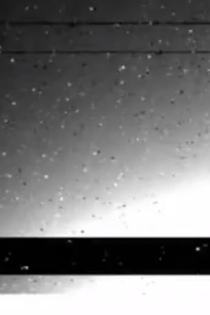
Black Rain is sourced from images collected by the twin satellite, solar mission, STEREO. Here we see the HI (Heliospheric Imager) visual data as it tracks interplanetary space for solar wind and CME's (coronal mass ejections) heading towards Earth. Data courtesy of courtesy of the Heliospheric Imager on the NASA STEREO mission.
Black Rain
Earthworks – Making Of
Joe Gerhardt, Ruth Jarman
Geologically, layers of earth form over thousands of years. The processes are almost imperceptible to humans. A research project in a Spanish quarry reconstructs earth movements, models them and records them acoustically. Creaking, rumbling and trickling, the layers leave traces of sounds animated in an audiovisual five-channel installation by the duo Semiconductor.
Earthworks – Making Of
20 Hz
Joe Gerhardt, Ruth Jarman
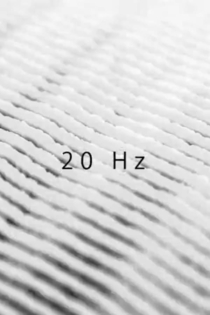
20 Hz observes a geo-magnetic storm occurring in the Earth's upper atmosphere. Working with data collected from the CARISMA radio array and interpreted as audio, we hear tweeting and rumbles caused by incoming solar wind, captured at the frequency of 20 Hertz. Generated directly by the sound, tangible and sculptural forms emerge suggestive of scientific visualisations. As different frequencies interact both visually and aurally, complex patterns emerge to create interference phenomena that probe the limits of our perception.
20 Hz
Heliocentric
Joe Gerhardt, Ruth Jarman
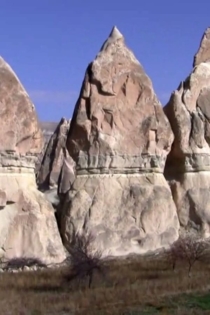
Heliocentric uses time-lapse photography and astronomical tracking to plot the sun’s trajectory across a series of landscapes. The entire environment feels to pan past the camera whilst the sun stays in the centre of each frame, enabling us to gauge the earth’s rotation and orbit around the sun. As the Suns light becomes disrupted by passing weather conditions and the environment through which we encounter it, it audibly plays them as if it were a stylus.
Heliocentric