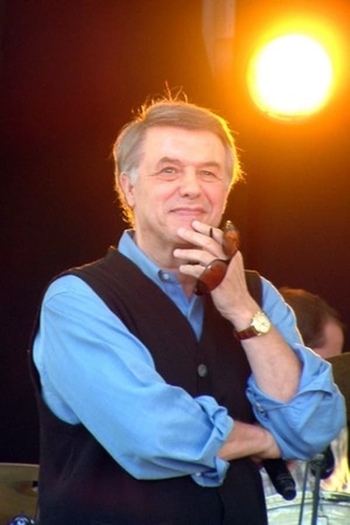
Salvatore Adamo
1943 (82 года)Since 2001 Adamo holds the Belgian noble title of Ridder, similar to the English title of "Knight".
He first gained popularity throughout Europe and later in the Middle East, Latin America, Japan, and the United States. He has sold more than 80 million albums and 20 million singles making him one of the most commercially successful musicians in the world. He mainly performs in French but has also sung in Italian, Dutch, English, German, Spanish, Japanese, and Turkish. "Tombe la neige", "La nuit", and "Inch'Allah" remain his best known songs. He is currently the best selling Belgian musician of all time.
The father of Adamo, Antonio, emigrated to Belgium in February 1947 to work as a colliery worker in the mines of Marcinelle. Four months later his wife, Concetta, and their son, Salvatore, joined him in the town of Ghlin, (Mons) before moving to Jemappes, (Mons).
In 1950, Salvatore was bedridden for a year with meningitis.
Salvatore's parents did not want their son to become a miner, so he went to a Catholic school run by the Frères des Ecoles Chrétiennes. By 1960, the family of Antonio and Concetta Adamo had seven children overall. Salvatore grew up in Jemappes (Mons), where he was a dedicated student at school and distinguished himself in music and the arts.
Adamo's early influences were the poetry of Victor Hugo and Jacques Prévert, the music of French singer-songwriters like Georges Brassens, and the Italian canzonette. He started singing and composing his own songs from an early age. His debut was in a Radio Luxembourg competition, where he participated as singer and composer of the song "Si j'osais" ("If I dared"), winning the competition's final held in Paris on 14 February 1960.
Adamo's first hit was "Sans toi, ma mie", in 1963, from his debut album 63/64. He followed this with a series of hits, the most famous being "Tombe la neige" ("The snow falls") in 1963, "La nuit" ("The Night") in 1964, and "Inch'Allah". The self-penned "Petit bonheur" ("Little Happiness") sold over one million copies by April 1970, and was awarded a gold disc.
Adamo has sold over 100 million copies of recordings worldwide. He has recorded in many languages and, besides France and Belgium, had hits in Italy, the Netherlands, Germany, Spain, Portugal, Turkey and also in Japan, where he toured repeatedly. He has had hits and toured also in Latin America and throughout the Middle East.
In Chile, the audience awarded him an appreciation prize known as the "Antorcha" (Gold and Silver Torch) at the "Festival de Viña del Mar" held yearly in the "Quinta Vergara", at the seaside resort of Viña del Mar, where he once had to sing in three different, sold-out venues in the same night. In the 1980s, Adamo's career faltered, as the style of his music was no longer fashionable. Since the 1990s, however, and on the crest of a nostalgia wave, he has successfully resumed composing, issuing records and touring, starting with a full season at the Casino de Paris venue in April 1990. ...
Source: Article "Salvatore Adamo" from Wikipedia in English, licensed under CC-BY-SA 3.0.

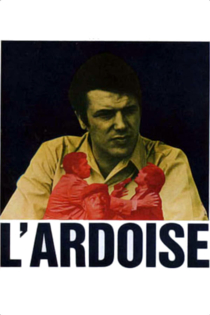
L'ardoise
Claude Bernard-Aubert
Salvatore Adamo, Michel Constantin
Philippe, Théo and Bob share the same cell in the prison of La Santé. Philippe, a young student, known as "Sciences-Po", is planning revenge against those who sent him to prison. He offers his two fellow prisoners, seasoned mobsters, to help him recover an important document from a diamond dealer in Le Havre. This paper would rehabilitate his father, his two comrades being able to keep the diamonds contained in the safe... But the coup does not go as planned.
The Comeuppance
Les Arnaud
Léo Joannon
Bourvil, Salvatore Adamo
In the sunny landscapes of Provence, Henri Arnaud is a conscientious law student who's got a lovely girlfriend, Tina. The person who used to pay for his studies dies and the poor young man's disposable funds are low. He asks an antique dealer if he can lend him some money. This shady guy agrees, but in return for homosexual relations. Henri kills him and runs away. Fortunately, a good judge, who bears the same name as him, comes to his rescue.
Les Arnaud

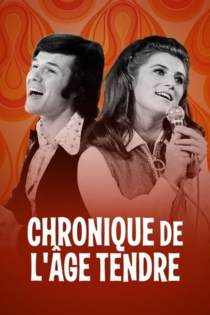
Chroniques de l'âge tendre
Yann Grasland, Pascal Forneri
Sheila, Salvatore Adamo
This document proposes an immersion in the French society of the 60s and 70s and in the youth of the time with the testimonies and confidences of Sheila, Salvatore Adamo, Antoine, Hervé Vilard, Michel Fugain, Nicoletta, Michel Jonasz, Laurent Voulzy and the photographer Tony Frank. They tell with hindsight and humor, their beginnings in the 60s and 70s, and before becoming idols. It is also an opportunity to leaf through the pages of the successful magazines of the time "Salut les copains" and "Mademoiselle Age tendre". Created by Daniel Filipacchi, they highlighted the idols of the moment, music, fashion, sexuality, consumer objects and questions about society.
Chroniques de l'âge tendre