Fred Immler
1880 - 1965
Das Kind ruft
Urban Gad
Asta Nielsen, Fred Immler
Ernest Schiller, a wealthy merchant, has the cherished ambition to secure as his son-in-law the Count De Grechy, a member of the nobility. His ambition is about to be realized, for the Count has accepted an urgent invitation to be Schiller's guest. His arrival is hailed with delight by the merchant, who offers the freedom of his home. Bertha, Schiller's daughter, does not experience the same enthusiasm which is manifested by her father. The reason for this is that she has pledged her heart and hand to Franz Rambauld, her sweetheart. The Count's attentions, therefore, are greatly distressing to Bertha. Nevertheless, through her father's insistence, the unfortunate girl is compelled to engage herself to the Count.
Das Kind ruft


Das Schiff der verlorenen Menschen
Maurice Tourneur
Marlene Dietrich, Fritz Kortner
A young doctor gets stuck on a ship after treating an injured first mate. Later, he rescues a woman from plane wreckage, and with the help of the cook, he hides her away from the rowdy and dangerous crew.
The Ship of Lost Men

Die Teufelsanbeter
Marie Luise Droop
Carl de Vogt, Meinhart Maur
In the wild, hardly explored mountains of Kurdish country lives the mysterious society of the Jesidi , who are called the devil worshipers by their opponents. In these mountains, shaded by dark fir trees, revenge and hatred reign and constant struggle between the countless races and sects. Strange festivals unite the fervor of thousands, crowned by the dramatic sacrificial death of one of their holy men. And yet, even in these pictures, which are filled with tremendous passion, there is no lack of warm humor and a cheerful, strong forgiving nature that leads everything to a liberating end. The film is believed to be lost.
Die Teufelsanbeter
Waterloo
Karl Grune
Charles Willy Kayser, Charles Vanel
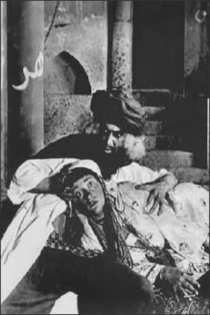
This presentation of 'Waterloo', a film by Karl Grune about the last hurrah of Napoleon, is a fascinating companion to the Abel Gance epic 'Napoleon'. 'Waterloo' presents a tale of several people involved in the final battle. Napoleon and Wellington, of course, but also the Austrian general Blutcher (who is seen as a ladies' man - his scene with a flirty Countess about halfway through the film is priceless; as are his touching scenes with his plain wife (who he imagines to be a young and nubile girl when they get romantic) and some people within his regiment. Not simply a film of war, 'Waterloo' is a story of people, of lovers, of lost opportunities.
Waterloo


Die Teufelskirche
Hans Mierendorff
Hans Mierendorff, Agnes Straub
In a prologue and four acts (the prologue and the first act are lost so is necessary to describe what happens with title cards) the film depicts the terrible dream of Asmus wherein the devil joins the human world disguised as a tinker. He meets Frau Ane, Asmus' wife; Ane yearns to have a baby but in vain so the devil takes advantage of Frau Ane's motherly inner desire by making a deal with her but for his own purposes. As a result, the farmer's wife comes under the devil's spell and then seduces the local priest, giving the devil to chance to build his own church to replace the old church that has burned down.
The Devil's Church
Vordertreppe und Hintertreppe
Urban Gad
Asta Nielsen, Paul Otto
Comedy about the courting couple Sabine and Lehman. Her roving eye catches a lieutenant, and when he finds out about her winning lottery ticket, he tries to steal it. Lehman intervenes and saves the day.
Frontstairs and Backstairs
Die Filmprimadonna
Urban Gad
Asta Nielsen, Paul Otto
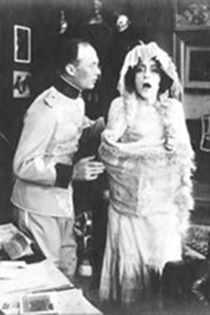
Film star Ruth Breton has a habit of falling in love. When dating Walter she meets Von Zornhorst. When Zornhorst discards her, she pines away. As a last token of his love for Ruth, Walter writes a play for her, but during the final act of "Pierrot's Death", Ruth expires.
The Film Prima Donna

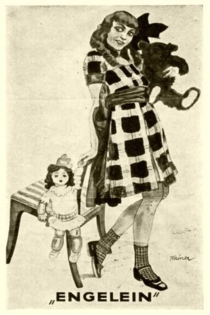
Engelein
Urban Gad
Asta Nielsen, Alfred Kuehne
Engelein is a comedy of deliberately mistaken identity. If Jesta, a 17-year-old, can play the part of a 12-year-old, her family will gain a large inheritance from a rich uncle from Chicago. Her unruly “play-acting” for the uncle is preceded by an earlier incident in the film that results in Jesta being evicted from her girl’s school. Wearing a long, woman’s skirt, she climbs up a ladder and onto a thatched roof. She reaches over the top of the wall to kiss her boyfriend, who appears from the other side. However, Jesta is caught by the headmistress, and her forced descent is precipitous. Pulled downward, she reveals a great deal of a black-stockinged leg. She looks distinctly sexual as she falls into the matrimonly arms of the law, whose duty is to enforce the rules of female decorum.
Little Angel