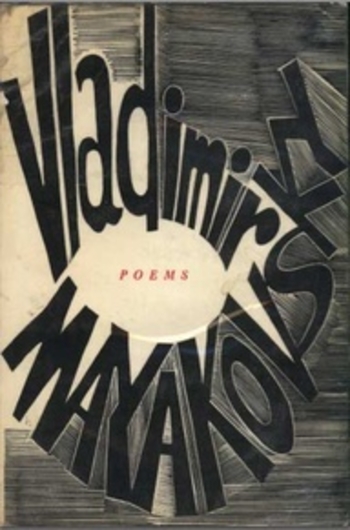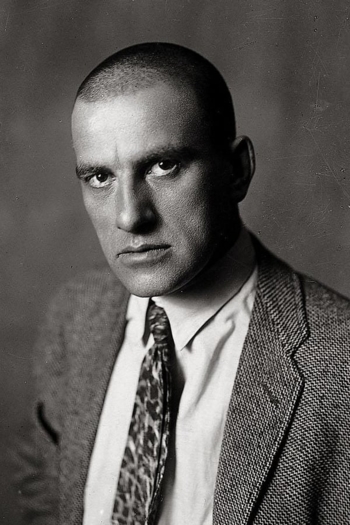
Vladimir Mayakovsky
1893 - 1930During his early, pre-Revolution period leading into 1917, Mayakovsky became renowned as a prominent figure of the Russian Futurist movement, being among the signers of the Futurist manifesto, A Slap in the Face of Public Taste (1913), and writing such poems as "A Cloud in Trousers" (1915) and "Backbone Flute" (1916). Mayakovsky produced a large and diverse body of work during the course of his career: he wrote poems, wrote and directed plays, appeared in films, edited the art journal LEF, and created agitprop posters in support of the Communist Party during the Russian Civil War. Though Mayakovsky's work regularly demonstrated ideological and patriotic support for the ideology of the Communist Party and a strong admiration of Vladimir Lenin, Mayakovsky's relationship with the Soviet state was always complex and often tumultuous. Mayakovsky often found himself engaged in confrontation with the increasing involvement of the Soviet State in cultural censorship and the development of the State doctrine of Socialist realism. Works that contained criticism or satire of aspects of the Soviet system, such as the poem "Talking With the Taxman About Poetry" (1926), and the plays The Bedbug (1929) and The Bathhouse (1929), were met with scorn by the Soviet state and literary establishment.
In 1930 Mayakovsky committed suicide. Even after death his relationship with the Soviet state remained unsteady. Though Mayakovsky had previously been harshly criticized by Soviet governmental bodies such as the Russian Association of Proletarian Writers (RAPP), Premier Joseph Stalin described Mayakovsky after his death as "the best and the most talented poet of our Soviet epoch."
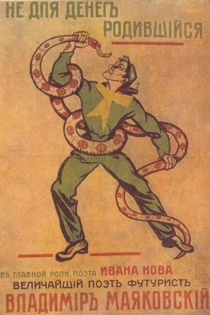
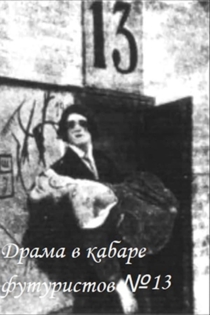

Барышня и хулиган
Vladimir Mayakovsky, Yevgeni Slavinsky
Vladimir Mayakovsky, Aleksandra Rebikova
A young woman arrives in her school where she must teach for the first time. Her task consists in teaching a class of adults to read and write. All her students are male, ranging from boys to old men, and they are rather rowdy and difficult. All the more as a young hooligan dares write her on a test paper that he loves her. Feeling harassed by the young man, she is defended by other students. But she more or less feels the young bad boy's love is true and when this one is lying on his dying bed, after being stabbed by the other students, she solaces him by kissing him tenderly.
The Young Lady and the Hooligan