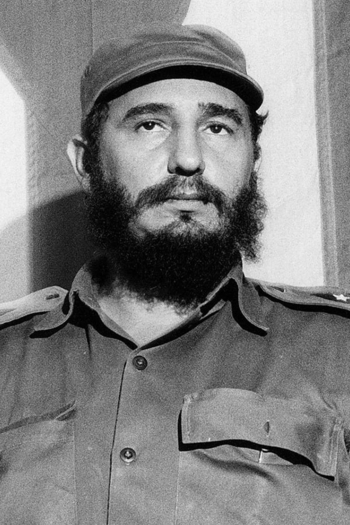
Fidel Castro
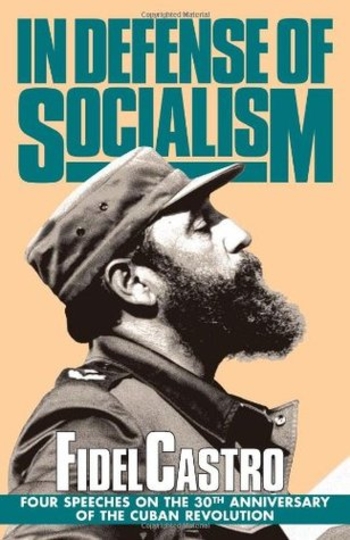
1926 - 2016Born in Birán, Oriente, the son of a wealthy Spanish farmer, Castro adopted leftist and anti-imperialist ideas while studying law at the University of Havana. After participating in rebellions against right-wing governments in the Dominican Republic and Colombia, he planned the overthrow of Cuban President Fulgencio Batista, launching a failed attack on the Moncada Barracks in 1953. After a year's imprisonment, Castro traveled to Mexico where he formed a revolutionary group, the 26th of July Movement, with his brother Raúl Castro and Ernesto "Che" Guevara. Returning to Cuba, Castro took a key role in the Cuban Revolution by leading the Movement in a guerrilla war against Batista's forces from the Sierra Maestra. After Batista's overthrow in 1959, Castro assumed military and political power as Cuba's Prime Minister. The United States came to oppose Castro's government and unsuccessfully attempted to remove him by assassination, economic blockade, and counter-revolution, including the Bay of Pigs Invasion of 1961. Countering these threats, Castro aligned with the Soviet Union and allowed the Soviets to place nuclear weapons in Cuba, resulting in the Cuban Missile Crisis – a defining incident of the Cold War – in 1962.
Adopting a Marxist–Leninist model of development, Castro converted Cuba into a one-party, socialist state under Communist Party rule, the first in the Western Hemisphere. Policies introducing central economic planning and expanding healthcare and education were accompanied by state control of the press and the suppression of internal dissent. Abroad, Castro supported anti-imperialist revolutionary groups, backing the establishment of Marxist governments in Chile, Nicaragua, and Grenada, as well as sending troops to aid allies in the Yom Kippur, Ogaden, and Angolan Civil War. These actions, coupled with Castro's leadership of the Non-Aligned Movement from 1979 to 1983 and Cuba's medical internationalism, increased Cuba's profile on the world stage. Following the Soviet Union's dissolution in 1991, Castro led Cuba through the economic downturn of the "Special Period", embracing environmentalist and anti-globalization ideas. In the 2000s, Castro forged alliances in the Latin American "pink tide" – namely with Hugo Chávez's Venezuela – and formed the Bolivarian Alliance for the Americas. In 2006, Castro transferred his responsibilities to Vice President Raúl Castro, who was elected to the presidency by the National Assembly in 2008. Description above from the Wikipedia article Fidel Castro, licensed under CC-BY-SA, full list of contributors on Wikipedia.
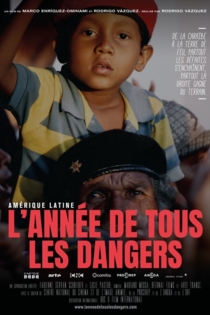
Nadie
Miguel Coyula
Rafael Alcides, Fidel Castro
Half blind and half deaf, ostraziced Cuban writer Rafael Alcides tries to finish his unpublished novels to discover that after several decades, the home made ink from the typewriter he used to write them has faded. The Cuban revolution as a love story and eventual deception is seen through the eyes of a man who is living an inner exile.
Nobody

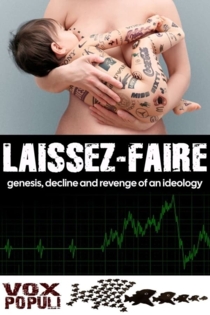

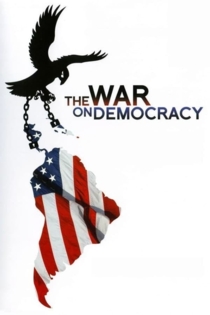
The War on Democracy
Chris Martin, Sean Crotty
John Pilger, Hugo Chávez
Set both in Latin America and the United States, the film explores the historic and current relationship of Washington with countries such as Venezuela, Bolivia and Chile. Pilger says that the film "...tells a universal story... analysing and revealing, through vivid testimony, the story of great power behind its venerable myths. It allows us to understand the true nature of the so-called "war on terror". According to Pilger, the film’s message is that the greed and power of empire is not invincible and that people power is always the "seed beneath the snow".
The War on Democracy
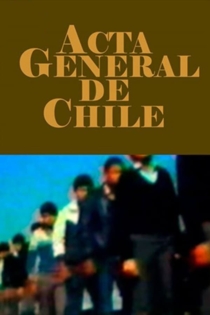
Acta General de Chile
Miguel Littín
Hortensia Allende, Salvador Allende
In 1985, Miguel Littin returned clandestinely to Chile and made this documentary divided in four parts about the political reality of the country. The parts are titled, Miguel Littin: Clandestine in Chile; The North of Chile: When I Fled to the Pampa; From the Frontier to the Interior of Chile in Flames; and Allende: the Time of History, the film features testimony from Garcia Marquez, Fidel Castro and Hortensia Bussi. Also shown is the Chile of Augusto Pinochet and Salvador Allende. When Littin returned to Spain and finished his work, Gabriel Garcia Marquez set out to write the story of the film, published under the title Clandestine in Chile: the Adventures of Miguel Littin, which quickly became a best seller.
Chile: A Genral Record
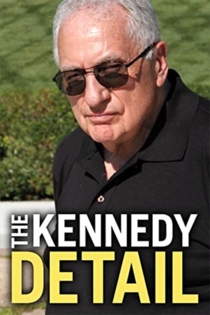
The Kennedy Detail
Vince DiPersio
Martin Sheen, Clint Hill
Based on the book by Gerald S. Blaine With Lisa McCubbin "The Kennedy Detail", this documentary interviews the men who served on President JFK's Secret Service Detail and their memories of the man, president, and perceptions of Camelot. Some of these men were there on the fateful day when life changed on the streets of Dallas, TX in Dealey Plaza on November 22nd, 1963.
The Kennedy Detail
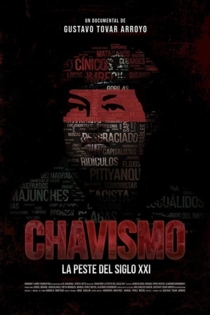
Chavismo: La peste del siglo XXI
Gustavo Tovar-Arroyo
Hugo Chávez, Fidel Castro
An analysis of the causes, social, political, and economic that caused the rise of Hugo Chávez as president of Venezuela; his abuse of power and the response of civil society, including the student movement; his political fall as well as the secrecy that surrounded his illness and the succession of Nicolás Maduro.
Chavismo: The Plague of the 21st Century
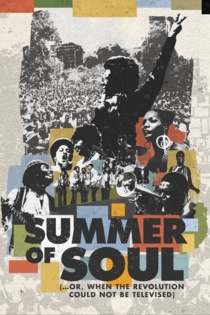
Summer of Soul (...or, When the Revolution Could Not Be Televised)
Ahmir-Khalib Thompson
Stevie Wonder, Lin-Manuel Miranda
During the same summer as Woodstock, over 300,000 people attended the Harlem Cultural Festival, celebrating African American music and culture, and promoting Black pride and unity. The footage from the festival sat in a basement, unseen for over 50 years, keeping this incredible event in America's history lost — until now.
Summer of Soul (...Or, When the Revolution Could Not Be Televised)
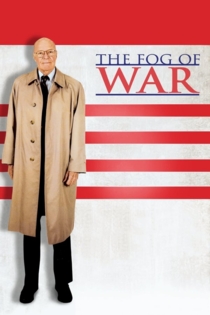
The Fog of War
Errol Morris
Robert McNamara, Errol Morris
Using archival footage, cabinet conversation recordings, and an interview of the 85-year-old Robert McNamara, The Fog of War depicts his life, from working as a WWII whiz-kid military officer, to being the Ford Motor Company's president, to managing the Vietnam War as defense secretary for presidents Kennedy and Johnson.
The Fog of War
Le fond de l'air est rouge
Chris Marker
Laurence Guvillier, Davos Hanich
French essay film focusing on global political turmoil in the 1960s and '70s, particularly the rise of the New Left in France and the development of socialist movements in Latin America.
A Grin Without a Cat
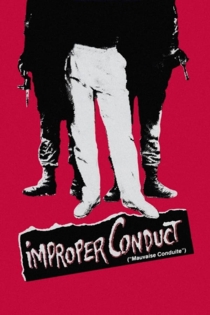
Mauvaise Conduite
Orlando Jiménez Leal, Néstor Almendros
Michel Dumoulin, Reynaldo Arenas
The story of the persecution of homosexuals and intellectuals in Cuba under Fidel Castro's dictatorship, from the beginning of the Cuban Revolution (1953-59) until the early 1980s. Interviews with relevant personalities of Cuban culture who suffered persecution demonstrate that concentration camps for gays existed in Cuba.
Improper Conduct