
Tawfiq Saleh
2021 - 2013His first film, Darb al-mahabil (1955), co-written by Najeeb Mahfouz, was set in a popular neighborhood but represented a kind of allegory of greed and materialism, dismantling the opportunism of the alley's inhabitants who chase a mentally retarded homeless person after they learn he has won the lottery. It took Saleh another seven years to direct his Sira' al-abtal (1962), set during the cholera epidemic of the 1930s. It featured Shukri Sarhan as a leftist country doctor who battles not only against the disease, but also against the peasant's ignorance, the midwife's intrigues and the egocentric interests of the feudal landowner.
Saleh's next films were produced by the General Film Organization. His Yaumiyat na'ib fi-l-aryaf (1968), taken from 'Taufiq al-Hakim"s novel, counts among the best adaptations. Yet he often came up against censorship and bureaucracy. Al-moutamarridoune (1968) and Al-sayyid bulti (1967) (in English: "Mister Fish"), both had to wait two years until their release. In the case of "Mister Fish", which deals with the struggle of working fishermen against a monopolist, the censor used a scene of two young women occupied with removing the hair from their legs to postpone the release of the film.
Finally, in the early 70s, Saleh left the country. His Al-makhdu'un (1972), produced by the Syrian National Film Organization and adapted from Ghassan Kanafani's novel "Men Under the Sun", was one of the first Arab films to move away from a melodramatic approach to the Palestinian question and to express scepticism regarding regarding pan-Arab solidarity. Saleh's last feature Al-ayyam al-tawila (1980) was produced by the Iraqi Theatre and Film Organization, and presented _Saddam Hussein_ as a patriotic guerilla. Saleh, who had moved to Iraq in 1973 in order to teach cinema, returned to Egypt in the mid-1980s to teach at the Higher Film Institute.
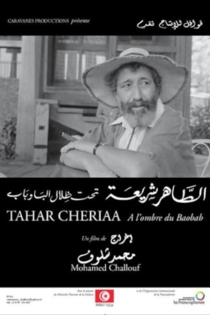
المخدوعون
Tewfik Saleh
Mohamed Kheir-Halouani, Abderrahman Alrahy
The film follows three Palestinian refugees brought together by dispossession and hope for a better future. Hiding in the tank of a truck, the men attempt to make their way across the border into Kuwait, the "promised land." A masterful adaptation of Ghassan Kanafani's novel Men Under the Sun, The Dupes is also one of the first Arab films to address the Palestinian predicament.
The Dupes
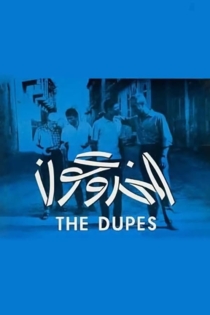
Sira' al-abtal
Tewfik Saleh
Shukri Sarhan, Samira Ahmed
A difficult period in Egypt in the year 1947, when the villages of Egypt attacked cholera. A doctor (Shukri), who tried to serve the villagers to save them from poverty and hunger, is appointed in a village. (Adel Bey) The feudal lord of the village exploits its people to work on his land as forced labor and whoever objects to hand him over to a mental hospital, taking advantage of his influence.
Struggle of the Heroes
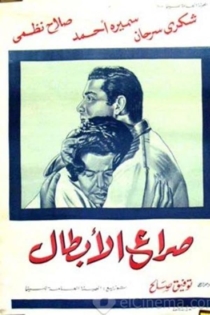
المتمردون
Tewfik Saleh
Hamdy Ahmed, Tewfik El Dekn
A sick doctor is admitted to an isolated sanatorium located in the middle of a desolate desert. As a patient, he becomes aware of the discrepancy that exists between the conditions of the privileged patients, who are well-treated, and the poor ones, who particularly suffer from a lack of water. With the help of the doctor, the poor patients rebel and undertake to restore justice and order in the hospital.
The Rebels
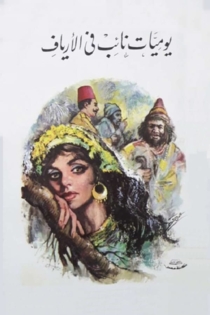
يوميات نائب في الأرياف
Tewfik Saleh
Raviya Achour, Ahmed Abdelhalim
Based on the novel by Egyptian writer Tawfiq al-Hakim, 1937, Diary of A Country Prosecutor records the daily activities and tribulations of a public official appointed to act as a village justice in the countryside.
Diary of a Country Prosecutor
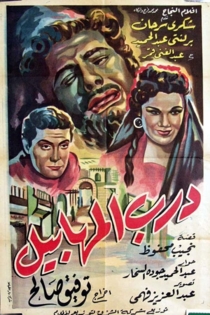
Darb al-mahabil
Tewfik Saleh
Berlanty Abdel Hamid, Tewfik El Dekn
The first film by director Tawfik Saleh, Fools’ Alley is considered one of the most important Egyptian films of the ‘50s – a success very much dependent on a story by Naguib Mahfouz. In an archetypal Egyptian neighborhood, Taha works hard to put aside enough money to marry his beloved Khadija, but when the necessary funds suddenly become available there is an unexpected turn of events. The life of the entire neighborhood is turned upside down and the true colors of its inhabitants are revealed.
Fools’ Alley
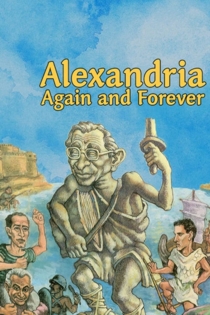
إسكندرية كمان وكمان
Youssef Chahine
Youssef Chahine, Yousra
Set in 1987 against the backdrop of a hunger strike by the Egyptian film industry, Chahine himself steps in to play Yehia, the famed Egyptian director whose life is chronicled in "Alexandria, Why?" and "An Egyptian Story". Obsessed with Amr, the handsome actor he discovered and cast as his alter-ego in parts one and two of The Alexandria Trilogy, Yehia pressures Amr to star in various film projects that change even as Yehia's perception of the young actor begins to change. He first casts Amr as Hamlet, which the actor deems too demanding for his talents, then as the lead in a musical biopic of demigod Alexander the Great, who founded the city of Alexandria in 332 B.C.
Alexandria Again and Forever
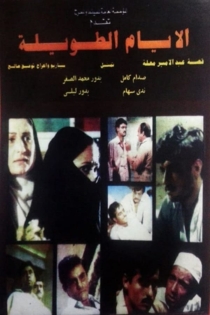
الأيام الطويلة
Tewfik Saleh, Terence Young
Saddam Kamel, Nada Siham
In 1959, underground revolutionaries try to assassinate Prime Minister Abd al-Karim Kassem in Baghdad. News reports claim they have failed, and at first the revolutionaries lay low, but as the secret police continue to comb the neighborhoods with house-to-house searches, they flee to the countryside. Among those fleeing is Saddam Hussein, the future president of the republic.
Long Days

صراع الأبطال
Tewfik Saleh
Shukri Sarhan, Samira Ahmed
A difficult period in Egypt in the year 1947, when the villages of Egypt attacked cholera. A doctor (Shukri), who tried to serve the villagers to save them from poverty and hunger, is appointed in a village. (Adel Bey) The feudal lord of the village exploits its people to work on his land as forced labor and whoever objects to hand him over to a mental hospital, taking advantage of his influence.
صراع الأبطال