Michèle Bardollet
2021La Tête des autres
Georges Folgoas, Raymond Rouleau
Guy Tréjan, Judith Magre
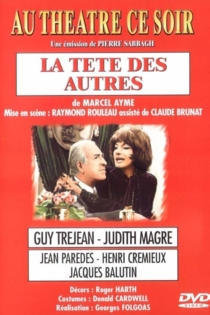
Prosecutor Maillard can rejoice: he has just obtained the death sentence of an accused accused of murder. It is the third head he gets at the assizes. There followed an evening of rejoicing with his wife and friends, including the prosecutor Bertolier. The latter's wife is Maillard's mistress. The lovers left alone, the condemned man, Valorin, burst into the room. He managed to escape during his transfer to the remand center. Valorin immediately recognized Bertolier's wife. And for good reason: at the time of the crime, they were together in a brothel. Stunned by the miscarriage of justice he has just committed, Maillard then tries to rehabilitate Vallorin while trying to avoid a scandal in the judiciary. He then calls Bertolier to the rescue. Valorin is opportunely killed "accidentally" and ... everything will go back to "order".
La Tête des autres
Mother
Henri Verneuil
Claudia Cardinale, Omar Sharif
Henri Verneuil was born Achod Malakian of Armenian parentage on October 15, 1920, in Rodosto, Turkey, and his family fled to France and settled in Marseilles when he was a young child. He later recounted his childhood experience in the novel Mayrig, which he dedicated to his mother and made into this 1991 film with the same name.
Mother
Paris, My Love
Vittorio Caprioli
Franca Valeri, Vittorio Caprioli
Parigi O Cara is probably the most camp in the history of Italian cinema, certainly a favourite with the GLBT community who quote its lines by heart. Unique as it's the only film where Franca Valeri (now 90) is the unquestioned star, in the role of Delia, a snobbish, stingy prostitute who is moving to Paris looking for greener and more lucrative pastures. An anti-neorealist, amoral, almost abstract comedy, which anticipates Almodóvar, a ferocious, though gentle, non-moralistic portrayal of the 60's boom and its broken dreams. The dialogue between Delia and her brother (played by Fiorenzo Fiorentini), when he does (or does not) tell her he is a homosexual, is memorable, a primordial coming-out, a masterpiece of allusions. But what makes it one of the first examples of a film with a "gay point of view" is the approach: perceptive, non-conformist, caustically witty. A film ahead of its times, still unbeaten.
Paris, My Love

La nuit des traqués
Bernard-Roland
Philippe Clay, Juliette Mayniel
A young and hapless Antwerp thief, working for a gang led by leather-clad Philippe Clay, quarrels with his boss and kills him during a fight. Enlisting his sister's help, he tries to get rid of the body in the harbour, - attracting the attention of a night watchman who seeks to profit from the situation
The Night of the Hunted
Douce violence
Max Pécas
Elke Sommer, Pierre Brice
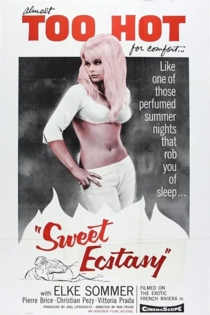
Olivier, a handsome but callow and moody young student, picks up an enthusiastic actress during a theatre rehearsal, and is introduced to her acquaintances -- a group of jaded rich kids who spend their time storming around the Riviera harassing passersby, throwing wild parties and following all the latest trends. When sexy Elke gives him the eye, he leaves the actress in the lurch and joins the gang for a decadent party aboard a yacht. However, Elke's wanton ways and Olivier's inexperience do not mesh, and in a snit, he accidentally sets the yacht afire. The gang wreaks its vengeance by luring him into a dangerous contest of bravura on a construction site.
Sweet Ecstasy