Rudolph Schildkraut
1862 - 1930Rudolph Schildkraut (April 27, 1862 - July 15, 1930) was an Austrian film and theatre actor.
Schildkraut was born in Istanbul, in the Ottoman Empire, to a Jewish family. His parents ran a hotel. He grew up in Brăila, Romania. In Vienna, he received acting lessons from Friedrich Mitterwurzer. He debuted in the early 1880s in Sopro, his first solid role came in 1885 in Krems.
In 1893 he moved to Vienna to an engagement at the newly opened Raimund Theater. In 1898 he moved to the Carl Theatre. Among other things, he played the character Wurm in Love and Intrigue. In 1900 he came to the German Theatre in Hamburg, 1905 to the German German Theatre in Berlin.
There he became one of the most important actor in the theatre company players of Max Reinhardt. His Shylock, which he played in 1905 and 1913 in Reinhardt's productions of The Merchant of Venice was praised by Fritz Kortner as a "monument to the art of acting." Other major roles were the title role in King Lear (1908), Mephisto in Faust I (1909), Muley Hassan in Friedrich Schiller's Fiesco (1909), the grave-digger in Hamlet (1909) and Peter Bast in Knut Hamsun's From the devil fetched (1914). Schildkraut performed for the first time in the United States in 1910/11.
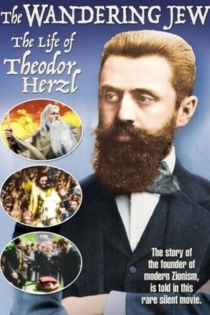
Schildkraut was known as a film actor in the German Empire in the early silent era. He starred in several film dramas. His last European-made film was a biography of the German Zionism founder Theodor Herzl, in which he played Herb Schildt "The struggling Israel." In 1920 he moved permanently to America and made his debut the same year in New York City in the play Silent Forces. From 1922 he also played in the English language. In 1925 he founded his own Jewish theatre in The Bronx.
In his last five years he appeared in several Hollywood productions. His most notable film, which raised his profile in America, was The King of Kings by Cecil B. DeMille in 1927 in which he played the High Priest Caiaphas.
He was married to Erna (Weinstein), with whom he had a son, Joseph Schildkraut (1896–1964), who was also known as an actor.
Schildkraut died at the age of 67 years of a heart attack, in Los Angeles. He is interred in the Hollywood Forever Cemetery, Hollywood, CA. His son also died at the same age, also of a heart attack.
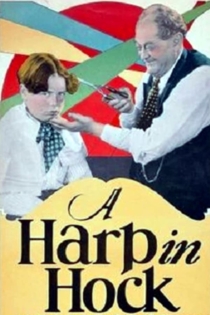
A Harp in Hock
Renaud Hoffman
Rudolph Schildkraut, Frank Coghlan Jr.
A Harp in Hock, also known as The Samaritan, is a lost 1927 American silent melodrama film directed by Renaud Hoffman, produced by DeMille Pictures, and distributed by Pathé Exchange. The film starred Rudolph Schildkraut, Junior Coghlan, May Robson, and Bessie Love, and was based on the short story by Evelyn Campbell.
A Harp in Hock
His People
Edward Sloman
Rudolph Schildkraut, Rosa Rosanova
The two sons of a poor Russian-Jewish pushcart peddler on New York's Lower East Side are causing their father grief. As Morris and Sammy stray from traditions cherished by their parents, each generation learns to accept change to preserve the family as a source of love and respect.
His People
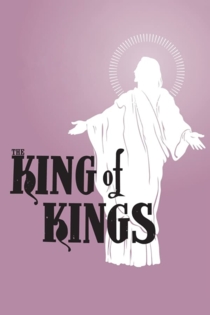
The King of Kings
Cecil B. DeMille
H.B. Warner, Dorothy Cumming
The King of Kings is the Greatest Story Ever Told as only Cecil B. DeMille could tell it. In 1927, working with one of the biggest budgets in Hollywood history, DeMille spun the life and Passion of Christ into a silent-era blockbuster. Featuring text drawn directly from the Bible, a cast of thousands, and the great showman’s singular cinematic bag of tricks, The King of Kings is at once spectacular and deeply reverent—part Gospel, part Technicolor epic.
The King of Kings

Pals in Paradise
George B. Seitz
Rudolph Schildkraut, John Bowers
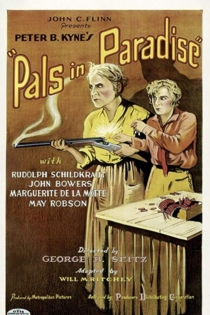
Bill Harvey discovers a lost mine, rich with gold. Geraldine "Jerry" Howard has the claim to it left her by her father. Bill tells her that the death of the claimant, her father, makes a claim void. Infuriated, she goes to John Kenton, a crooked lawyer, for aid. Kenton sees an opportunity for wealth if he marries Geraldine, but Bill tells her that Kenton is only after her money. She gets more infuriated. While Bill and a posse are raiding an immoral cabaret, Kenton raids the Paradise freight depot to steal the money. The depot catches fire and Kenton shoots his henchman to save himself. The town and Geraldine think Kenton is a hero. It is up to Bill to prove otherwise.
Pals in Paradise
Theodor Herzl, der Bannerträger des jüdischen Volkes
Otto Kreisler
Ernst Bath, Rudolph Schildkraut
This early film biography of the founder of modern Zionism depicts a young Herzl learning about Jewish persecution throughout the ages and developing his theory of political Zionism, which he saw as the only solution to anti-semitism.
Theodor Herzl, Standard-Bearer of the Jewish People
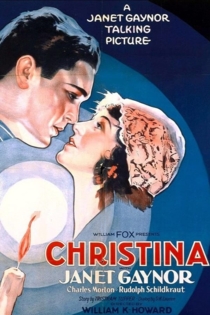
Christina
William K. Howard
Janet Gaynor, Charles Morton
This part-talkie (17 minutes of dialogue in its 83-minute running time) tells the tale of Christina, the daughter of Dutch toymaker Niklaas. Much to her dad's dismay, Christina falls in love with sideshow huckster Jan. Likewise disapproving of the romance is Jan's jealous employer Mme. Bosman, who frames the young man on an embezzlement charge.
Christina