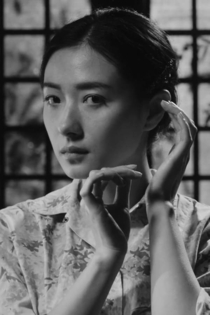
Yang Fudong
2021杨福东 竹林七贤5
Yang Fudong
Chen Ran, Yanqin Gao
The film 'Seven Intellectuals In Bamboo Forest' is based on the history of seven talented intellectuals from the ancient Chinese Wei and Jin Dynasties. Ruan Ji, Ji Kang, Shan Tao, Liu Ling, Ruan Yan, Xiang Xiu and Wang Rong were famous poets and artists at that time. Open and unruly, they used to gather and drink in the bamboo forest, singing songs and playing traditional Chinese musical instruments, in the hope of escaping from earthly life. They pursued individuality, freedom, and liberty. Their remarkable talent and passion made them a notable group in Chinese history. Part 5 is about the return to the city and to reality. We live in the city and belong to it. If any problem arises, we are able to solve it.
Seven Intellectuals in Bamboo Forest, Part V
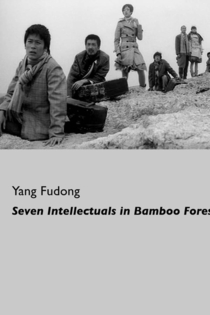
明日早朝
Yang Fudong
Tan Zhuo, Lü Yulai
A large-scale solo exhibition by Chinese contemporary video artist Yang Fudong — grandly opened in the West Bund of Shanghai Art Museum. Yang collaborated with actors including Tan Zhuo, Lu Yulai, Xu Caigen, etc., and showed a 30-day art museum 'new film plan' for the audience at the museum. The Northern Song Dynasty Church and Nietzsche texts are the solemn philosophical language randomly selected by the director as a dialogue in the shooting scenes, and accompanied by the incomparable tone, gestures and facial expressions of the performers. Through this abstraction, stimulation breeds suspense, absurdity, and confusion. To be sure, Yang Fudong has once again found a strong personal style in recycling history.
Dawn Breaking
杨福东 竹林七贤4
Yang Fudong
Chen Ran, Kong Chenjiang
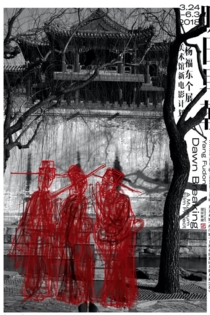
The film 'Seven Intellectuals In Bamboo Forest' is based on the history of seven talented intellectuals from the ancient Chinese Wei and Jin Dynasties. Ruan Ji, Ji Kang, Shan Tao, Liu Ling, Ruan Yan, Xiang Xiu and Wang Rong were famous poets and artists at that time. Open and unruly, they used to gather and drink in the bamboo forest, singing songs and playing traditional Chinese musical instruments, in the hope of escaping from earthly life. They pursued individuality, freedom, and liberty. Their remarkable talent and passion made them a notable group in Chinese history. Part 4 is about the idea of living on an island with no one else, avoiding the hustle and bustle of the busy metropolis. In Chinese legend, there is an island of Peach Blossoms - the very ideal place to live, where one's thoughts can fly freely.
Seven Intellectuals in Bamboo Forest, Part IV
陌生天堂
Yang Fudong
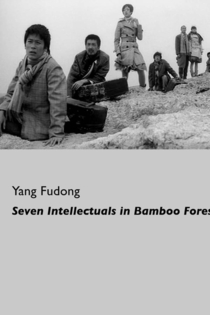
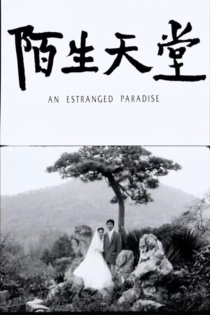
Shot in 1997 and premiered at Documenta XI in 2002, An Estranged Paradise displays many of Yang's signature motifs — crisp black-and-white 35mm cinematography, storylines that blur contemporaneity with traditional stylistics, homages to/revisions of genre cinema akin to the early work of his influences Jean-Luc Godard and Jim Jarmusch — while also reflecting his early studies as a painter, notably in a prologue that muses on the traditional methods and subjectivity of Chinese landscape painting. Set in the city of Hangzhou (where Yang had studied at the China Academy of Fine Art), the film takes as its focal point a restless young man, Zhu Zi, following him as he aimlessly wanders through the city. Through a series of distinct vignettes, Yang depicts Zhu Zi's inability to find comfort in friends, lovers or environment as a reflection of the existential difficulty of China's "nameless generation," cast adrift during the rapid changes at the turn of the millennium.
An Estranged Paradise
我并非强迫你
Yang Fudong
Implicitly a reaction to the forms of individualism in a developing modern mass society. Yang Fudong strings together takes with different characters so quickly one after the other that they “lose face.” A man explains to a woman the sentence"I didn't force you". Separate movements of 12-14 people are combined/cut to form a fictive man who repeats the words "I didn't force you" to a woman.
After All, I Didn't Force You
The Revival of the Snake
Yang Fudong
10 channel video installation. Music:Wang Wenwei. This work tells the end of the story of a soldier going into exile. On a sunny winter's day, the icy ground is stared with snow and life seems as peaceful as the weather. A soldier, escaping from a battlefield, comes to this deserted place which is plagued with the smell of death. He is wandering, attempting to leave this uninhabited world. The only option left to him, however, is walking, ceaselessly and endlessly. What is waiting for him? A hibernating snake is startled awake from its nice dreams and then sees a human, eyes blindfolded and hands bound on the back, kneeling on the freezing ice-covered lake. Who is sentenced to death by the sound of gunshots reverberating around the mountains?
The Revival of the Snake
The Light That I Feel
Yang Fudong
8 channel-video installation, sound, 8- 14 mins. Music by: Jin Wang. "The light that I feel" series refers to an eponymous film shot during the summer 2014 on the island of Sandhornøy in Norway where Yang Fudong directed local actors and dancers. The Light That I Feel was first shown in situ on eight screens arranged within an architectural structure purposely built for the occasion on a beach on the island, and editing it at the Nordland College of Art and Film, Kabelvag. Influenced by Ingmar Bergman’s work, this project enabled Yang Fudong to direct European actors for the first time in a magnificent Scandinavian landscape. The artist seeks to show how the wind and trees can express a narrative. As in many of his films landscapes play a paramount role equivalent to that of the protagonists.
The Light That I Feel
East of Que Village
Yang Fudong
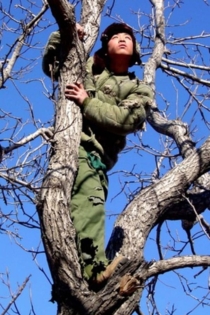
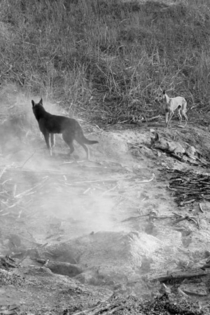
Shot in the rural Chinese province of Hebei, this work captures a pack of wild dogs scavenging in an arid desolate landscape. East of Que Village considers the impact of Chinese industrialisation and urbanisation on rural communities, casting fresh light on those neglected by the new social-economic paradigm. The dogs, which literally have to eat each other to survive are juxtaposed with a group of villagers who struggle in the same ways. The work reflects the sense of isolation and loss increasingly present in Chinese society as communities are scattered, traditional rural villages are dissolved, and the fight for survival takes hold. The work's title signals to the only road leading from the village to the outside world.
East of Que Village

杨福东 竹林七贤2
Yang Fudong
The film 'Seven Intellectuals In Bamboo Forest' is based on the history of seven talented intellectuals from the ancient Chinese Wei and Jin Dynasties. Ruan Ji, Ji Kang, Shan Tao, Liu Ling, Ruan Yan, Xiang Xiu and Wang Rong were famous poets and artists at that time. Open and unruly, they used to gather and drink in the bamboo forest, singing songs and playing traditional Chinese musical instruments, in the hope of escaping from earthly life. They pursued individuality, freedom, and liberty. Their remarkable talent and passion made them a notable group in Chinese history. Part 2 exposes closed city life in a noisy metropolis, such as Shanghai. The 7 young people live in the city, but seem to have little connection with the city.
Seven Intellectuals in Bamboo Forest, Part II

西门子 "S10"
Yang Fudong
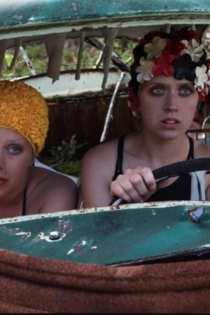
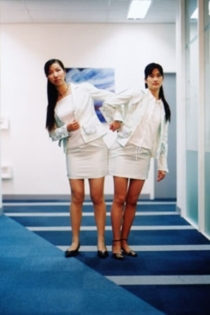
In “S10” (2003), two female office workers wearing uniforms covered in zippers, zip together their arms and various other parts of their bodies. At this point we have entered the realm of a modern-day Shan Hai Jing inhabited by "exaggerated" creatures, a realm that is at the same time a metaphorical expression of a new concept of "subject" that is in the process of evolving organically from the individual to the other, and to the group. If we are all interconnected, just how far does the territory of the "individual" extend?
Siemens "S10"

Lock Again
Yang Fudong
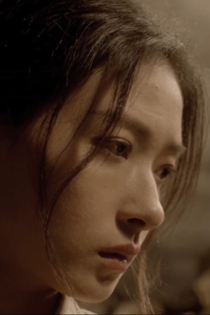
Two young men wear the uniform of 70’s policeman, sometimes they look like runaway criminal. They want to escape reality which is impossible to cast off. They yearn for the bright sunshine life, expecting the time to be captured, to exchange for a calmness of the heart.
Lock Again

愚公移山
Yang Fudong
Wan Qian, Wan Shengli
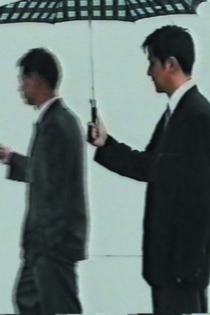
Yang Fudong, one of the most influential contemporary artists in China, is known for his epic black-and-white films and photographs, which straddle the worlds of contemporary art installation and cinema. Moving Mountains is a 46-minute, black-and-white film, accompanied by photographs from the film set, drawings and props. The film is inspired by the ancient tale of a man, seeking to move a mountain, and extolls the virtues of perseverance and collective action. The artist makes this story a poetic reflection upon human nature and the shifting values to which it can be subjected.
Moving Mountains