
Anne Teresa De Keersmaeker
1960 (65 лет)Rosas Danst Rosas
Thierry De Mey, Anne Teresa De Keersmaeker
Cynthia Loemy, Sarah Ludi
Thierry De Mey filmed Rosas danst Rosas in the former technical school of architect Henry Van de Velde in Leuven. The film version is much shorter than the show itself. In his film Thierry De Mey opts for a heavily ‘inter-cut’ version in which, apart from the cast of four dancers from 1995 and 1996, he also has all the other performers from the long history of the show dance along. He makes maximum use of the geometrical and spatial qualities of the Van de Veldes building. Incidentally, the building was thoroughly renovated straight after the film was made, making it one of the last testimonials to the original architecture. The film was shown on all of the major European television channels and also had a cinema career in the ‘art house circuit’.
Rosas Danst Rosas
Rain
Gerard-Jan Claes, Olivia Rochette
Anne Teresa De Keersmaeker
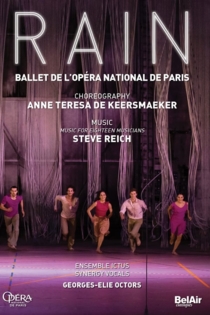
A poetic portrait of the world-renowned Ballet de l'Opéra national de Paris as they mount a new work by famed contemporary choreographer Anne Teresa De Keersmaeker, Rain is a formalist exercise in documentary filmmaking that at times resembles long lost outtakes from The Red Shoes.
Rain
Hoppla!
Wolfgang Kolb, Anne Teresa De Keersmaeker
Johanne Saunier, Jean-Luc Ducourt
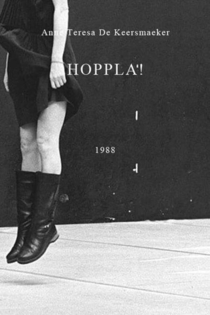
In Hoppla!, two choreographies by Anne Teresa De Keersmaeker are brought together and performed to the music of the Hungarian composer Béla Bartók: Mikrokosmos, seven short works for two pianos, and Quatuor no. 4, Bartók’s fourth string quartet. The reading room of the Ghent University library, designed by the renowned architect Henry Van de Velde, serves as location.
Hoppla!
Fase
Thierry De Mey
Anne Teresa De Keersmaeker, Michèle-Anne De Mey
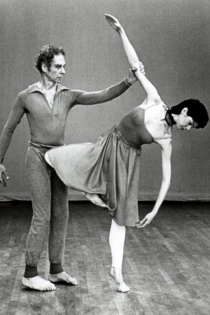
"Fase" consists of three duets and one solo dance, choreographed to four repetitive compositions by the American minimalist musician, Steve Reich: Piano Phase, Come Out, Violin Phase and Clapping Music. Reich allows his tones to gradually shift in rhythm and melody and between the instruments. The choreography applies the same phase-shifting principle. The purely abstract movements are executed so perfectly that they seem almost mechanical and yet affect us in a strange way.
Fase
Zeitigung
Anne Teresa De Keersmaeker
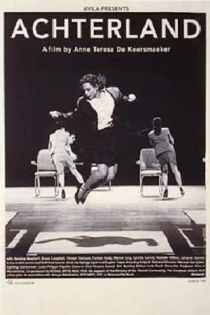
Almost ten years after Zeitung, Anne Teresa De Keersmaeker and the musician Alain Franco started off with those same building blocks to create Zeitigung. Against the backdrop of a changing world, and channeled through the bodies of eight young dancers, Franco and De Keersmaeker offer an updated version of their own earlier work. As a part of their strategy they invited the young choreographer and dancer Louis Nam Le Van Ho to confront his own writing with De Keersmaeker’s choreography; his contribution builds a bridge to a new generation of creators and choreographers, providing a different perspective on De Keersmaeker’s and Franco’s ongoing examination of the essence of dance and composition. Franco joins Rosas’s dancers on stage, performing the piece live on the piano. In a broad historical gesture, the music of Johann Sebastian Bach, Johannes Brahms, Arnold Schönberg, and Anton Webern stretches across the geometric principles and improvised sections of the choreography.
Zeitigung
An evening with Anne Teresa De Keersmaeker at the Opéra National de Paris
Anne Teresa De Keersmaeker
On this repertory evening, Rosas brings together three early works by Anne Teresa De Keersmaeker. In 1986, De Keersmaeker first ventured into the terrain of contemporary classical music with Bartók's string quartet Quartet No. 4. In a choreography punctuated by both playful and combative accents, De Keersmaeker took on the task of distilling a dance score out of Bartók's complex rhythms and layered harmonies. In the Grosse Fuge (1992), De Keersmaeker sets out to find a male vocabulary, with Rosas’ dancers challenging gravity in a piece that sought to provide a physical translation of Beethoven's ingenious use of counterpoint. The final piece of the evening, Verklärte Nacht (1995), presents a shamelessly romantic love story, in which the contrasting feelings of a man and a woman are dissected and interpreted in an expressive duet based on Schönberg's eponymous musical score.
An evening with Anne Teresa De Keersmaeker at the Opéra National de Paris
Mozart: Così Fan Tutte
Anne Teresa De Keersmaeker
Jacquelyn Wagner, Michèle Losier
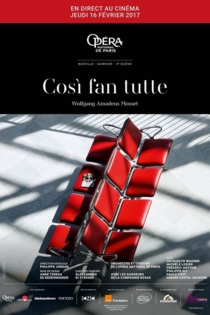
Prompted by Don Alfonso, a cynical old philosopher, two young idealists decide to put their lovers’ fidelity to the test. But love will teach them a bitter lesson: those who believe themselves phoenixes and goddesses will discover the desires of the flesh… In 1790, one year after the French Revolution, in what would be their final collaboration, Mozart and Da Ponte conduct a scientific investigation of love. With six singers doubled by six dancers, Anne Teresa De Keersmaeker depicts the desire which unites and separates human beings, like the interactions between atoms that, once broken, make new bonds possible
Mozart: Così Fan Tutte
En attendant
Anne Teresa De Keersmaeker
In En Atendant, Anne Teresa De Keersmaeker is taking a new step in her exploration of the combination of music and dance. After Bach and Webern in Zeitung, The Beatles in The Song and Mahler in 3Abschied, this time her starting point is the Ars Subtilior: a complex and intellectual form of polyphonic music from the 14th century that is based on dissonance and contrast. Ars Subtilior developed on the ruins of the plague and the Church at a time when the social, political and religious pillars of mediaeval society were fragmenting. Nowadays this upheaval seems more relevant than ever. In the light of today’s increasingly confusing events and the complexity of the choices we face, the question of our mortality and physicality is becoming ever more crucial.
En attendant
Drumming
Anne Teresa De Keersmaeker
Drumming (1998) is one of Anne Teresa De Keersmaeker’s most iconic choreographies, written to the eponymous, minimalistic percussion score by Steve Reich. The music starts with a single rhythmic motif, which subsequently multiplies and unfolds into a rich cornucopia of textures including drums, woodwinds, brass and voice. Reich here ramps up the technique already used in his earlier composition Piano Phase: through minor tempo accelerations the musicians almost imperceptibly push their unison out of joint, resulting in a never-ending volley of canons. In the dance, the choreographic complexity was devised in a similar fashion: a single movement phrase serves as the foundation for an infinite number of variations across time and space. When the music stops and the bodies come to a halt, the audience realizes what they have witnessed: a wave of pure dance and pure sound, a vortex of vital energy.
Drumming
Cesena
Anne Teresa De Keersmaeker
For Cesena Anne Teresa De Keersmaeker and Rosas worked closely with Björn Schmelzer and his graindelavoix ensemble. This new production might almost be called the counterpart to its predecessor, En Atendant. Whereas in that piece the twilight merged almost imperceptibly into night, this piece heralds the start of the day. The stage is shared by 19 dancers and singers who explore the limits of their ability. Dancers sing and singers dance, once again in dialogue with the wilful 14th-century scores of the Ars Subtilior. For the third time, Ann Veronica Janssens has collaborated with Rosas for a set design, providing a sculpture of passing time, of the constant transformation of what is around us and of what only becomes visible in the course of time. The start of a new day, or a new look at a distant past.
Cesena
Rain
Anne Teresa De Keersmaeker
Rain, set to Steve Reich's Music for 18 Musicians (1976), is one of Anne Teresa De Keersmaeker’s most characteristic performances. With this vibrant choreography, De Keersmaeker returned, in 2001, to two of her great loves: pure dance and the minimalistic music of Steve Reich. Accompanied by the pulsating tones of his music, for an hour and ten minutes ten dancers occupy the stage, delineated by a curtain of fine strings, displaying an impressive succession of virtuoso dance phrases. The mathematical figures, the sustained repetition, the geometric occupation of the space, the art of continuous variation – everything that had gradually become the choreographer’s signature was pushed to the extreme in Rain.
Rain
Drumming Live
Anne Teresa De Keersmaeker
As of 9 October 2020, Rosas will be restaging Drumming (1998). These will be the first performances of Drumming since the last tour, which ran between 2012 and 2016. This revival will be danced alternately by the company’s repertoire group and a new cast of young dancers.
Drumming Live
Drumming & Rain: A Choreographer's Score
Anne Teresa De Keersmaeker
Drumming & Rain: A Choreographer’s Score is a conversation in which the Belgian choreographer Anne Teresa De Keersmaeker offers the performance theorist and musicologist Bojana Cvejić wide-ranging insights into choreography, and into the making of Drumming and Rain, two landmark works created to the music of minimalist composer Steve Reich. Both choreographies are known for a vitalist fusion of structural brilliance and virtuosic energy. Not only the superb dancing, but also the costumes by Dries Van Noten and the scenography by Jan Versweyveld participate in the integrated composition of the two performances.
Drumming & Rain: A Choreographer's Score