
Hito Steyerl
1966 (60 лет)November
Hito Steyerl
In the eighties, Hito Steyerl shot a feminist martial arts film on Super-8 stock. Her best friend Andrea Wolf played the lead role, that of a woman warrior dressed in leather and mounted on a motorcycle. The engagement expressed in the formal grammar of exploitation films later became Wolf’s political praxis: She went to fight alongside the PKK in the Kurdish regions between Turkey and northern Iraq, where she was killed in 1998. Now honoured by Kurds as an “immortal revolutionary,” her portrait is carried at demonstrations.
November
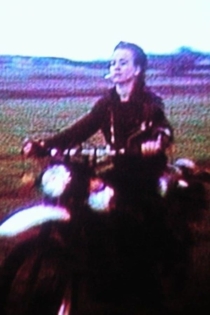
Lovely Andrea
Hito Steyerl
Hito Steyerl, Steve Osada
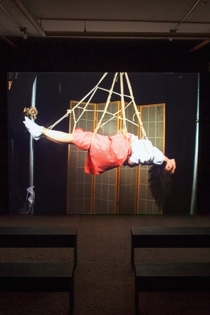
If all pictures became current, in that they pass by and in doing so, are connectable with one another, whether elegantly or obscenely, through translation or associationhow would it be possible to fasten down a picture? Hito Steyerls light-hearted picture translations are about fastening things in an elegant-obscene way: In Tokyo she is looking for a photo series that she posed for in 1987 as a rope bondage model. While making inquiries with experts and authorities in the bondage arts (which are mainly marketed online nowadays), she found what she was looking for in a magazine archive. The cinematic tension is extremely high just now says the translator while Steyerl looks through photos of herself from her days as a film student.
Lovely Andrea
Journal No. 1 - An Artist's Impression
Hito Steyerl
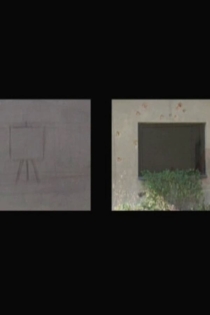
In 1947, two years after the end of the Second World War, Film Journal No. 1 was released in Sarajevo. Fifty years later, after the collapse of the Communist bloc, this newsreel was lost in the confusion of the fighting in Yugoslavia. In Journal No. 1 Hito Steyerl attempts to find out how the footage got lost and what was on this document from the Sutjeska studio. In the simultaneous projection of Journal No. 1 the ‘unattainability of an historical zero hour of the national identity’ takes concrete form: The lost newsreel reports on a literacy campaign as well as Muslim women confidently removing their headscarves. We listen however to eyewitnesses trying to recapture the lost content and we see the artist Arman Kulasic making a number of drawings that resemble the story-boards for the lost film. What appears to be moments of great change remain limited by subjective and uncertain memory. The film was premiered at documenta 12.
Journal No. 1 - An Artist's Impression
How Not to Be Seen: A Fucking Didactic Educational .MOV File
Hito Steyerl
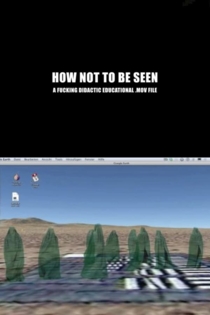
How Not to Be Seen: A Fucking Didactic Educational .MOV File (2013) mocks an instructional film on the idea of becoming invisible in the digital world.
How Not to Be Seen: A Fucking Didactic Educational .MOV File
The Business of Thought: A Recorded History of Artists Space
Sierra Pettengill
Laurie Anderson, Hito Steyerl
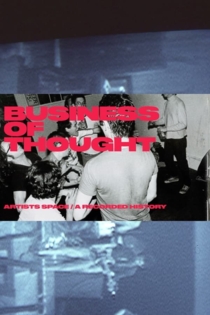
An oral history of Artists Space, the legendary New York artists organization. Told through the voices of the artists, critics and curators who formed it, the film is narrated by voiceover culled from 30 hours of archival cassette tape interviews over a 45 year period. Artists such as Laurie Anderson, Mike Kelley, Hito Steyerl and David Wojnarowicz walk us through the decades. A formally-experimental and raucously-told chronology composed of rare archival documentation, The Business of Thought... is a reminder of the radical potential of the arts and the importance of collective, cultural spaces.
The Business of Thought: A Recorded History of Artists Space
Drill
Hito Steyerl
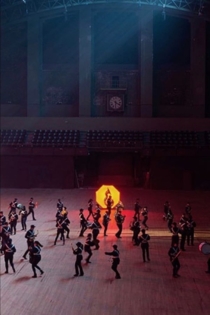
Hito Steyerl reveals her most recent installation in the U.S. to date, commissioned by the Armory and curated by Park Avenue Armory’s visual arts curator Tom Eccles. Steyerl utilizes both the Wade Thompson Drill Hall and historic interiors of the building in mounting both pre-existing works as well as new projects commissioned by the Armory in her ongoing illumination of the world’s power structures, inequalities, obscurities, and delights. When viewed collectively, this material allows the viewer to zoom in on and out from some of the most complex and pressing issues of our time.
Drill
Factory of the Sun
Hito Steyerl
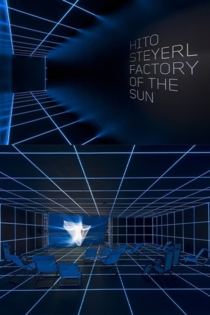
In this immersive work, which debuted at the 2015 German Pavilion at the Venice Biennale, Steyerl probes the pleasures and perils of image circulation in a moment defined by the unprecedented global flow of data. Ricocheting between genres—news reportage, documentary film, video games, and internet dance videos—Factory of the Sun uses the motifs of light and acceleration to explore what possibilities are still available for collective resistance when surveillance has become a mundane part of an increasingly virtual world. Factory of the Sun tells the surreal story of workers whose forced moves in a motion capture studio are turned into artificial sunshine.
Factory of the Sun
Abstract
Hito Steyerl
Abstract (2012) is a return to the contested narrative of Andrea Wolf’s death, with Steyerl traveling to Kurdistan in search of information about her friend's murder. The work links cinematic shooting and military warfare together, implicating Germany’s role in the operation. This has been screened in the past as a dual-channel work. But in this case it has been re-purposed by the artist as a split screen film. (KG) From e-flux: Abstract presents a scenario in which the violence of warfare and the violence of aesthetics twist around each other. The two-channel video visits the site where Steyerl’s friend Andrea Wolf was killed in 1998, but through a prism that refracts cinematic language against the weapons that killed her friend. As the site and circumstances of her death fold into the act of witnessing it from a distance, the ethical burden of identifying those responsible also appears to live and die with the debris that still remains at the site of the helicopter attack.
Abstract


Robots Today
Hito Steyerl
The film uses footage from south-eastern Turkey of the Kurdish town of Cizre on the Syrian border, which now resembles a ghost town following numerous skirmishes of escalating intensity between the government and the PKK footage from south-eastern Turkey of the Kurdish town of Cizre on the Syrian border, which now resembles a ghost town following numerous skirmishes of escalating intensity between the government and the PKK (Kurdistan Workers' Party). It is the hometown of Ismail al-Jazari, the Arab polymath (he was a scholar, inventor, mathematician, engineer and artist) who wrote a book about mechanical apparatuses in 1205 to convey knowledge about ingenious devices. He described a hundred mechanical devices, some 80 of which are trick vessels of various kinds, along with instructions on how to construct them. Steyerl combines the pictures of the town with questions addressed to Siri, the software installed in iPhones: What role does computer technology play in war?
Robots Today

Adorno's Grey
Hito Steyerl
Adorno’s Grey features a single-channel video set in the Goethe-Universität in Frankfurt, where German philosopher Theodor W. Adorno famously taught. It shows two conservators scraping the walls of a lecture hall, looking for the legendary grey that Adorno had his classroom painted in order to promote concentration. The excavation is staged as a film set: the technical apparatus of the production is exposed and Steyerl’s directions for the excavators can be heard off camera. The video returns to an image of a camera being set up to take a photo of the lectern.
Adorno's Grey

Universal Embassy
Hito Steyerl
A short documentary about the Universal Embassy. After the collapse of the Somali government twenty years ago, its embassy in Brussels was left empty. The embassy and the sovereignty of the grounds were claimed by a group of activists who planted their own flag. This former piece of ‘Somalia’ is the only place on earth that does not belong to a country. The documentary shows how a group of people without a residence permit must live. The Universal Embassy is devoted to the cause of other homeless people, the sans papiers.
Universal Embassy
Die Leere Mitte
Hito Steyerl
Dong Yang, Huan Zhu
Steyerl’s film traces the impact of an influx of transnational companies on the city dwellers of Berlin in post-reunification Germany. The effect of the changing economy and politics on the city and its inhabitants is echoed through their physical relocation to its outer edges. In 1990, squatters proclaim a socialist republic on the death strip. Eight years later, the new headquarters of Mercedes Benz are built in the same location. The film makes use of slow super-impositions to uncover a journey across changing architectural and cultural boundaries. "The Empty Centre" tries to give a voice and a history to those who continue to be marginalised by the simultaneous dismantling and reconstruction of the borders which they are trying to cross.
The Empty Center
The Tower
Hito Steyerl
Oleg Fonaryov, Vova Pakholiuk
Steyerl’s immersive installation focuses on the making of the video game "Skyscraper: Stairway to Chaos" by the Ukrainian company Ace3D, based on Saddam Hussein’s unrealised plans to reconstruct the Tower of Babel in Babylon, the ancient capital that he began rebuilding in the 1980s.
The Tower
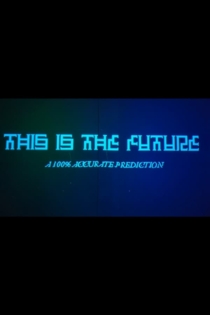
This Is The Future
Hito Steyerl
As part of an art installation, Steyerl uses AI technology to create a garden of the future that emulates the Venetian landscape of elevated walkways. Viewers walk among digital flowers that cycle through their lifespan without ever actually existing. Through Steyerl’s self-created technology, she asks whether AI can successfully predict the future, the answer being an explicit ‘no’.
This Is The Future
Normalitat 1-10
Hito Steyerl
What is declared normal by some and accepted as such by the majority sometimes represents a concrete threat to others. Normality 1-10, a series of short video essays, registers everyday neo-fascist violence as being an instrument of such "normalization." In a matter-of-fact and at the same time insistent manner, Hito Steyerl offers a richly detailed report on the growing number of anti-Semitic and racist attacks - on cemeteries, monuments and human beings - in both Austria and Germany. In a sober visual language, she develops a number of forms and styles of commentary to pose questions concerning the social structures inherent to this variety of violence and their representation. From sixpackfilm.com
Normalität 1-10