Akihiko Katayama
1926 - 2014
限りなき前進
Tomu Uchida
Isamu Kosugi, Hisako Takihana
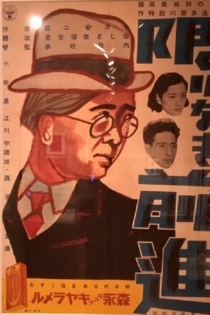
One of Uchida’s early sound films, Unending Advance is based on a curious story by Yasujiro Ozu, in which an examination of the quotidian problems of a middle-aged salaryman and his family segues into an idyllic dream of an implausible future. The surviving print, although incomplete, offers an essential glimpse into Uchida’s prewar period, when he was associated more with realist dramas than with the period films that dominated his work after the war.
Unending Advance
武蔵野夫人
Kenji Mizoguchi
Kinuyo Tanaka, Yukiko Todoroki
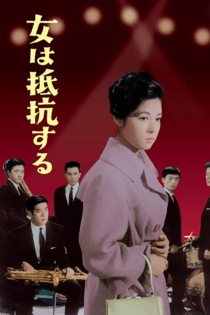
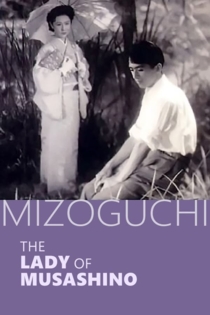
Set in post-war Japan, The Lady of Musashino tells the story of Michiko, a disillusioned young woman trapped in a loveless marriage. She confides in her younger cousin, Tsutomo, and the two become close, but decide not to consummate their affair. He instead becomes involved with the flirtatious Tomiko, who is also conducting an affair with Michiko's husband. When Michiko finds that her husband has abandoned her, she decides to take her fate into her own hands.
The Lady of Musashino

路傍の石
Tomotaka Tasaka
Akihiko Katayama, Reizaburô Yamamoto
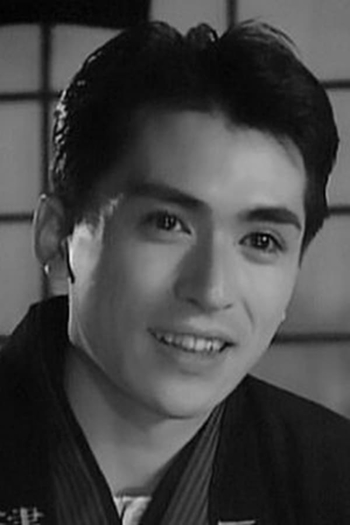
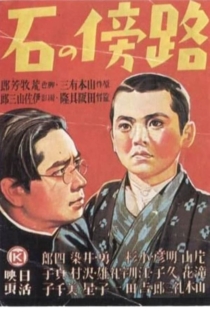
Tomotaka Tasaka's A Pebble by the Wayside (Robo no Ishi), made in 1938 and taken from a Yuzo Yamamoto novel, takes place around 1902, was about a young boy brought up entirely by his mother since his drunken father is never home. An intelligent teacher wants to send him to middle school, but instead the father apprentices him to a clothing store to which he is in debt. The mother dies and the boy is forced to quit work when his father insults the store owner. Later the boy goes to Tokyo, but only to continue his hardships. First he is forced to do a maid's job at a boarding house and later is used by an old woman to steal at funerals. Finally he is rescued by the teacher, whom he meets in Tokyo.
A Pebble by the Wayside
荒木又右衛門 決闘鍵屋の辻
Kazuo Mori
Toshirō Mifune, Yuriko Hamada
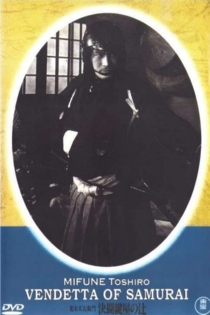
The famous showdown at Kagiya corner has been told many times, but never before with the realism and intensity of this version scripted by Kurosawa Akira and starring Mifune Toshiro as the famed swordsman who must face his best friend as they are forced to take opposite sides in a vendetta caused by the murder of a family member. Told mostly in flashback as the avengers await the arrival of their quarry, this film displays true heroism in the face of fear as most of the combatants, while of the samurai class are not skilled swordsmen. They contrast sharply with the true warriors involved in this battle. Araki Mataemon (Mifune), who was not only a direct student of Yagyu Munenori, but the founder of his own sword style under the Yagyu name is a powerful force ready to assist his brother-in-law against the murderer's allies that include not only another noted sword teacher, but the deadly spear of Katsumi no Hanbei.
Vendetta of a Samurai
爆音
Tomotaka Tasaka
Ryo Akaboshi, Noboru Asahi
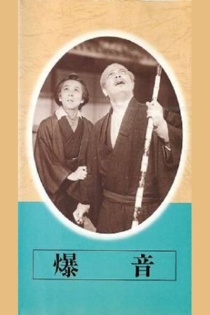
"Around the time he made such remarkably ambivalent war films as Mud and Soldiers and Five Scouts, Tasaka directed this 'home front' comedy-drama which is too bizarre to be serious propaganda. [The plot revolves around a public contribution campaign to buy airplanes.] The mayor's aviator son promises to fly over the village in salute, and much of the narrative concerns the preparations for this great event. Tasaka throws in a few songs, some village humor and satire, and tremendous camera mobility, finally wringing every possible effect from his climax." John Gillett, British Film Institute
Explosion!
安珍と清姫
Koji Shima
Raizō Ichikawa, Ayako Wakao
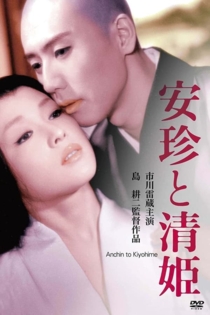
Princess Kiyo accidentally injures a local priest, Anchin, while on a hunt. She apologizes, but feels irritated by Anchin’s indifference to her in spite of her beauty. One night, while Anchin is recuperating in a hot spring, he is approached by Kiyo. She tells him that she is in love with him.
The Priest and the Beauty