Corinne Cantrill
2021At Uluru
Arthur Cantrill, Corinne Cantrill
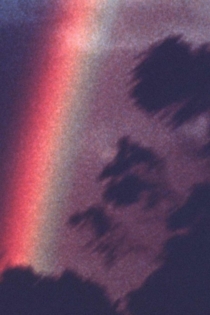
Ayers Rock is examined in the light of its ancient human and animal associations. It is seen under various light effects which create different colour and texture impressions. The timelessness of the monolith is suggested by negative colour, the result of using fine-grain Eastmancolour print stock in the camera, a slow speed material which required the intense Central Australian light for adequate exposure. A half-speed recording of the local bird call and insects contributes to the sense of cross eras. Human perception of time, colour and sound is questioned. As Einstein said: 'The distinction between past, present and future is only an illusion, even if a stubborn one.'
At Uluru
In This Life's Body
Corinne Cantrill
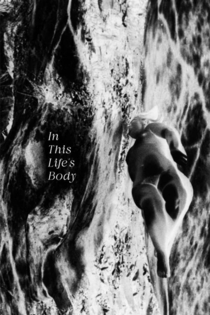
Filmmaker Corinne Cantrill traces her fascinating life story through hundreds of photographs. Formally rigorous and emotionally profound, Corinne's insightful narration explores how photographs both reveal and hide our identity.
In This Life's Body
Harry Hooton
Arthur Cantrill, Corinne Cantrill
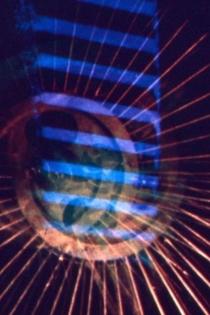
The film Harry Hooton is conceived as a huge energy field combining the energy of light and colour, movement, editing and sound — a dense, vibrating, pulsating work, unrelenting in its thrust; a celebration of Hooton’s definition of art as the communication of emotion to matter.
Harry Hooton
The Second Journey (To Uluru)
Arthur Cantrill, Corinne Cantrill
Corinne Cantrill
As the camera moves gently from afar into the very heart of the monolith, the magic of the holiest site of the Aborigines unfolds in shimmering nuances of light. Shot at different times of day, the close-up and panorama shots of this more than 500-million-year-old stone formation combine silence and acoustically altered birdsong to convey a feeling of timelessness into which a sense of loss is also inscribed. The somnambulistic moonrise in the great sky seems almost like an abstract painting and yet it is real. The areas of discolouration in the film material caused by problems in the developing process were deliberately left in the film as a metaphor for the looming threat to this natural environment through bushfires and tourism.
The Second Journey (To Uluru)
Red Stone Dancer
Arthur Cantrill, Corinne Cantrill
"On several occasions we were impressed by the apparent vitality of some spools with arbitrary discards, compared to the laboriously assembled sequences of what is waste. Based on this idea, the cinema is a reel of clips from the Red Stone Dancer scene in Gaudier-Brezska's main film. It was done in an iconoclastic way very quickly, celebrating that we were abandoning the limitations of the documentary form. It was the first of many films in which we recycled previously filmed material and used it for new purposes."
Red Stone Dancer

Notes on the Passage of Time
Arthur Cantrill, Corinne Cantrill
A three colour separation study filmed at Pearl Beach, which examines the same scene of Amethyst Avenue during the progression of a winter, then a summer day. With the sea in the background, the moving objects such as the pedestrians, cyclists, traffic are transparent and ephemeral while the stationary objects are opaque and retain a permanent quality. A strange, almost surreal quality illustrating the transitional nature of life.
Notes on the Passage of Time
Robert Klippel – Junk Sculpture No. 3
Arthur Cantrill, Corinne Cantrill
“In Robert Klippel – Junk Sculpture No. 3, 1963 (1965), a spiky Klippel creation resonates almost visibly with the high, piercing tones of Larry Sitsky’s music. (Here the “voice” belongs to a harpsichord; another film in the same series creates a similar effect by electronically altering recordings of human song.)” —Jake Wilson, Senses of Cinema
Robert Klippel – Junk Sculpture No. 3
Skin of Your Eye
Arthur Cantrill, Corinne Cantrill
Masses, crowds in the streets, traffic, large gatherings of people for political, religious, cultural events; TV newscasts – the tide of humanity being the matrix from which the alternative movement arose. From these masses emerge individuals: friends and family, co-workers, filmmakers, poets. A play between the quotidian and the particular.
Skin of Your Eye
The City of Chromatic Dissolution
Arthur Cantrill, Corinne Cantrill
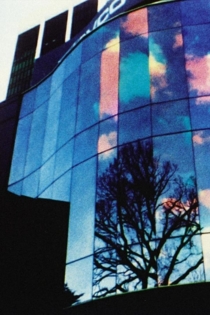
Arthur and Corinne Cantrill are two of Australia's most prominent experimental filmmakers. The Cantrills are well known for their 'colour separation' films. To create these works they shoot a scene three separate times on black and white film stock, using a different colour filter each time. In the lab, they combine these three films onto a single Eastmancolour print. This process creates dramatic transitions in colour that the Cantrills liken to the vibrancy of Technicolor. Though the footage here was shot in the mid-’80s, it was only last year that they edited it into this fifteen-minute movie. Structurally it’s simple enough: just a series of views of various parts of inner Melbourne, from panoramic wide shots to close-ups of the sides of buildings. The soundtrack blends and warps familiar urban noises – cars, buskers, the ringing bells of trams – into a kind of musique concréte.
The City of Chromatic Dissolution

Two Women
Arthur Cantrill, Corinne Cantrill
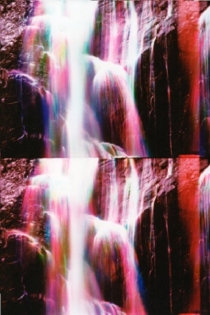
TWO WOMEN records our passage through the tribal lands of the Central Australian region – a personal charting of this mythical landscape. The film is shaped by an unedited recording made of a Pitjantjatjara women’s song cycle: "Two Women", which describes the travels of ancestral women through this region. The film is not a literal interpretation of the song story, and there is no translation of the song. We are outsiders to this culture, and must therefore learn what we can from the ‚surface’ of the song cycle – from the voices singing, talking, whispering, coughing, laughing, reprimanding children.
Two Women
The Room of Chromatic Mystery
Arthur Cantrill, Corinne Cantrill
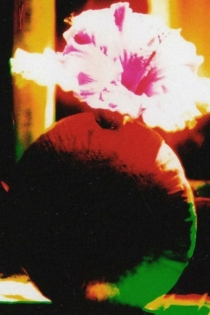
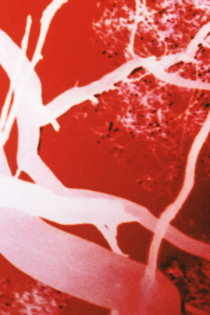
'The Room of Chromatic Mystery' is (...) another three-colour separation film, shot in the living room of the Cantrills’ old house in Brunswick. An ordinary domestic scene, with flowers and carved artifacts on a table by the window; but the borderlines of these objects quiver, and everything is bathed in a spectral or perhaps extraterrestrial glow. The mysterious soundtrack blends voices from earlier films – including the whispering of the singers in 'Two Women' – with discussions in a foreign language on a shortwave radio, drowned in static like the hiss of time escaping. An image of a place. An echo of a voice. (Jake Wilson)
The Room of Chromatic Mystery