
Lucélia Santos
1957 (68 лет)
O Sonho de Rose - 10 Anos Depois
Tetê Moraes
Lucélia Santos
Documentary depicting what happened to the characters in the film Terra para Rose, made by the same director. Shows the life of some 1500 families of landless rural laborers who, for the first time in 1985, occupied an unproductive large landholding, the Annoni plantation in Rio Grande do Sul. After camping out for years in tents, facing down the police and negotiating with the government, the former landless laborers have managed to turn their dream into reality, and are now successful small farmers.
O Sonho de Rose - 10 Anos Depois


Terra Para Rose
Tetê Moraes
Bolívar Anoni, Dante de Oliveira
Documentary about the oppression of a group of a families of the MST, the Brazilian Landless Workers Movement, who invaded Anoni Farm, a farm in the state of Rio Grande do Sul, Brazil, in 1985, and Rose, a woman fighting for the right of owning a land and for elementary human rights, and mother of the first baby born in the camping site.
Terra Para Rose



Casa Grande
Fellipe Barbosa
Thales Cavalcanti, Marcello Novaes
As a privileged teenager living in an affluent suburb of Rio de Janeiro, Jean has little to worry about beyond games, grades and girls. But as his overbearing father drags the family into debt, Jean is forced into a change of lifestyle which opens his eyes to the world beyond his 'casa grande' - not least that of the feisty, mixed-race firecracker Luiza. Cultures, classes and generations collide in this engrossing coming-of-age drama from Brazil.
Casa Grande


O Sonho Não Acabou
Sérgio Rezende
Miguel Falabella, Lucélia Santos
The routine of a group of brazilian teenagers living in Brasília, Brazil's capital. Their aspirations, dreams and illusions presented in a context of a country that was on the final years of a dictatorship back in the 1980s.
The Dream's Not Over

Mulher Oceano
Djin Sganzerla
Gustavo Falcão, Djin Sganzerla
After relocating to Tokyo, a Brazilian writer begins a new novel, provoked by her experiences in Japan and by one of the last scenes she witnessed in Rio de Janeiro: a female swimmer tearing up the horizon with powerful strokes in the wide, open sea. Those two women apparently share no connection, until their lives start to interfere in one another, strangely linked through the sea. Hannah, the writer, plunges into a journey of self-discovery in Japan, while Ana, the swimmer in Rio de Janeiro, oddly has her body transformed into some kind of inner Ocean.
Mulher Oceano

Vagas para Moças de Fino Trato
Paulo Thiago
Norma Bengell, Lucélia Santos
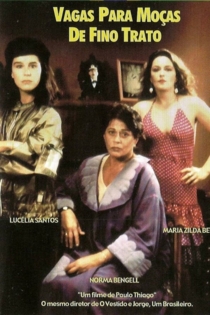
In Vitória, the middle-age piano teacher Gertrudes sublets her apartment to two younger women, the unstable Lúcia and the nurse Madalena. Gertrudes misses and daydreams her former love and has a motherhood relationship with Lúcia; Madalena has a promiscuous life, having one night stand with the most different men every day and her behavior is criticized by Gertreudes; and Lúcia is dreamer that manipulates Gertrudes and expects that the handyman Alfredo becomes her prince charming. Their conflictive relationship ends when Madalena discloses their inner feelings and secrets to each other.
Vagas para Moças de Fino Trato
Baixo Gávea
Haroldo Marinho Barbosa
Lucélia Santos, Louise Cardoso
Clara directs the rehearsals of a theatrical play about Fernando Pessoa while constantly seeking the right man and the love of his life. One of the actresses is the lesbian Ana, who interprets the poet Mário de Sá Carneiro. She is Clara's friend and confidant with whom she shares an apartment. Clara does not perceive Ana's love for her, that always helps her to recover from the disappointments. Unlike the character Sá Carneiro, poet of decadentism, nostalgia, metaphysics and vague, Ana is the pragmatic side of Clara, who often brings a disillusioned vision as if it were Fernando Pessoa himself, who may be associated with concepts of the poet's heteronyms.
Baixo Gávea

Bonitinha, Mas Ordinária
Braz Chediak
Lucélia Santos, José Wilker
The youngest daughter of a rich man has been raped by five black men in the slums of Rio de Janeiro, and her father arranges her marriage to one of his employees in order to save the family’s honor.
Bonitinha mas Ordinária ou Otto Lara Rezende

Já Não Se Faz Amor Como Antigamente
John Herbert, Adriano Stuart
Anselmo Duarte, John Herbert
Film in three segments. In the first, father is suspicious about his son's masculinity. The second one shows a Don Juan-like guy who, at church for his own wedding, cannot remember who the bride might be. In the third, a rich husband tries to find the tattooed man he saw escaping through his wife's bedroom window.
Já Não Se Faz Amor Como Antigamente