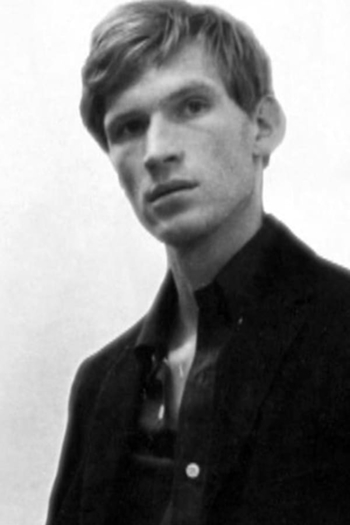
Bas Jan Ader
1942 - 1975Ader was lost at sea in 1975, attempting to cross the Atlantic Ocean from the American coast to England sailing in a thirteen-foot sailboat. His deserted vessel was found off the coast of Ireland on 18 April 1976, offering few clues as to his fate.
From Wikipedia, the free encyclopedia
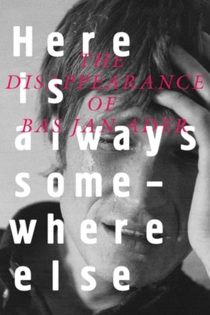
Here Is Always Somewhere Else
René Daalder
Bas Jan Ader, Tacita Dean
The life and work of enigmatic Dutch/Californian conceptual artist Bas Jan Ader, who in 1975 disappeared under mysterious circumstances at sea in the smallest boat ever to cross the Atlantic. As seen through the eyes of fellow emigrant filmmaker René Daalder, the picture becomes a sweeping overview of contemporary art films as well as an epic saga of the transformative powers of the ocean.
Here Is Always Somewhere Else
I'm Too Sad to Tell You
Bas Jan Ader
Bas Jan Ader
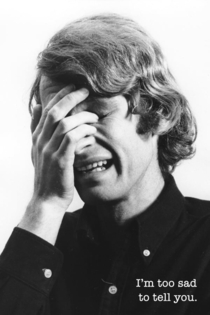
This short film is part of a mixed media artwork of the same name, which also included postcards of Ader crying, sent to friends of his, with the title of the work as a caption. The film was initially ten minutes long, and included Ader rubbing his eyes to produce the tears, but was cut down to three and a half minutes. This shorter version captures Ader at his most anguished. His face is framed closely. There is no introduction or conclusion, no reason given and no relief from the anguish that is presented.
I'm Too Sad to Tell You
Nightfall
Bas Jan Ader
Bas Jan Ader
Shot in his garage-studio, the camera records Ader painstakingly hoisting a large brick over his shoulder. His figure is harshly lit by two tangles of light bulbs. He drops the brick, crushing one strand of lights. He again lifts the brick, allowing tension to accrue. The climax inevitable—the brick falls and crushes the second set of lights. Here the film abruptly ends, all illumination extinguished.
Nightfall

Untitled (Tea Party)
Bas Jan Ader
Bas Jan Ader
Untitled (Tea Party) is a short silent film. The camera slowly zooms into a sunlit clearing in a forest where Ader, formally dressed, is crawling towards a large box, propped up by a stick, under which he takes his afternoon tea—in the English style.
Untitled (Tea Party)
Fall I / Fall II
Bas Jan Ader
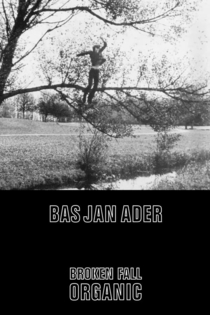
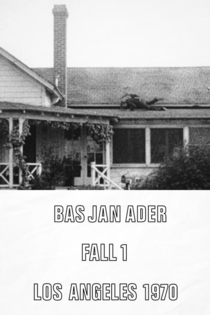
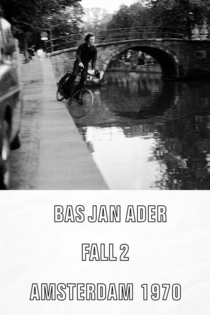
In Fall II we see a canal in Amsterdam. Bas Jan Ader cycles into the frame, seemingly losing control over his handlebar and driving straight into the water. In Fall I Ader is sitting on a chair on his roof in Claremont, Los Angeles, before falling down the roof in slow motion. In both works, Ader loses control and the power of gravity takes over. The absurdity of the 16mm films questions, like most conceptual art, the connection between art and life. Ader performs pointless tasks, that are set up for failure. Surrendering to the elements is a recurrent theme in Ader’s oeuvre and seems to be completed by his disappearance in 1975, when he tried to sail the Atlantic in the smallest sailboat ever and was never found back.
Fall I / Fall II
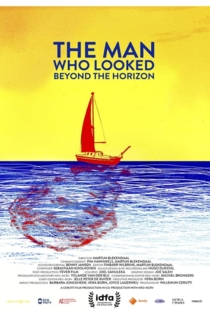
The Man Who Looked Beyond the Horizon
Martijn Blekendaal
Bas Jan Ader
More than 40 years ago, Bas Jan Ader decided to go on an adventure. In a tiny sailing boat, the Dutchman set sail across the ocean. Nine months later the boat was found adrift at sea. There was no sign of Ader. It’s a story that has always fascinated filmmaker Martijn Blekendaal, not just because of the disappearance itself, but also because of the entire mystery that surrounds it. Blekendaal embarks on an investigation that follows his footsteps to Hollywood. It turns out that, in order to understand what drove this man to his fateful voyage, the filmmaker has to overcome his fear of looking beyond his own horizon. In a whirlwind montage of images jumping from one time, place and person to another, Blekendaal shows us that Bas Jan left behind something more special than just a mystery.
The Man Who Looked Beyond the Horizon