Mako Idemitsu
2021


What a Woman Made
Mako Idemitsu
In Idemitsu's seminal women's liberationist video, the image of a tampon swirling in a toilet bowl slowly appears, as the artist speaks about the troubling roles, responsibilities and expectations of women in a clinical tone. Minimal in composition, What a Woman Made is a candid critique of the treatment of women in Japanese society.
What a Woman Made

Kae, Act Like A Girl
Mako Idemitsu
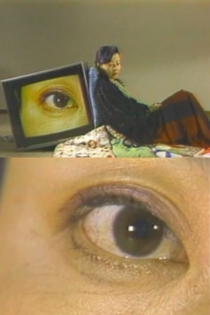
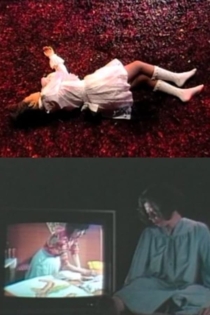
In Kae, Act Like A Girl, Idemitsu continues her experimental narrative exploration of women's roles in contemporary Japan with a tale of women's liberationist awakening. Here she presents a young female artist's conflict with the traditional, patriarchal expectations of women in Japanese culture, in which men are privileged and women are groomed to be wives and mothers. Within Idemitsu's narrative, video screens and images represent the protagonist's inner struggle — memories, conscience, familial pressure — as she subordinates and then ultimately achieves her personal and artistic desires.
Kae, Act Like A Girl
英雄ちゃん、ママよ
Mako Idemitsu
Atsumi Sakashita, Hiroshi Kawabe
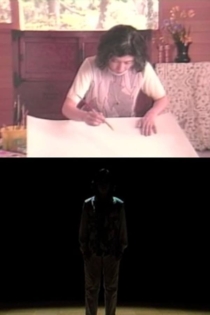
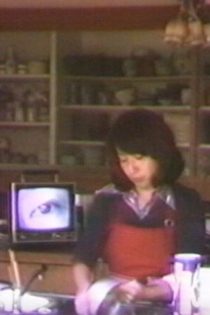
HIDEO, It's Me, Mama is a psychological melodrama that introduces narrative and structural devices that are integral to Idemitsu's work. Exploring the flawed universe of the contemporary Japanese family, she focuses on a woman's identity as mother through mother-child and husband-wife relationships. Hideo, a young man living away from his parents, is kept under constant surveillance by his doting mother via an omnipresent television monitor. In a cogent metaphor for familial relations in the media-saturated culture of contemporary Japan, Mama can only communicate with her beloved, absent son through the video screen. Idemitsu's poignant irony is embodied in the scene in which Mama, blind to her husband's needs, caresses Hideo's video image. (Electronic Arts Intermix)
Hideo, It's Me, Mama
Kiyoko's Situation
Mako Idemitsu
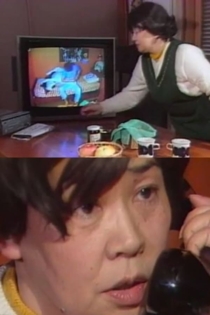
Kiyoko's Situation articulates the deeply embedded cultural roles of Japanese women through the parallel stories of two female artists, Kiyoko and Tani. In Idemitsu's narrative-within-a-narrative, "Kiyoko's situation" is played out on a television monitor within Tani's drama. Tani is paralyzed in her attempts to paint by her feeling that, as a single woman, she has failed in society's eyes. Kiyoko, a young mother viciously criticized by her husband and family for her fierce determination to paint, eventually compromises her art for "maternal duty." As Kiyoko complies with the family, Tani, isolated and despairing, is driven to suicide. Idemitsu's chillingly omniscient television monitor, which acts as the psychological "other," metaphorically and literally condemns Tani to death. In the final cruel irony, she hangs herself, using the television monitor as a jumping-off point.
Kiyoko's Situation

Inner Man
Mako Idemitsu
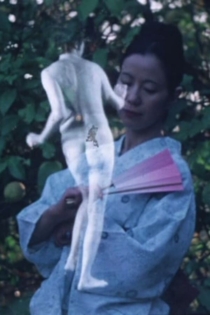
This film shows the images of a dancing woman who is wearing Kimono overlapping another image which a naked man is dancing. This is one of the original psychological concepts of C.G. Jung. For women, Animus is an image of a man by projection of her mental energy.
Inner Man

Onna no sakuhin
Mako Idemitsu
Taking place during the women’s liberation movement, Idemitsu filmed the Womanhouse which became her first 16mm film work. Judy Chicago and Miriam Schapiro jointly organized the Feminist Art Program at the California Institute of the Arts (Cal Arts) in 1971. The Cal Arts Feminist Art Program group performed for the audience at Womanhouse in 1972. They transformed an old run-down mansion in Los Angeles into Womanhouse. In the kitchen a progression of sculptured breasts gradually turned into fried eggs; one bathroom contained a mass of Tampax, and if you opened the linen closet you found a trapped mannequin.
Woman's House

Great Mother (YUMIKO)
Mako Idemitsu
The second part of a trilogy, Great Mother (YUMIKO) is a domestic melodrama that examines the cultural and familial role of Japanese women by tracing the psychology of a turbulent mother-daughter relationship. Yumiko, a rebellious young woman from an affluent family, encounters resistance from her mother, a successful career woman, when she becomes pregnant and marries. The mother is an icy, assured presence, seen only on a television screen as a superego who monitors Yumiko's behavior. The television becomes a powerful metaphorical device, underlining the disunity of the familial structure and acting as a psychological presence. As Yumiko's marriage deteriorates, her pain is juxtaposed with the banal rituals of her mother's life (instructing her subordinates at work, scrubbing the floor at home), an irony ultimately heightened by the viewer's awareness of the reflexivity of this drama-within-a-drama.
Great Mother (YUMIKO)
Yoji, What's Wrong With You?
Mako Idemitsu
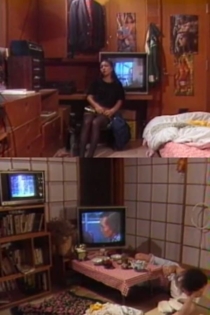
The psychosexual drama Yoji, What's Wrong With You? examines the identity of women as mothers in Japanese culture, through an Oedipal narrative of a skewed "family romance." When Yoji announces to his mother that he wants her to meet a new girlfriend, the mother's jealousy destroys the relationship. Idemitsu's signature device of using a television monitor within the domestic space works as a powerful metaphor for the ubiquity of the mother in Yoji's psychological life. Idemitsu's melodramas always articulate a double-edged irony: With no identity outside of her maternal role, Yoji's mother fastens onto her son, ultimately destroying him. Yoji himself is seen as emotionally stunted, unable to leave his mother or experience love for any other woman.
Yoji, What's Wrong With You?