Maria Klonaris
1950 - 2014
The Amazonian Angel
Katerina Thomadaki, Maria Klonaris
Lena Vandrey
This filmic portrait is born of a double movement: the meeting of Lena Vandrey with our cinematographic universe, our meeting with her pictorial world, her space and her collection of processional figures and articulated dolls. Crossings of imaginations, of mythologies: the South, the origins, the search for a "greecity", the search for the magical potential of the image, the feminine one as "force in love". Crossings of plastic gestures: one on canvas support, the other on photographic and filmic support. We invited the artist to become herself body-painting, filmed painting. We have staged her texts, her paintings, her objects, her space. Attempt to reveal it as an embodiment of its own mythology.
The Amazonian Angel

Unheimlich III: Les Mères
Katerina Thomadaki, Maria Klonaris
Maria Klonaris, Katerina Thomadaki
After five years of intense work on identity, an alchemical quest for the depths, after nine films and films / actions where the actresses' gestures resounded against a black background which eliminated the environment to reveal the inside, taken outside: encounter of the inside with the outside. Journey back into memory. Crossing the Greek landscape in August. The seas. The ruins, remains of abandoned houses, homes with holes, pierced by the wind, inside crossed by the outside. Unheimlich: the disturbing strangeness. Activation of a memory of origins. Unheimlich: what should remain secret, hidden and which manifests itself. MHTRIS = mother's country.
Unheimlich III: The Mothers
Selva. Un portrait de Parvaneh Navaï
Maria Klonaris
Parvaneh Navaï
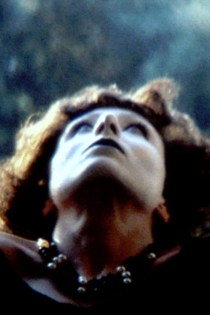
Trance dances and out of body projection. In front of the camera, Parvaneh Navaï becomes a mediator who enters in contact with and immerses into the energies of Nature, while her own energy radiates and echos in the forest ("selva"). The camera amplifies and expands her presence, transforming the forest into an imaginary space. The camera becomes a painter's brush.
Selva. A Portrait of Parvaneh Navaï

Double Labyrinthe
Katerina Thomadaki, Maria Klonaris
Maria Klonaris, Katerina Thomadaki
With this film-manifesto, the two artists invent what they called the Cinéma corporel (Cinema of the Body), they present themselves as a "double auteur femme" and they lay the foundations of the radical critical and esthetical positions of their work to come. Double Labyrinthe has a mirror structure based on their "mutual gaze": in the first part Katerina performs while filmed by Maria and in the second part Maria performs filmed by Katerina.
Double Labyrinthe
Unheimlich I: Secret Dialogue
Katerina Thomadaki, Maria Klonaris
Elia Akrivou, Maria Klonaris
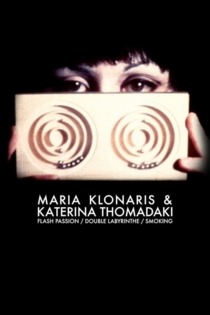
The film takes the Freudian concept of the uncanny generated by an inexplicable strangeness to expose the reappearance of the repressed feminine unconscious through splitting, doubling and mirroring the cinematic image to question the boundaries of the real. The late Maria Klonaris, who sadly passed away in the begining of 2014, with co-author Katerina Thomadaki, was responsible for some of the most radical womens' liberationist and transgender films and art ever created. Of Greek origin but based in Paris, Klonaris and Thomadaki were founders of the Cinema of the Body, a profound investigative practice into gender and bodily identity.
Unheimlich I: Secret Dialogue
Unheimlich II: Astarti
Katerina Thomadaki, Maria Klonaris
Maria Klonaris, Parvaneh Navaï
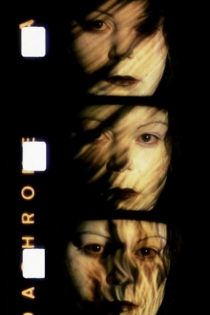
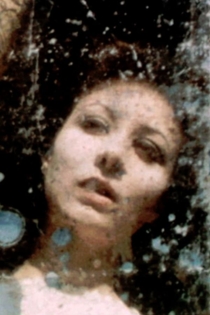
Astarti, the Greek name for Ishtar, is an archetype of a deep, nocturnal feminine that emerges from subterranean darkness. We experience an embodied cinematic experience realised through a sensuous aesthetic as we are invited to enter a strange and uncertain world of inner depths and hypnotising effects. There, we encounter three women actantes, embodied by the artists, who play mythic and magical female figures such as Medusa and Salome. They metamorphose, dance and enter trances where the body vibrates into transformation. Figures reveal themselves out of silence which is both the moment of creation and an eternal reality. The film itself actualises that which is inactual and gives form to blackness through a poetics of intimacy and an ethics of interpersonal relationships, which is founded in the artists’ own double authorship.
Unheimlich II: Astarti
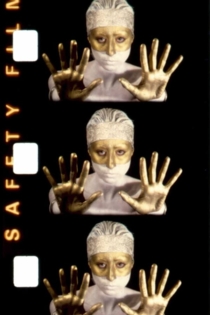
Arteria magna in dolore laterali
Katerina Thomadaki, Maria Klonaris
After the semantic body (Double Labyrinth) and the libidinal body (L'enfant qui a pissé des paillettes, Soma) we are dealing here with another theme: that of the painful body or, more precisely, the memory of the body in relation to pain lived.
Arteria magna in dolore laterali
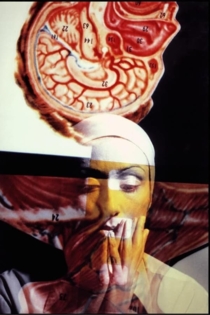

Orlando - Hermaphrodite II
Katerina Thomadaki, Maria Klonaris
An echoing, nocturnal, elliptical text. Female voices speak it. Fragments of music punctuate and suspend the images. The text says the transformation of the hero into a woman during his sleep. Games of inverted masks, transvestites, transparency of the frontiers of the sexes. Self-representations. Black and white visions clouded with magenta and cyan. Fields, positives, negatives, degrees of grey, light textures. A device made up of screens and projectors, still images and moving images, the projection surface multiplied. Water, bare trees, light trails, a gun, tigers.
Orlando - Hermaphrodite II
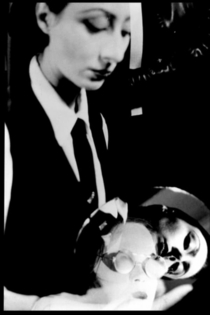
Angel Scan
Katerina Thomadaki, Maria Klonaris
Maria Klonaris
Angel Scan. "Trip" – but without substances – except the substances created by the brain when energy awakes as a creative conscience, accompanied by an intense experience of "light" and "darkness". Hustle and bustle, bombing of atoms, dance of electric particles animated of an ultra fast movement.Invisible units of infra-atomic energy, forms/colours which are characterized by their irradiating heat and by their attraction strength as well as their potential of sound/ vibratory energy.
Angel Scan
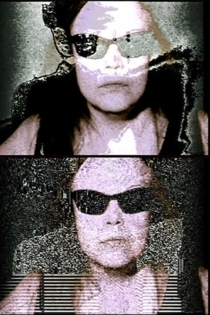
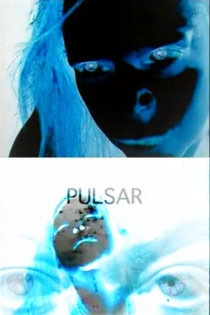
Pulsar
Katerina Thomadaki, Maria Klonaris
Maria Klonaris
"Pulsar" belongs to "The Angel Cycle" ("Le Cycle de l´Ange"). In this cycle of works we create bonds between the human body and astronomical bodies. Maria Klonaris´ improvised performance is a negative dance which lies between pleasure and catastrophe, a black and blue body language which grapples with the white of the screen and the luminous suddenness of a firework display.
Pulsar