Patrice Kirchhofer
2021Chromaticité I
Patrice Kirchhofer
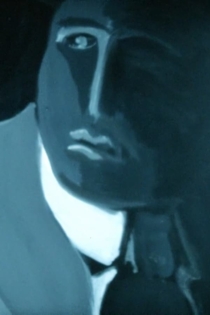
I saw people flee in fright before the force of Chromaticité I, during which I remained fastened to my seat, in the clutches of fear. The last image, the screen turns white: I glance at my neighbour, immobilised just as myself. (Bernard Weidmann, Rhizome Hérétique, 1980)
Chromaticité I
Sensitométrie III
Patrice Kirchhofer
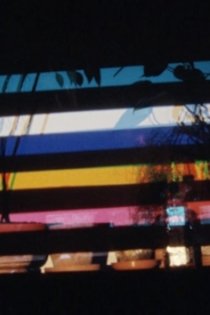
Large visual elaborations of Kirchhofer means most simple devices and childish in cinema archeology, Thaumatrope the Praxinoscope, all optical toys. This fundamental investigation of the batch becomes particularly clear in Sensitométrie III (Sensitometry III), where work on the range is very pure because it is accentuated by the open opposition between positive and negative. But the difference is that, where other devices seeking forms of regularity and stability to swallow motionless in the mobile, film Kirchhofer rather explore all possible rhythms, so to enhance the irregularity, difference, discontinuous. The parade always comes up against the still image, continuity serves monumentalize Meanwhile, the optical illusion is stripped and the beauties of the irregular explode. Nicole Brenez - Portrait Arte - May 2006
Sensitométrie III
Sensitométrie II
Patrice Kirchhofer
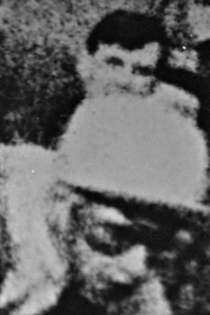
First film made outside of pure animation, with all that it is possible to put and omit in a first film essay, which contains authoritatively - and without knowing it at the beginning - images made by others long before and not the least, with trifles that make a whole.
Sensitométrie II
Densité Optique I
Patrice Kirchhofer
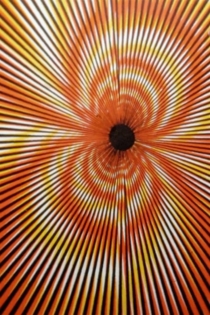
Densité Optique I (Optical Density I) mark a chromatic decomposition of the image. The choice to show a scrolling film movie as an extreme slow motion, frame by frame voluntarily directs the gaze on the work of the image. This aesthetic can remember those photographs retouched by painting. However, this type of image is obtained by a chemical decomposition of the film emulsion. Indeed, it is composed of three colored layers deposited on a transparent plastic substrate. Light passing through these layers is tinged with the colors and optical density, recreates the images and colors of the frames. Certain mixtures of chemistries acids attack these layers in the decolorizer, diluting in different aspects.
Densité Optique I
Anorexie IV
Patrice Kirchhofer
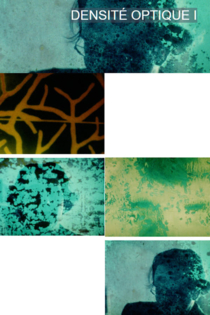
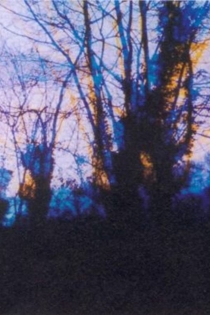
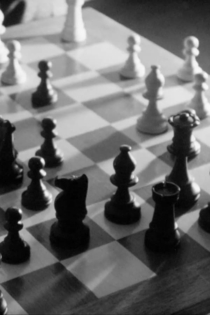
“Breaking in. Patrice Kirchhofer’s Anorexie 4 continues on the path of the narrated narrative (a short story by Chandler) and Décembre 79 on the path of photography. At the end of these two journeys, the film becomes the subject and the trace of the same act of breaking in. In Anorexie 4 the voice shapes the images (the play of chess and of light) and in Décembre 79, shot in the same abandoned mining region, the photos shape the film: chemical deposits, fossils instantaneously striped and imprinted by signs of life and haunted by their ghostly presence. A space of dreary grey, of desolation, which is in a never-ending process of dying because the place, even before being filmed, already went through a vampire-like depletion. In accepting the invitation of these tracking shots of abandoned factories, the spectator is summoned to riverbanks similar to those of Dreyer’s Vampyr and Murnau’s Nosferatu.” Charles TESSON. Festival de Digne. Cahiers du Cinéma n° 314 – Juillet–Août 1980.
Anorexie IV
Resultante I
Patrice Kirchhofer
An experiment transposing a painting by the artist Jacqueline Bosson into film. A particularly delicate exercise which consists of preserving the quality of both the colors and the range of blacks and whites, of directing the gaze to a single part of an ensemble predefined by one of the many factors involved in “making visible”, without turning away from the the fact that one’s attention is liberated from the noises and distractions of the gallery, of the museum, of the world… — different and similar from those the screening room — an inevitability of light.
Resultante I