
Emily Richardson
2021Aspect
Emily Richardson
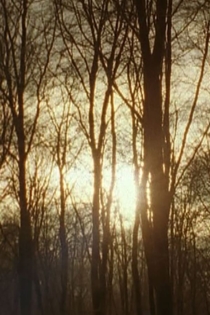
Across the surface of the forest, light, colour, shadow shift; rhythmic, kaleidoscopic. Matter and the immaterial in constant counteraction. The screen becomes a painting in animation. Ordinarily, light describes the motif. Here, the forest is almost – almost – occluded as the light that delineates the world becomes autonomous, visible; describes itself as subject. There are some very strange effects: light and shadow grow, die back; bark shimmers; branches tremble, or clouds pass above; trees shiver in the cold, or shake in threatening gesture; sunlight flickers, on and off, like an electric bulb. The portrait lives. These films are not the index of space and objects, but a cinema of time, movement, light; flickering lashes of mesmerised eyes in the click of an aperture.
Aspect
Petrolia
Emily Richardson
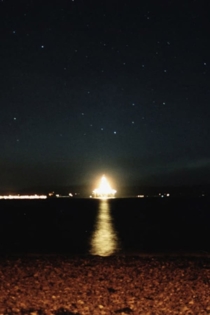
Petrolia takes its name from a redundant oil drilling platform sat in the Cromarty Firth, Scotland. The film looks at the architecture of the oil industry along the Scottish coastline where oil and gas supplies are predicted to run dry in the next forty years. Shooting on 16mm film, using time lapse and long exposure techniques, the film presents a record of industrial phenomena, – the toxic beauty of the refinery at Grangemouth, huge drilling platforms gliding across the water as they come in for maintenance and repair at Nigg and the last dance of the shipbuilding cranes in Glasgow harbour.—http://emilyrichardson.org.uk/
Petrolia
Cobra Mist
Emily Richardson
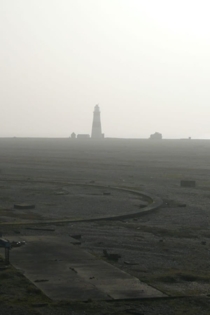
Construed in the time of running clouds, a panoramic and another examination of vacant buildings on the British shore (Orford Ness), a deserted place on Earth, place of non-specificity as a base for an open course of events that shape the sense, consisting in interaction between the image and the viewer.
Cobra Mist
Redshift
Emily Richardson
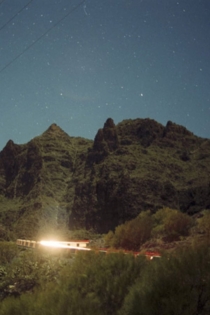
Belying their apparent stillness, Emily Richardson’s time lapse studies make for compelling and surprisingly eventful viewing: in the case of Redshift (named appropriately, after Hubbles law regarding the different wavelengths of light from stars), the activity is on a galactic scale: the wheeling of the heavens over a ragged line of coast. Her other piece, Nocturne, offers compelling evidence of her gifts as a filmmaker: her extraordinary compositional sense, her precise editing, and her uncanny intimation of the menace and beauty of cities at night. Based in London she is undoubtedly a major talent. — Shane Danielsen; 57th Edinburgh International Film Festival 2003, Black Box Activity.
Redshift
The Futurist
Emily Richardson
The Futurist is a condensed experience of film viewing, a single 360 degree animated shot in an empty 1920’s cinema where the sound becomes a cacophony of past projections and the aural experience is closer to that of the projectionist than the audience.
The Futurist
Nocturne
Emily Richardson
Composed of a series of twilight images of empty streets, Nocturne is a mesmerising and tonally expressive work that similarly recalls the seminal tone poem Koyaanisquatsi, with the rigourous symmetry and urban desolation of Chantal Akerman’s News From Home. — New York Video Festival 2003 Notes.
Nocturne
Spender House
Emily Richardson
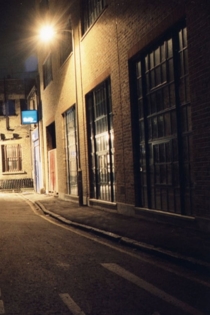
The Spender House in Essex was designed in 1968 by Richard and Su Rogers (Team 4) for photographer and artist Humphrey Spender. It was a prototype and precursor to the iconic house, Parkside, designed for Rogers’ parents the following year, making it the first example of hi-tech domestic architecture in the UK.
Spender House
Block
Emily Richardson
Day through night Block is a portrait of a 1960’s London tower block, its interior and exterior spaces explored and revealed, patterns of activity building a rhythm and viewing experience not dissimilar from the daily observations of the security guard sat watching the flickering screens with their fixed viewpoints and missing pieces of action.—http://emilyrichardson.org.uk
Block