Raymonde Carasco
1939 - 2009Life Lesson
Boris Lehman
Loup Abramovici, Blanche Irène Albera
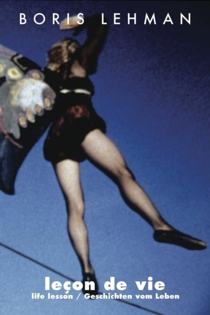
To attain knowledge, man and woman had to be willing to give up their innocence," says Boris Lehman. Life Lesson is a poetic and philosophic reflection on the theme of paradise lost. Some fifty persons illustrate the planet's convulsions and the world's vacillations. Trying to communicate, to commune with the invisible, they cry out, sing out, give out messages, each in their own way, in their own state of solitude. These are like multiple echoes that resemble waves in the water or stars in the sky. " Behind these images and sounds that have been stifled by today's society, Lehman hunts for noises, cries, songs, messages that go astray. He says that if we look at the invisible we may hear the words. He invites us to look beyond the appearances of social life and to vibrate in tune with life's polyphony that is all around us."
Life Lesson
Artaud et les Tarahumaras
Raymonde Carasco
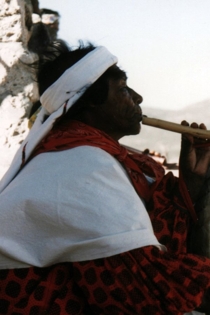
This film is a confrontation between the texts Antonin Artaud wrote about the Tarahumaras and the films Raymonde Carasco made with the Tarahumaras (from 1977 to 1994) on the track of Antonin Artaud, in Norogachic, the only place explicitly mentioned by Antonin Artaud.
Artaud and the Tarahumaras
Un film (autoportrait)
Marcel Hanoun
Raymond Jourdan, Alain Robbe-Grillet
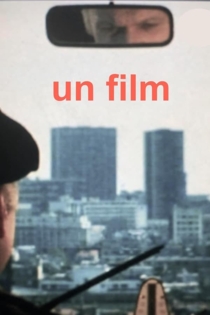
The shooting diary of a film shot in France and in the United States. Using photos of Paris and of New York City, excerpts of his former films, statements by friends of his and shooting sequences of the film itself, tormented filmmaker Marcel Hanoun has made a heterogeneous and unclassifiable film about the difficulty of filming.
Un film (autoportrait)
Cinématon
Gérard Courant
Gérard Courant, Alain-Alcide Sudre
Cinématon is a 156-hour long experimental film by French director Gérard Courant. It was the longest film ever released until 2011. Composed over 36 years from 1978 until 2006, it consists of a series of over 2,821 silent vignettes (cinématons), each 3 minutes and 25 seconds long, of various celebrities, artists, journalists and friends of the director, each doing whatever they want for the allotted time. Subjects of the film include directors Barbet Schroeder, Nagisa Oshima, Volker Schlöndorff, Ken Loach, Benjamin Cuq, Youssef Chahine, Wim Wenders, Joseph Losey, Jean-Luc Godard, Samuel Fuller and Terry Gilliam, chess grandmaster Joël Lautier, and actors Roberto Benigni, Stéphane Audran, Julie Delpy and Lesley Chatterley. Gilliam is featured eating a 100-franc note, while Fuller smokes a cigar. Courant's favourite subject was a 7-month-old baby. The film was screened in its then-entirety in Avignon in November 2009 and was screened in Redondo Beach, CA on April 9, 2010.
Cinématon

Tutuguri: Tarahumaras 79
Raymonde Carasco
This film was shot in summer 1979. The repeated ritual of Tutuguri that Tranquilino the saweame sang and danced six times in a short, strictly accurate duration. Secret words from which only emerge vowels, dance that builds a sacred space between the four cardinal points of a cross, a black and pagan sign. A native solar rite, prior to the Spanish conquest. The assembly here builds in a single plane the two poles of real time and an expanded space-time, from dual material: Tutuguri and Carreras.
Tutuguri: Tarahumaras 79
Ciguri – Tarahumaras 98 - La Danse Du Peyotl
Raymonde Carasco
Raymonde Carasco, Jean Rouch
A documentary cycle involving the Rarámuri or Tarahumara people of Northern Mexico. This film addresses rites of winter as well as peyote and bakaka rites. Its commentary, read by Raymonde Carasco and Jean Rouch, is drawn from texts by Antonin Artaud.
Ciguri – Tarahumaras 98 - La Danse Du Peyotl
Tarahumaras 2003, La fêlure du temps - La Despedida
Raymonde Carasco
Fifth chapter of La fêlure du temps. "Yes, the dead, I see him very well. He tells me of the necessity to do that ritual. We have to end this, that he may be clean, limpiado, that he must finish all that needs to be finished."
Tarahumaras 2003, La fêlure du temps - La Despedida
Los Pintos - Tarahumaras 82
Raymonde Carasco
To mark the celebrations of Holy Week, the Tarahumara Indians of Mexico invented (or found) dance-rites in which men paint the face and body. Passion processions depict two kinds of "fariseos" (Pharisees): some dressed in white and crudely daubed with chalk; others, almost naked--feather helmets wearers--fully marked with large white spots. Children, teenagers, young men; all the men of the tribe are organized into a strip under the lead of an older flag carrying dancer. They occupy the site of the village for three days and three nights witn uninterrupted, obstinate drums. Commemoration or preparation for what fight? For the strange figure of Governador leather mask seems to revive the tradition of the leader of nomadic warriors. On Easter morning, the public festivities end abruptly with the appearance of two Pascoleros in body paint, the dual perform a subtle dance: they will be the signal for the up-to-death of Judas.
Los Pintos - Tarahumaras 82
Tarahumaras 2003, La fêlure du temps - Initiation - Gloria
Raymonde Carasco
Third chapter of La fêlure du temps. "It's enough that Gloria tells you the first time: if you want to work that way, do it. The sueño is not taught: you yourself are going to think how to work the sueño"
Tarahumaras 2003, La fêlure du temps - Initiation - Gloria
Divisadero 77 (Gradiva - Western)
Raymonde Carasco
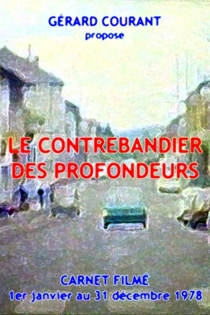
By combining a journey to the locations for Eisenstein’s unfinished opus Que Viva Mexico! with images of an Indian girl walking, Carasco has created a cinematic topos across multiple historical eras. We see figures walking, marching, in motion, as we set out on the trail of a film, and of the Tarahumara – those who run fast.
Divisadero 77 (Gradiva - Western)