Ericka Beckman
2021
Hiatus
Ericka Beckman
Madi Distefano, Daniel Ruth
“HIATUS is a 20-minute experimental narrative film about a young woman who plays HIATUS, an on-line interactive ‘identity’ game. Propelled through action by her Go-Go cowgirl construct Wanda, and powered by a computer corset that stores her programs in a garden interface, Maid meets Wang, a powerful take-over artist. She must learn how to use the power of her ‘organic memory’ to block his expansion and preserve her freedom.” — E.B. 1999
Hiatus
Blind Country
Ericka Beckman
Mike Kelley, Bob Gibson
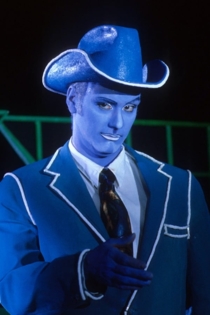
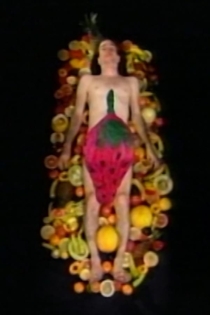
This collaborative video project is based on a short story by H.G. Wells called "The Country of the Blind"—about a man who travels to a country of blind people and attempts to dominate their sensual, feminine culture with his male, sight-derived power. Following this theme, "Blind Country" begins with animated fruit dancing over Mike Kelley's body and the admonition of "Northerners" to "refill the quickly emptying sack." In the male-dominated land of the North, candy-spurting pinatas stand as phallic symbols. Presumably castrated, and stripped of his authority, Kelley acts the buffoon as he is led through the murky land of the South, a "female," earthy, "realm of the senses" opposing the phallocentric world of the North.
Blind Country
Switch Center
Ericka Beckman
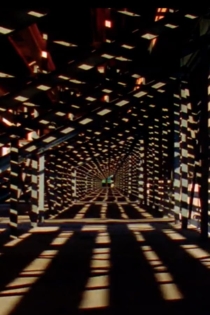
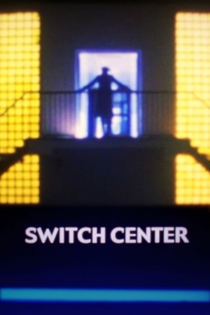
Says Beckmann of her film: "SWITCH CENTER is a tribute to the futuristic architecture of the Soviet postwar period, and a reaction to seeing it transitioned to shopping malls or global corporate office structures. I was invited by Balazs Bela Studio in Budapest to produce a short experimental film in Hungary. I was the first American artist to be invited by this famous film collective after the fall of Soviet power". She would also describe the film as an homage to Fernand Léger's Ballet Mécanique.
Switch Center
The Red Tapes
Vito Acconci
Vito Acconci, Ericka Beckman
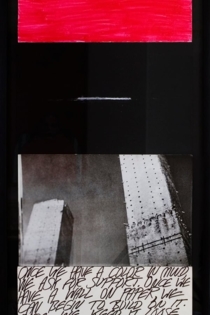
A three-part video epic in which avant-garde artist Vito Acconci explores the relationship between the self and national mythology. Through multiple vignettes, Acconci brings together a collage of music, photographs, diorama, experimental theater and his own profile, to tell a semi-autobiographical narrative that, in turn, becomes a critique of the alienated quality of American mythology.
The Red Tapes
Reach Capacity
Ericka Beckman
Ani Block, Adam H. Marchand
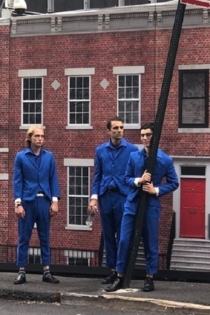
Almost forty years after its first appearance in You The Better, the house returns as a character in Beckman’s new work Reach Capacity, now symbolising real estate. The economic and political elements and the structure of the film are closely associated with the most famous of all board games dealing with real estate, Monopoly. Its origins go back to the early 1900s, when Elizabeth Magie created a first version of what she called The Landlord’s Game. Magie’s game had two sets of rules, a Prosperity set and a Monopolist set (only the latter was kept by Parker Brothers when they further developed the game without her). Magie’s aim was to illustrate how society as a whole thrives when monopolies are banished and income is distributed equally. Beckman takes over Magie’s dual game structure by having her screen flip over when a monopoly is reached.
Reach Capacity
The Broken Rule
Ericka Beckman
Mike Kelley, Matt Mullican
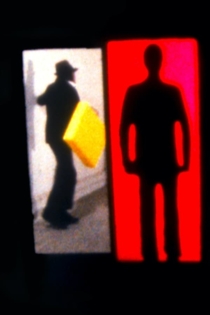
“THE BROKEN RULE is my reaction to the American education system, where learning blocks must be acquired by the group before any individual can progress to the next level. My film pictures learning blocks as relay races conducted by male players, where the girls are scores, and the goal is to enter the working world by the end of the game. Mike Kelley, the lead player in my film, makes a ritual out of his mistakes to escape the consequences of his mistakes. In this film, one person’s work is another person’s play, and play creates competition, a component of work.” — E.B. 1979
The Broken Rule
We Imitate; We Break Up
Ericka Beckman
“Mario was a construction; the girl tried to imitate it. But she knew there was more that she could do. Mario limited her. In my imagination I saw a competitive relationship that could only go so far. In making this film I combined the ‘real’ with the ‘constructed’, proving for myself that these two aesthetics could not fuse together; they had to remain apart working in tandem as a relationship, thus their meaning now included competition and cooperation.” E.B.1978
We Imitate; We Break Up
Cinderella
Ericka Beckman
Gigi Kalweit, Mike Kelley
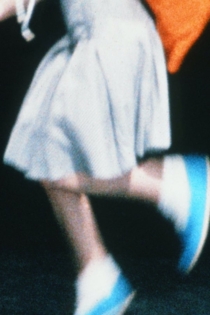
“CINDERELLA is a musical treatment of the fairy tale. I have broken apart the story and set it as a mechanical game with a series of repetitions where CINDERELLA is projected back and forth like a ping-pong ball between the hearth and the castle. She never succeeds in satisfying the requirements of the ‘Cinderella Game’. The film was shot MOS, the dialogue is lip-synched, and along with the out-front score and effects track magnifies the film’s sense of alienation.” — E.B. 1984
Cinderella
Out of Hand
Ericka Beckman
“OUT OF HAND is a search film, where a small boy returns to a house that is being evacuated, to search for something that he left behind. His method is to follow hidden clues in this house and to respond to the hidden aids in his memory. Back and forth, between inquisition and logic, he constructs a search with two unknowns – ‘What it is’ and ‘Where it is’. Each object he chooses has multiple functions, which extend both into the physical space of his search, and into the imaginary world of his perception and memory.” E.B. 1980
Out of Hand
You the Better
Ericka Beckman
Ashley Bickerton
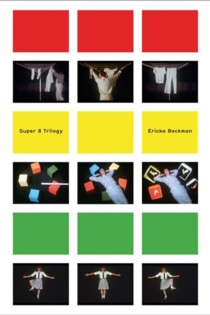
“YOU THE BETTER is a film based on games of chance, and as games such as roulette, or craps go, this one is closed – meaning that the player cannot really affect the outcome. A team of uniformed players, led by the artist Ashley Bickerton, performs the mechanics of a game servicing an off-camera betting entity, the ‘House’. Although the game keeps changing and players are swapped out, one thing remains the same, the ‘House’ is hidden and controls the bets, the ‘chance’ of winning is nil. The game, in fact, is not between the players, but rather between the ‘House’, and the ‘Bettor’.” — E.B. 1983
You the Better
Tension Building
Ericka Beckman
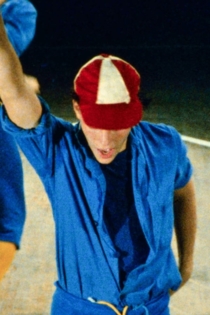
"Tension Building is a composite of linked architectural spaces, some are real and some are models. It combines stop motion and live action filmmaking shot at the Harvard University Coliseum in Boston (1935) and the Municipal Stadium in Florence (1932), built in by Luigi Nervi. It features Boston Symphony Orchestra percussionist Richard Flanagan, and the U Mass Minute Man Marching Band. I used my camera like a surveyor’s transit and created some rules for its path around the stadium." - Ericka Beckman
Tension Building