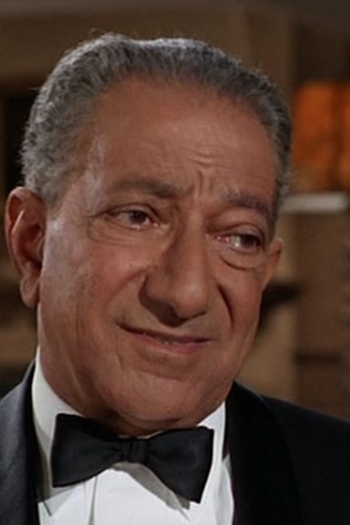
Abraham Sofaer
1896 - 1988Abraham Sofaer (October 1, 1896 – January 21, 1988) was a stage actor of Burmese-Jewish descent who became a familiar supporting player on film and television in his later years. He was born in Rangoon, Burma (now Yangon, Myanmar). Sofaer's strong features and resonant voice complemented the many exotic character parts he played. He began his acting career on the London stage in 1921, but soon was alternating between London and Broadway. By the 1930s, he was appearing in both British and American films. Among his more prominent performances were the dual role of the Judge and Surgeon in Powell and Pressburger's A Matter of Life and Death (1946) and St. Paul in Quo Vadis (1951). He also appeared on television from its earliest days in the late 1930s and on radio. Although his film appearances diminished after the 1950s, he continued to have guest roles on dozens of major U.S. television series throughout the 1960s, including Star Trek ("Charlie X"), The Twilight Zone ("The Mighty Casey"), Lost in Space ("The Flaming Planet") and The Outer Limits ("Demon with a Glass Hand"), until retiring in the mid 1970s. He may be best-remembered for his recurring role as Hadji, the master of all genies, on I Dream of Jeannie. Sofaer married Psyche Angela Christian, with whom he had two sons and four daughters. He died in Woodland Hills, Los Angeles, California, as the result of congestive heart failure in 1988. The noted jurist of the same name is the son of one of the actor's cousins.
Description above from the Wikipedia article Abraham Sofaer, licensed under CC-BY-SA, full list of contributors on Wikipedia.




A Matter of Life and Death
Emeric Pressburger, Michael Powell
David Niven, Kim Hunter
When a young RAF pilot miraculously survives bailing out of his aeroplane without a parachute, he falls in love with an American radio operator. But the officials in the other world realise their mistake and dispatch an angel to collect him.
A Matter of Life and Death

Dreyfus
Milton Rosmer, F. W. Kraemer
Cedric Hardwicke, Charles Carson
In 1894, French officer Alfred Dreyfus is wrongly convicted for the treasonous acts of another man, Major Esterhazy. When investigations begin into the dubious evidence used in the trial, an institutional coverup begins, aided by fears of army disgrace and anti-Semitic paranoia against Dreyfus. But a determined group, headed by prominent author Émile Zola, leads a mounting public call to reopen the Dreyfus case.
Dreyfus


Rembrandt
Alexander Korda
Charles Laughton, Gertrude Lawrence
This character study joins the painter at the height of his fame in 1642, when his adored wife suddenly dies and his work takes a dark, sardonic turn that offends his patrons. By 1656, he is bankrupt but consoles himself with the company of pretty maid Hendrickje, whom he's unable to marry. Their relationship brings ostracism but also some measure of happiness. The final scenes find him in his last year, 1669, physically enfeebled but his spirit undimmed.
Rembrandt
Pandora and the Flying Dutchman
Albert Lewin
James Mason, Ava Gardner
Pandora Reynolds is a woman who has never fallen in love – but one who men kill and die for. When she meets dashing and mysterious ship's captain Hendrik van der Zee, he pushes her to commit the ultimate act of love.
Pandora and the Flying Dutchman





The Greatest Story Ever Told
George Stevens
Max von Sydow, Michael Anderson Jr.
From his birth in Bethlehem to his death and eventual resurrection, the life of Jesus Christ is given the all-star treatment in this epic retelling. Major aspects of Christ's life are touched upon, including the execution of all the newborn males in Egypt by King Herod; Christ's baptism by John the Baptist; and the betrayal by Judas after the Last Supper that eventually leads to Christ's crucifixion and miraculous return.
The Greatest Story Ever Told

Twice-Told Tales
Sidney Salkow
Vincent Price, Sebastian Cabot
3 horror stories based on the writings of Nathaniel Hawthorne. In the 1st story titled "Dr. Heidegger's Experiment", Heidegger attempts to restore the youth of three elderly friends. In "Rappaccini's Daughter", a demented father is innoculating his daughter with poison so she may never leave her garden of poisonous plants. In the final story "The House of the Seven Gables", The Pyncheon family suffers from a hundred year old curse and while in the midst of arguing over inheritance, a stranger arrives.
Twice-Told Tales