Louis Hock
2021Light Traps
Louis Hock
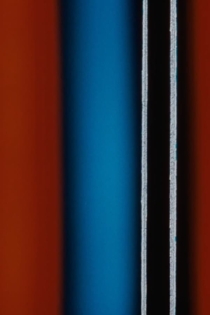
In the 1970s, Californian artist Louis Hock created a number of studies in the effects of pure colour. The late 1960s saw the rise of the ‘colour field’ vogue which arose in abstract painting in reaction to the emphasis on individual expressive gestures in Abstract Expressionism. ‘Colour field’ artists like Mark Rothko and Barnett Newman sought to empty the image plane out into broad, flat areas of colour. With its humming bars of pure hues, Light Traps is like a moving ‘colour field’ painting – a ‘colour field’ film.
Light Traps
There? Where?
Babette Mangolte
Babette Mangolte, Louis Hock
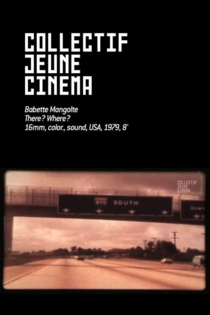
A naive look at Southern California by an outsider, and/or an essay on displacement through the disjunction of Californian images and off screen voices. Where is the location of these voices, here or there? Are the images near or far in relation to the voices? Are the images commenting on the images or vice versa?
There? Where?
Pacific Time
Louis Hock
Allan Kaprow, David Antin
At first viewing PACIFIC TIME appears to be a departure from the more abstract and more purely visual delights of Hock's preceding efforts. Considerably longer, it employs actors, dialogue and 'plot.' Upon closer examination, however, it proves to be of a kind with his earlier output - only more ambitious and perhaps, more mature. Again, distortion of time conventions is at the forefront of Hock's array of stylistic devices. But, rather than the 'magic,' highly assured time-lapse photography of STUDIES IN CHRONOVISION or MISSISSIPPI ROLLS, here Hock employs radical slow-motion sound and brilliantly inventive written subtitles. [Source: Douglas Edwards 'FIlm Commentary: Louis Hock', Gosh!, 1978]
Pacific Time
Studies In Chronovision
Louis Hock
Film sketches constructed over the past five years investigating temporal composition via single frame-time lapse techniques: light struck metronomes, 20th century dust from a Mayan dream, horology complete with coordinates, Kodak vs. Timex.
Studies In Chronovision

Southern California
Louis Hock
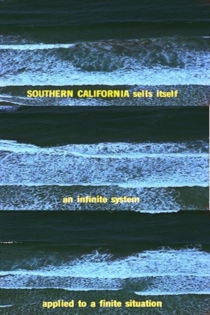
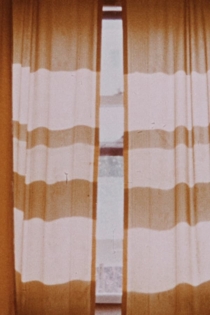
A single thread of 16mm film runs through three side-by-side projectors, all aimed at the same wall. Twenty-two and a half second elapse between the time when the first and the second screen images appear and the same amount of time passes between the appearance of the same silent image in the second and third, so that every image can be expected to occur twice in each 45-second cycle. (Jonathan Rosenbaum)
Southern California