Mike Leggett
2021Tender Kisses
Mike Leggett
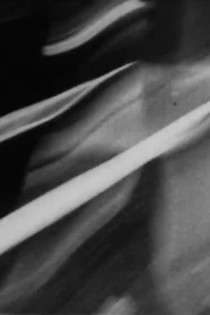
The film starts with an extreme close-up of television static. Through a series of carefully controlled processes, the abstract nature of the image (which is concerned with pattern, colour and time), is juxtapositioned with the formal images of domestic room interiors and exteriors. With this work, Leggett questions the legibility of the image, examining the illusion produced by the two great illusionists – television and cinema – and the extent to which these can be manipulated and do manipulate.
Tender Kisses
Shepherd’s Bush
Mike Leggett
Shepherd’s Bush was a revelation. It was both true film notion and demonstrated an ingenious association with the film-process. It is the procedure and conclusion of a piece of film logic using a brilliantly simple device; the manipulation of the light source in the Film Co-op printer such that a series of transformations are effected on a loop of film material. From the start Mike Leggett adopts a relational perspective according to which it is neither the elements or the emergent whole but the relations between the elements (transformations) that become primary through the use of logical procedure.
Shepherd’s Bush
The Sheepman and the Sheared
Raban Leggett, Mike Leggett
An experimental film in seven parts for continuous projection. With the excepti on of parts 1 and 2, each film can be hired individually. Individual parts as f ollows: Part 1: Sheep (3 mins st.) Part 2: Sheepman (10 mins st.) Part 3: Window (45 mins) Part 4: Lane (18 mins st.) Part 5: Farm (25 mins) Part 6: Blue plus greed plus red (15 mins) Part 7: Sheepwoman (16 mins sd. commag.)
The Sheepman and the Sheared

Sheepwoman
Mike Leggett
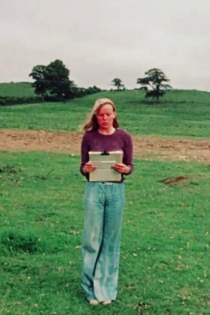
Sheepwoman is the final part in Sheepman & The Sheared, a seven-part film made within the workshop and theoretical context of the London Film-Makers’ Co-operative, and more particularly of structural/material film. In the series, Leggett delicately negotiates a dialectic between the creation of images and stripping the images of their illusionism. The film takes Landscape as Object in front of the filmmaker and the medium of film; specific conditions to do with both Nature and human activity with Nature are recorded with the camera, but the camera itself is also subject to the observation and reaction of the filmmaker. In Sheepwoman, the camera image – of a woman reading a text on shearing – is the subject, which is examined in conjunction with synchronous/non-synchronous sound and written word image.
Sheepwoman
Friday Fried
Mike Leggett
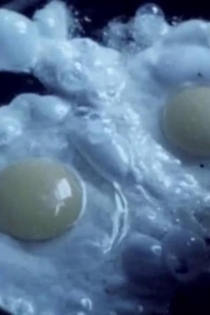
Friday Fried mixes sound images in a strictly procedural manner based upon a relationship with the picture track which itself is structured around a sequence of 16 slide images. Four voices narrate a series of descriptions which refer to the visual detail in the picture whilst also cross-narrating with one another. During the construction of the soundtrack 12 different sources were combined without alteration to balance, tone etc. throughout the film’s 15 minute duration.
Friday Fried
The Heart Cycle
Mike Leggett
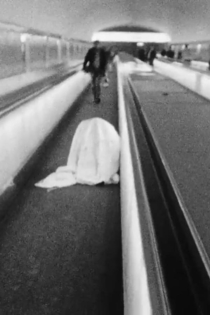
Work on The Heart Cycle commenced as a series of experiments with a roll of 16mm ‘found footage’ film and a newly acquired CCTV system (sited at the college of art in which I worked). A film projector and several studio cameras connected through a simple vision mixer to monitors and a video tape deck, recorded a series of procedures and adjustments made to the system during experiments and ‘rehearsals’. The new media of analogue video delivered motion pictures that displayed in ‘real time’, the state of a system in synthesis. These peaked as a final performance, the extent unedited, 'single-take' recording of The Heart Cycle.
The Heart Cycle