Barbara Meter
1939 (87 лет)De minder gelukkige terugkeer van Joszef Katus naar het land van Rembrandt
Wim Verstappen
Rudolf Lucieer, Roelof Kiers
The dutchified Hungarian Joszef Katús returns, after a months-long absence, to Amsterdam on 29 April 1966. The arrival of the Provos changed a great deal in the Dutch capital. The film follows Katús, mostly roaming the streets, in a loose documentary style. The events are set against the backdrop of four national occasions - The Queen's Birthday, Labour Day, Liberation Day and Remembrance Day.
De minder gelukkige terugkeer van Joszef Katus naar het land van Rembrandt
Aanraking
Barbara Meter
A wordless experimental collage of impressions and moods. Grainy fragments of landscapes, flakes whirl in the wind. Fog and mist, shadows of people in the city and by the water… Silhouettes that fade and turn into pure light and shadow until we discern the specks and scratches on the film strip itself. Sometimes, for a fraction of a second, a face, a person. A film as a memory that eludes us.
A Touch
Convalescing
Barbara Meter
“Convalescing, when you don't have to participate in the world. Time to read, to dream, to look - the blue, the light of the television, the blue, the book, the patterns the light, the blue. Time to appreciate how much that really is.”
Convalescing
Bis an den Himmel und noch viel mehr
Barbara Meter
In her recent film Up to the Sky and Much Much More, Meter uses letters sent to her by her father during World War II to provide the film's narration, while interviews with her mother expand on his opposition to fascism — as well as to constraints of any kind, including the bonds of family — and his eventual conscription to the Eastern front. Remarkably, her father's epistolary accounts of his daily life as a soldier also include fantastical watercolour illustrations of his travels, which Meter incorporates to movingly amplify the emotional resonance of a father-daughter bond made fraught by distance and war.
Up to the Sky and Much Much More
Ariadne
Barbara Meter
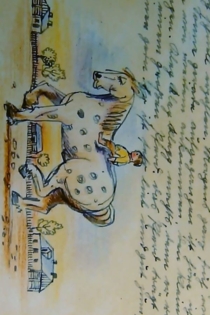
The constant movement of the wheels, threads, sprockets, feet and hands suggests restlessness, and this is paralleled by the soundtrack. The unknown woman could be Gretchen from Faust, hopelessly in love or Ariadne who gave Theseus the thread to find his way out of labyrinth or perhaps she is one of the fates, weaving destiny… Enlarged from Super-8 to 35mm, the film is very grainy, in itself an homage to the medium of film which is also emphasized by the depiction of all kinds of turning machines, both in image and sound.
Ariadne
...And a Table
Barbara Meter
Barbara Meter, Mattijn Seip
A man and a woman sit in front of a window and eat breakfast. Through the window, we see the countryside. During the day, they remain seated at the table. The settings, light, and depth of field change: slowly we learn the vocabulary of the medium. In the final shots, the camera is reflected in the windows, and we see lights being cleared away. The film itself, and not the man and woman at the table, has become the subject of the film.
...And a Table
From the Exterior
Barbara Meter
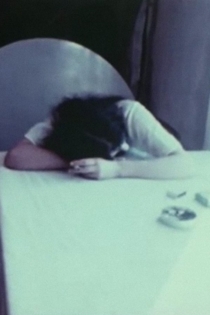
Barbara Meter's first experimental film. From outside, the handheld camera surreptitiously peers at life in the living rooms of nocturnal Amsterdam. Shots of lamp shades, plants, chairs, faces and pets. A poodle stares out of the window.
From the Exterior
Whether or not you believe
Barbara Meter
They can be seen in the whole of Greece: the small and humble buildings along the roadside dedicated to a saint. Often a burning candle illuminates the colourful interior. Most of them are erected to the memory of a beloved, killed in a car accident, others because someone has been miraculously saved. They are the evidence of a daily devotion and are called 'proskynitaria' or 'ikonismata'. The older ones many have been built becuase somebody had a significant dream on the spot, or to indicate the place of a former church or perhaps to protect the entrance of a house against ill luck. Each 'proskynitari' has its own story. This documentary tells us some of these stories and shows an importnat aspect of how the Greek people deal with death and what role religion plays in everyday life.
Whether or not you believe
Greece, to me
Barbara Meter
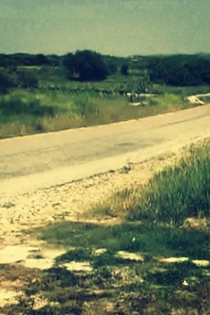
Often the images are held for awhile and then left to themselves - only to fade out just as they begin to move. For me this enhances the feeling of memory - and the sensation that when you leave a place you know that everything is still there, without you. And so the film is both elongated and fragmented.
Greece, to me