John Baldessari
2021
Ed Henderson Suggests Sound Tracks for Photographs
John Baldessari
Ed Henderson
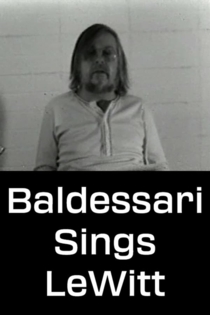
Baldessari has commented that he is "less interested in the form art takes than the meaning an image evokes." In Ed Henderson Suggests Sound Tracks for Photographs, he explores the relation between what is heard and what is seen, appropriating deliberately cliched imagery and generic film music to construct a series of surreal mini-movies. Baldessari describes photographs from National Geographic magazine to Ed Henderson, who picks out pieces of mood-setting stock music and sound effects to pair with the images. Baldessari subtly influences Henderson's selections, steering him towards music that he deems more appropriate. This strange collaboration results in an uncanny, often comic conjunction of sound and image. Removing the photographs and music from their original contexts, Baldessari deconstructs mass cultural narrative, suggesting how the associative meanings and evocations of its cliches and genres have permeated the collective unconscious.
Ed Henderson Suggests Sound Tracks for Photographs
Teaching a Plant the Alphabet
John Baldessari
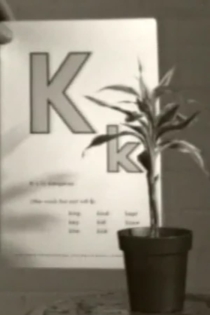
“[A] rather perverse exercise in futility,” this tape documents Baldessari’s response to Joseph Beuys’s influential performance, How to Explain Pictures to a Dead Hare. Baldessari’s approach here is characteristically subtle and ironic, involving ordinary objects and a seemingly banal task. The philosophical underpinnings of Baldessari’s exercise are structuralist theories about the opaque and artificial nature of language as a system of signs. Using a common houseplant to represent nature and instructional flashcards to represent the alphabet, Baldessari ironically illustrates this theorem. That language is the structuring element of the tape—the length of the tape was determined by the number of letters in the alphabet—enforces the connection between language and art, a recurrent theme in Baldessari’s work.
Teaching a Plant the Alphabet
Four Short Films
John Baldessari
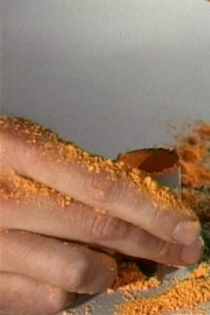
Contemporaneous to his best-known video works, these Super-8mm films represent Baldessari's conceptual engagement with motion picture film, pointing to the technical strengths and weaknesses of the celluloid medium relative to video, such as the superior reproduction of color, on one hand, and the difficulty of adding synchronized sound on the other. Conceived on an intimate scale (only the artist's hands are visible as he manipulates a range of objects), Baldessari's Super-8 films replace text and speech with a cunning visual language, in which he wordlessly describes physical changes in his environment: a bright light flashes on a mirrored surface, red liquid rises in a thermometer, and powdered pigment makes an indelible mess. Here Baldessari employs a method of communication that is based on spectacle rather than performance.
Four Short Films
Walking Forward-Running Past
John Baldessari
In Walking Forward-Running Past, Baldessari ingeniously employs photography and video to examine and ultimately deconstruct film. In this conceptual exercise, he tapes up photographic film stills of himself walking toward the camera—coming closer with each successive image—and then photos of himself running past it. The sequentiality of this action results in a crude montage, an ultimately futile attempt to recreate the phenomenological experience of cinematic movement. Gasping with exertion, Baldessari quickly and repeatedly replaces photo after photo. In his efforts to evoke the cinematic experience, a layered metonymic relationship develops between the static, photographic image of Baldessari running and his "real" movements on video.
Walking Forward-Running Past
Title
John Baldessari
Baldessari progresses from simple, static images, such as a rock in an empty room, to complex narrative scenes, like a woman eavesdropping on her next-door neighbor. Through the gradual integration of cinematic techniques—motion, color, sound, acting, editing and arc—the artist inverts the traditional Hollywood model, stressing structure over narrative coherence.
Title
I Will Not Make Any More Boring Art
John Baldessari
In 1971, Baldessari was commissioned by the Nova Scotia College of Art and Design in Canada to create an original, on-site work. Unable to make the journey himself, he suggested that the students voluntarily write the phrase "I will not make any more boring art" on the gallery walls. Inspired by the work's completion — the students covered the walls with the phrase — Baldessari committed his own version of the piece to videotape. Like an errant schoolboy, he dutifully writes, "I will not make any more boring art" over and over again in a notebook for the duration of the tape. In an ironic disjunction of form and content, Baldessari's methodical, repetitive exercise deliberately contradicts the point of the lesson — to refrain from creating "boring" art.
I Will Not Make Any More Boring Art
The Meaning of Various News Photos to Ed Henderson
John Baldessari
Baldessari introduces eight news photos to Ed Henderson — ranging in subject matter from geese at the zoo to an accidental electrocution — and asks him to identify them. Henderson's associative responses suggest the projection of unconscious desires and fears onto these arbitrary images, which are removed from their original contexts. The implied narratives that emerge from the seemingly random juxtapositions and sequences of photographs give rise to questions of manipulation, inference and meaning.
The Meaning of Various News Photos to Ed Henderson
I Am Making Art
John Baldessari
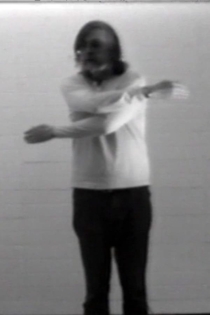
In an ironic reference to body art, process art and performance, Baldessari challenges definitions of the content and execution of art-making. Performing with deadpan precision, he moves his hands, arms and entire body in studied, minute motions, intoning the phrase "I am making art" with each gesture. Each articulation of the phrase is given a different emphasis and nuance, as if art were being created from moment to moment. This index of body movements is ironically offset by the repetitive monotony of the exercise.
I Am Making Art