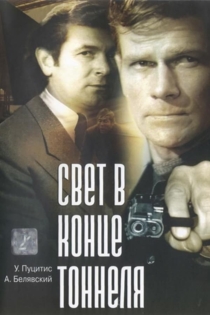
Uldis Pūcītis
1937 - 2000Uldis Pūcītis was born in Ranka parish, Gulbene District to Jānis Pūcītis and his wife Anna Pūcīte. After graduating from school in Ranka he continued his studies in Riga and studied at the Latvian State Conservatory, graduating in 1959. Following his graduation, he worked as schoolteacher in the town of Aizpute for four years while engaged at the Liepāja Theater from 1960 to 1972, the Dailes Theater from 1964 to 1973 and the Youth Theatre from 1962 to 1964 and again from 1973 until 1992.
Pūcītis made his film debut in a small role as a fisherman in the 1959 Ada Neretniece-directed Latvian language Soviet film Svešiniece ciemā (English release title: Stranger in the Village) before his first starring role opposite Latvian actress Vija Artmane in the Leonīds Leimanis-directed period-drama Purva bridējs, a film adaptation of the novel of the same name by Latvian writer Rūdolfs Blaumanis. He would go on to appear in a number of film and television roles throughout the 1960s and into the 1990s, as well as continuing his stage career.
In 1998, Pūcītis would write the script and co-direct the television mini-series Izpostītā ligzda for Latvijas Televīzija (LTV) with Armands Zvirbulis. The film and both Zvirbulis and Pūcītis would be awarded the Lielais Kristaps; the highest prize awarded for Latvian cinema.
Pūcītis was married to Olīvija Pūcīte (née Poselanova). Their daughter is actress Milēna Gulbe-Kavace, and grandson is professional tennis player Ernests Gulbis. In late 2000, Pūcītis fell ill at his summer home in Jūrmala. After being taken to the hospital in Riga, he was initially diagnosed with a stomach ulcer. However, he died in hospital of a pulmonary embolism and was buried at the Riga Forest Cemetery.

Elpojiet dziļi
Rolands Kalniņš
Uldis Pūcītis, Līga Liepiņa
Cezars Kalnins, portrayed by "Latvian Harrison Ford” Uldis Pucitis, installs telephones by day and composes pop songs by night. The puritan Soviet censorship deems Cezars’s lyrics "unsuitable and frivolous” and "unfit for the Soviet youth”. In fact, it can be argued that this assessment matches the opinion of the Soviet cinema authorities in regard to this film as a whole, since "Four White Shirts” was immediately banned and released in cinemas only in 1986. The creative boldness and stubbornness, evident in both Cezars’s bitingly ironic verses and the film’s unconventional narrative structure and fresh, new-wave-inspired mode of expression, turned out to be equally problematic for the hero and for the film itself, as well as for its director whose representation of the actual mechanisms of Soviet censorship ended up too realistic for his own good.
Four White Shirts

The Swamp Treader
Leonīds Leimanis
Vija Artmane, Uldis Pūcītis
In this film, set in Latvia in the late 19th century, Edgars, the coachman of Alaine Manor, loves Kristine, the washerwoman's daughter, although he is too hot-headed for Kristine's mother to consider him a good suitor for his daughter. The servant Viskrelis and stable boy Sutka try to tempt Edgars to a life of drinking and a relationship with the barmaid Matilde. Meanwhile, Kristine is courted by the rich land owner, Akmentins.
The Swamp Wader


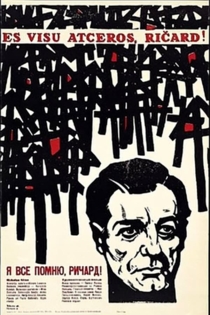
I Remember Everything, Richard
Rolands Kalniņš
Eduards Pavuls, Antra Liedskalniņa
During World War II three best friends are mobilized into the Waffen-SS Latvian Legion. Years later their fates continue to intertwine, as memories of war loom in back of their minds.
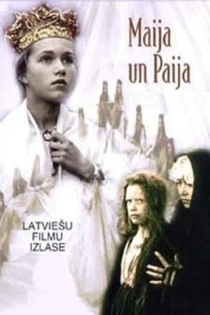
Akmens un šķembas

Atspulgs ūdenī
Andris Rozenbergs
Uldis Pūcītis, Lāsma Kugrēna
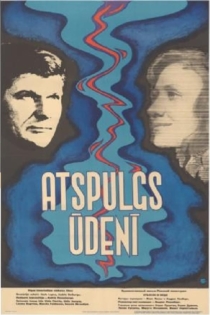
Based on a story by Janis Lapsa, written by Janis Lapsa and Andris Kolbergs, film is a singular work, filled with human warmth. It is a story about a talented surgeon Markalns, who after a serious personal crisis, returns to his native town in order to start his life anew. The attention is concentrated on the inner world of Markalns, his feelings in this so important period of his life, when to endure and to proceed means to regain the lost sense of life and himself. His character and emotional world opens in a wide scale: in collisions with colleagues, patients, friends, himself. He is contradictory, but even in moments of low spirits, virile. A real warmth and balance of mind is brought in the life of the outwardly robust and clumsy surgeon by a shy small-town girl Irita, called Doggie.
Reflection in the Water
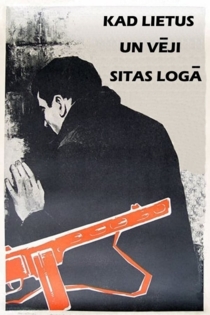
Kad lietus un vēji sitas logā
Aloiz Brench
Harijs Liepiņš, Eduards Pavuls
The Second World War has just ended, but national partisans are still hiding in Latvia's forests and fighting against the Soviet regime. Ansis Leinasars, who has been tasked to spark a coup in Latvia, arrives by night from across the sea, but his work is hampered at every step. His last hope is a meeting with the partisans in a church...
When Rain and Wind Hit Against Your Window
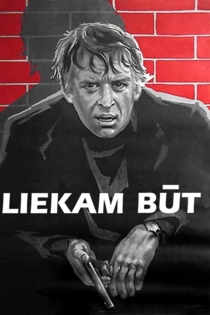
Liekam būt
Aloiz Brench
Vytautas Tomkus, Valdemārs Zandbergs
Voldis Viters is released after seven years in prison. He is 46 years old and has no family or job. Some of his old friends have abandoned the life of crime, and policeman Leo Aleksandrs, as well as the beautiful taxi driver Irēna, try to persuade Voldis to forget the past and move on. But when the crime boss Teksis proposes a plan to rob a jewelry store, Voldis agrees, thinking this will be his last crime before starting a new life. Marking the pinnacle of its director's filmography, To Be Unwanted is a psychological drama that centers not on a single crime or its investigation but on the emotional collapse of the criminal as he realizes that his amoral lifestyle has rendered him redundant within society.
To Be Unwanted
Dead Mountaineer's Hotel
Grigori Kromanov
Uldis Pūcītis, Jüri Järvet
The police get a call-out to a lonely hotel in the Alps. When an officer gets to the hotel everything seems to be alright. Suddenly, an avalanche cuts them off from the rest of the world and strange things start happening.
Dead Mountaineer's Hotel

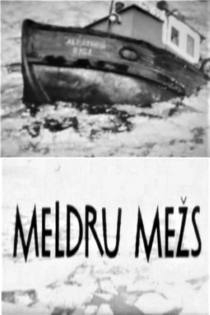
Meldru mežs
Ēriks Lācis
Ēvalds Valters, Artūrs Kalējs
Небольшое колхозное рыбацкое судно «Альбатрос» в условиях зимней непогоды получило несколько пробоин и затонуло вблизи побережья. Из четырёх человек команды спасся только рыбак Степс, отважившийся прыгнуть в ледяную воду. В результате возникшего недоразумения товарищи подозревают его в малодушии. Ситуация усугубляется тем, что он и сам считает себя виновным. После ухода жены Степс уезжает в Ригу, перебиваясь случайным заработком. Некоторое время спустя водолазы повторно осмотрели место аварии. Найденные тела погибших рыбаков позволили снять со Степса обвинение в якобы совершённом им неблаговидном проступке.
Meldru mežs
Отряд особого назначения
Vadim Lysenko
Leonhard Merzin, Pavel Remezov
Intelligence-diversionary group of athletes who know how to shoot snipers, run, jump, feel free in the water and under water, to withstand the monstrous load of hand-to-hand fights, will be able to reach the goal only going together, passing the task as a relay. Seven of them. Among them is a girl swimmer. It will be the most difficult, the last stage of the journey. The plot is based on the real facts of the great Patriotic war.
Special forces unit

«Тобаго» меняет курс
Aleksandrs Leimanis
Gunārs Cilinskis, Inessa Skrube
Лето, 1940 год. Предчувствуя крах режима Ульманиса, владелец корабля, отплывшего от берегов Латвии, решает бежать из страны. Впоследствии матросы узнают об установлении на родине Советской власти, - и корабль поменяет курс...
«Тобаго» меняет курс