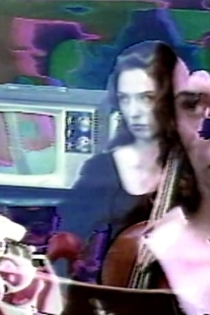
Charlotte Moorman
1933 - 1991Bye Bye Kipling
Nam June Paik
Dick Cavett, Ryuichi Sakamoto
This ambitious live satellite link-up of Japan, Korea and the United States features interviews with Keith Haring and architect Arata Isozaki, and performances and works by Philip Glass and the Kodo Drummers, Charlotte Moorman, Nam June Paik, and Lou Reed. In an extraordinary section, a performance in Japan of classical Western music is accompanied by a group of Kabuki dancers.
Bye Bye Kipling

Global Groove
John Godfrey, Nam June Paik
John Cage, Russell Connor
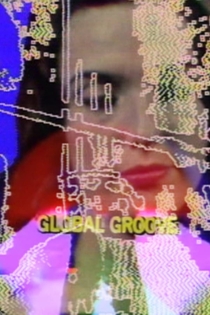
Global Groove was a collaborative piece by Nam June Paik and John Godfrey. Paik, amongst other artists who shared the same vision in the 1960s, saw the potential in the television beyond it being a one-sided medium to present programs and commercials. Instead, he saw it more as a place to facilitate a free flow of information exchange. He wanted to strip away the limitations from copyright system and network restrictions and bring in a new TV culture where information could be accessed inexpensively and conveniently. The full length of the piece ran 28 minutes and was first broadcasted in January 30, 1974 on WNET.
Global Groove
Guadalcanal Requiem
Nam June Paik
Charlotte Moorman
One of Paik’s most overtly political and poignant statements, Guadalcanal Requiem is a performance/documentary collage that confronts history, time, cultural memory and mythology on the site of one of World War II’s most devastating battles.
Guadalcanal Requiem
Suite 212
Nam June Paik
Russell Connor, Charlotte Moorman
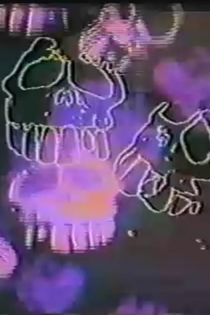
Suite 212 is Paik's "personal New York sketchbook," an electronic collage that presents multiple perspectives of New York's media landscape as a fragmented tour of the city. Paik critiques the selling of New York by multinational corporations and the city's role as the master of the media and information industries; Collaborators Yalkut, Davis and Kubota contribute their own vibrant and punchy segments.
Suite 212
"Topless Cellist" Charlotte Moorman
Howard Weinberg, Nam June Paik
Charlie Morrow, Yōko Ono
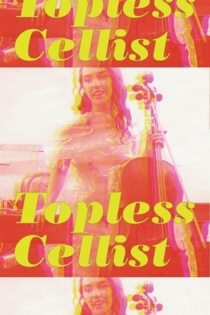
Nam June Paik's first single-channel videotape since 1989 is a heartfelt tribute to his long-time collaborator Charlotte Moorman. This portrait traces Moorman's career as an avant-garde performer, from her classical training to her notorious arrest as the "Topless Cellist" and subsequent talk-show celebrity. Rare documentations of Moorman's performances include Otto Piene's Sky Kiss and Jim McWilliams' Chocolate Cello. Interviews with Moorman's friends, family and collaborators, such as Yoko Ono, Christo and Jeanne Claude, Otto Piene, and Barbara Moore, among others, provide intimate recollections of the inimitable Moorman.
"Topless Cellist" Charlotte Moorman
Manopsychotisches Ballett
Jörg Siegert, Otto Muehl
Romilla Doll, Mica Most
"The Manopsychotic Ballet" was the last important action by Otto Muehl before he retired from the art world after a decade of painting and performance and focused on his commune as an alternative way of living. It marked the end of a very prolific phase of actions that followed the legendary Art and Revolution action by the Viennese Actionists in Vienna in 1968. As a result of this performance, Muehl and Günter Brus were prosecuted and could no longer exhibit publicly in Austria.
Manopsychotisches Ballett
A Tribute to John Cage
Nam June Paik
John Cage, Nam June Paik
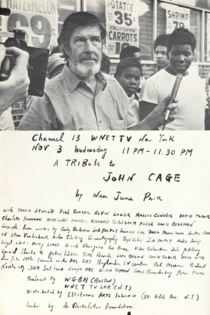
A Tribute to John Cage is Paik's homage to avant-garde composer John Cage. A major figure in contemporary art and music, Cage was one of the primary influences on Paik's work, as well as his friend and frequent collaborator. In this multifaceted portrait, Paik creates a pastiche of Cage's performances and anecdotes, interviews with friends and colleagues, and examples of Paik's participatory music and television works that parallel Cage's strategies and concerns. The methodology and philosophies that inform Cage's radical musical aesthetic — chance, randomness, the democratization of sounds — are evident as he performs such seminal pieces as 4'33" (of complete silence) in Harvard Square, or throws the I Ching to determine performance sites. Among the collage of elements included in this work are segments from Paik's Zen for TV; Paik and Charlotte Moorman in early performances, including the TV Bra; and anecdotes from composer Alvin Lucier.
A Tribute to John Cage
He! Viva Dada
Jean-Michel Humeau
Roland Topor, Alejandro Jodorowsky
Report from the second free expression festival organized at the American Cultural Center, Boulevard Raspail, in May 1965. The shows, all happenings inspired by ""théâtre panique/ the panic theater", includes Fernando Arrabal, Roland Topor and Alejandro Jodorowsky.
He! Viva Dada
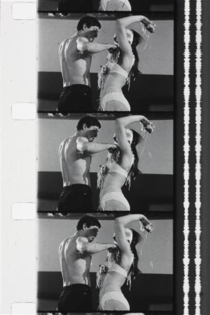
Stockhausen's Originale: Doubletakes
Peter Moore
Karlheinz Stockhausen, Allan Kaprow
This fascinating film documents the U.S. premiere production of Originale, a Happening by German composer Karlheinz Stockhausen. Filmed at the "2nd Annual Avant Garde Festival of New York," which was produced by Norman Seaman and Charlotte Moorman, the stage production was directed by Allan Kaprow. Performers include Nam June Paik, Moorman, Jackson Mac Low and Allen Ginsberg, among many others.
Stockhausen's Originale: Doubletakes
Good Morning, Mr. Orwell
Emile Ardolino, Nam June Paik
Peter Gabriel, Laurie Anderson
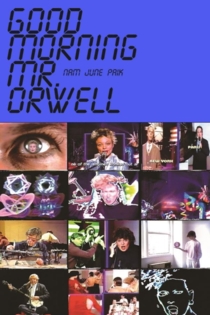
In his book "1984", George Orwell saw the television of the future as a control instrument in the hands of Big Brother. Right at the start of the much-anticipated Orwellian year, Paik and Co. were keen to demonstrate satellite TV's ability to serve positive ends-- Namely, the intercontinental exchange of culture, combining both highbrow and entertainment elements. A live broadcast shared between WNET TV in New York and the Centre Pompidou in Paris, linked up with broadcasters in Germany and South Korea, reached a worldwide audience of over 10 or even 25 million (including the later repeat transmissions).
Good Morning, Mr. Orwell
26'1.1499" For A String Player
Jud Yalkut
Charlotte Moorman, Nam June Paik
This tape is Jud Yalkut's video realization of Charlotte Moorman and Nam June Paik's concert performance of John Cage's composition 26'1.1499" For String Player. In this extraordinary performance, which is manipulated and synthesized by Yalkut, Paik and Moorman play Cage's score on a collection of "instruments" that include a pistol, a dish of mushrooms, balloons, a practice aerial bomb, and a telephone call to President Nixon.
26'1.1499" For A String Player