Daniel Gilfether
1849 - 1919The Matrimonial Martyr
Sherwood MacDonald
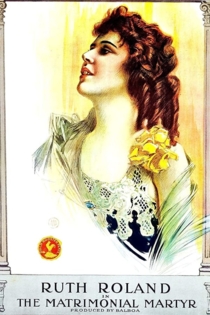
Ruth Roland, Andrew Arbuckle
Erma Desmond leaves her uncle and aunt to visit a friend, Phyllis, in the city. There, she finds work as the companion to the highly temperamental Mrs. Stanley. Mrs. Stanley has terrorized her husband to such an extent that he has gone away for a few months, purportedly to take their daughter to school, but mainly to get some peace. The servants, however, are still victims of her terrible fits until the day she decides to head for Reno to get a divorce.
The Matrimonial Martyr
Who Pays?
H.M. Horkheimer, Harry Harvey
Henry King, Ruth Roland
Who Pays? was a series of twelve three-reel dramas, released between March and July 1915. Henry King and Ruth Roland starred in each episode, playing different roles each time, with a variety of supporting players who varied from one episode to another. Each episode told a complete and individual story, but they were all inter-related by a uniform theme. Although there were no cliff-hanger endings, each episode did, in fact, end with a challenge to the audience: Who was responsible for the misfortune of the principal characters? The titles of the twelve episodes were: #1: The Price of Fame; #2: The Pursuit of Pleasure; #3: When Justice Sleeps; #4: The Love Liar; #5: Unto Herself Alone; #6: Houses of Glass; #7: Blue Blood and Yellow; #8: Today and Tomorrow; #9: For the Commonwealth; #10: Pomp of Earth; #11: The Fruit of Folly; #12: Toil and Tyranny.
Who Pays?
Twin Kiddies
Henry King
Marie Osborne, Henry King
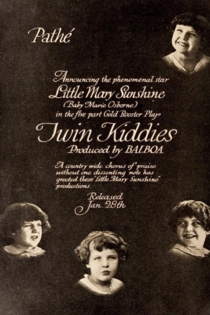
In March 1916, Pathé released a short feature entitled Little Mary Sunshine, starring a four-year-old Marie Osborne. This was one of the first features ever directed by King and it was so successful that Pathé asked the original production company, Balboa, for five more features with the same child wonder. All were produced during the second half of 1916, and only three of them survive today – one being Twin Kiddies, which shows the amazing progress King had made since the first film in the series. Of course, the story is thin, the ending quite abrupt, and the opening sequences rather long. Yet, the direction is much more subtle, alternating between shots of different size, suggesting that King was mastering the art of composition.
Twin Kiddies