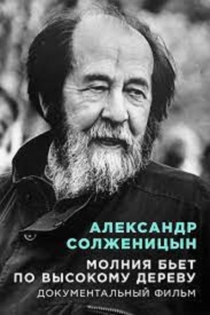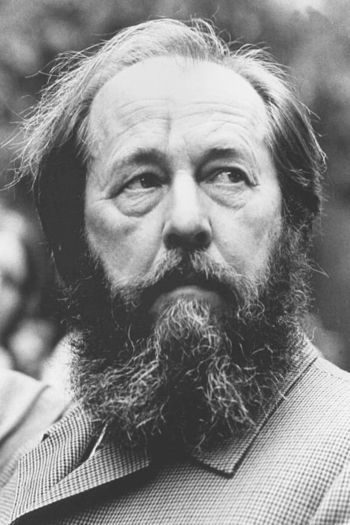
Alexandr Solzhenitsyn
1918 - 2008Solzhenitsyn was born into a family that defied the Soviet anti-religious campaign in the 1920s and remained devout members of the Russian Orthodox Church. However, Solzhenitsyn lost his faith in Christianity, became an atheist, and embraced Marxism–Leninism. While serving as a captain in the Red Army during World War II, Solzhenitsyn was arrested by SMERSH and sentenced to eight years in the Gulag and then internal exile for criticizing Soviet leader Joseph Stalin in a private letter. As a result of his experience in prison and the camps, he gradually became a philosophically minded Eastern Orthodox Christian.
As a result of the Khrushchev Thaw, Solzhenitsyn was released and exonerated. He pursued writing novels about repression in the Soviet Union and his experiences. He published his first novel, One Day in the Life of Ivan Denisovich in 1962, with approval from Soviet leader Nikita Khrushchev, which was an account of Stalinist repressions. Solzhenitsyn's last work to be published in the Soviet Union was Matryona's Place in 1963. Following the removal of Khrushchev from power, the Soviet authorities attempted to discourage Solzhenitsyn from continuing to write. He continued to work on further novels and their publication in other countries including Cancer Ward in 1966, In the First Circle in 1968, August 1914 in 1971, and The Gulag Archipelago in 1973, the publication of which outraged the Soviet authorities. In 1974 Solzhenitsyn lost his Soviet citizenship and was flown to West Germany. In 1976, he moved with his family to the United States, where he continued to write. In 1990, shortly before the dissolution of the Soviet Union, his citizenship was restored, and four years later he returned to Russia, where he remained until his death in 2008.
He was awarded the 1970 Nobel Prize in Literature "for the ethical force with which he has pursued the indispensable traditions of Russian literature", and The Gulag Archipelago was a highly influential work that "amounted to a head-on challenge to the Soviet state", and sold tens of millions of copies.
Solzhenitsyn was born in Kislovodsk (now in Stavropol Krai, Russia). His father, Isaakiy Semyonovich Solzhenitsyn, was of Russian descent and his mother, Taisiya Zakharovna (née Shcherbak), was of Ukrainian descent. Taisiya's father had risen from humble beginnings to become a wealthy landowner, acquiring a large estate in the Kuban region in the northern foothills of the Caucasus and during World War I, Taisiya had gone to Moscow to study. While there she met and married Isaakiy, a young officer in the Imperial Russian Army of Cossack origin and fellow native of the Caucasus region. The family background of his parents is vividly brought to life in the opening chapters of August 1914, and in the later Red Wheel novels. ...
Source: Article "Aleksandr Solzhenitsyn" from Wikipedia in English, licensed under CC-BY-SA 3.0.
Беседы с Солженицыным
Aleksandr Sokurov
Alexandr Solzhenitsyn, Aleksandr Sokurov
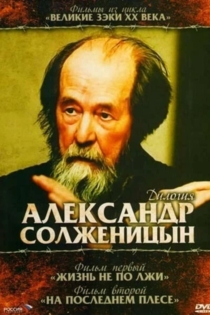
The Dialogues with Solzhenitsyn is a two-part Russian television documentary by Russian filmmaker Alexander Sokurov on Aleksandr Solzhenitsyn. The documentary shot in Solzhenitsyn’s home shows his everyday life and covers his reflections on Russian history and literature.
The Knot
Les vendredis d'Apostrophes
Pierre Assouline
Bernard Pivot, Pierre Assouline
40 years of "Apostrophes". Hours and historical meetings, Pierre Assouline has composed an anthology of the best extracts presented in the form of a primer, which he had commented on by a surprised Bernard Pivot.
Les vendredis d'Apostrophes
Solzhenitsyn: Trilogy
Sergei Miroshnichenko
Alexandr Solzhenitsyn, Evgeny Mironov
Documentary about the life and works of Aleksandr Solzhenitsyn in three parts, made for Russian TV in 2001, 2003, and 2008. The author died while the last part was being filmed.
Solzhenitsyn: Trilogy
Александр Солженицын Молния бьет по высокому дереву
Sergei Braverman
Alexandr Solzhenitsyn, Aleksandr Sokurov
The film is dedicated to the 100th anniversary of the birth of the outstanding Russian writer Alexander Solzhenitsyn.
Aleksandr Solzhenitsyn Lightning strikes a tall tree