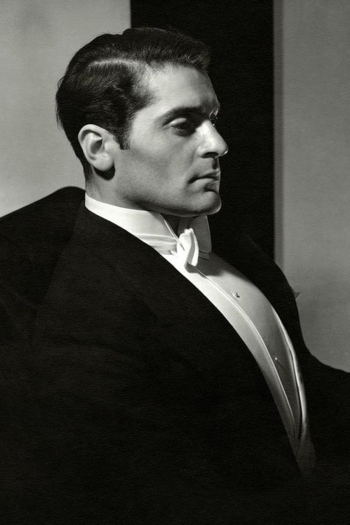
Francis Lederer
1899 - 2000Francis Lederer (November 6, 1899 – May 25, 2000) was a Czech-born film and stage actor with a successful career, first in Europe, then in the United States. His original name was František Lederer. Lederer's first American movies were Man of Two Worlds (1934), Romance in Manhattan (1934), with Ginger Rogers, The Gay Deception (1935), with Frances Dee, and One Rainy Afternoon (1936). He was cast as the lead with Katharine Hepburn in the 1935 film Break of Hearts, but the producers replaced him with Charles Boyer. It was Irving Thalberg's plan to make Lederer "the biggest star in Hollywood" but the death of Thalberg ended this possibility.
Although he continued to play leads occasionally – notably when he was a playboy in Mitchell Leisen's Midnight with Claudette Colbert and John Barrymore in 1939 – in the late 1930s Lederer began to expand his character parts, even playing villains. Edward G. Robinson praised Lederer's performance as a German American Bundist in Confessions of a Nazi Spy in 1939, and he earned plaudits for his portrayal of a fascist in The Man I Married (1940) with Joan Bennett. He also played Count Dracula for The Return of Dracula in 1958. Throughout his career, Lederer, who studied with Elia Kazan at the Actors Studio in New York City, continued to take stage acting seriously, and he performed often both in New York and elsewhere. He appeared in stage productions of Golden Boy (1937), Seventh Heaven (1939), No Time for Comedy (1939), in which he replaced Laurence Olivier, The Play's the Thing (1942), A Doll's House (1944), Arms and the Man (1950), The Sleeping Prince (1956) and The Diary of Anne Frank (1958).
Although he took a break from making films in 1941, in order to concentrate on his stage work, he returned to the silver screen in 1944, appearing in Voice in the Wind and The Bridge of San Luis Rey, and in films such as Jean Renoir's The Diary of a Chambermaid (1946) and Million Dollar Weekend (1948). He took another break from Hollywood in 1950, after making Surrender (1950), and returned in 1956 with Lisbon and the light comedy The Ambassador's Daughter. His final film appearance was in Terror Is a Man in 1959. During the 1950s, he served as honorary mayor of Canoga Park.
He would continue to make television appearances for the next 10 years in such shows as Sally, The Untouchables, Ben Casey, Blue Light, Mission: Impossible and That Girl. His final television appearance occurred in a 1971 episode of Rod Serling's Night Gallery called "The Devil Is Not Mocked". In it, he reprised his role as Dracula from The Return of Dracula.
Memories of Berlin: The Twilight of Weimar Culture
Gary Conklin
Claudio Arrau, Elisabeth Bergner
The film tells the cultural story of Berlin during the Weimar Republic through interviews with a number of persons who were involved in literature, film, art, and music during the period. It includes interviews with Christopher Isherwood, Louise Brooks, Lotte Eisner, Elisabeth Bergner, Francis Lederer, Carl Zuckmayer, Gregor Piatigorsky, Claudio Arrau, Rudolf Kolisch, Mischa Spoliansky, Herbert Bayer, Mrs. Walter Gropius, and Arthur Koestler.
Memories of Berlin: The Twilight of Weimar Culture



Die Büchse der Pandora
G.W. Pabst
Louise Brooks, Fritz Kortner
Lulu is a young woman so beautiful and alluring that few can resist her siren charms. The men drawn into her web include respectable newspaper publisher Dr. Ludwig Schön, his musical producer son Alwa, circus performer Rodrigo Quast, and seedy old Schigolch. When Lulu's charms inevitably lead to tragedy, the downward spiral encompasses them all.
Pandora's Box

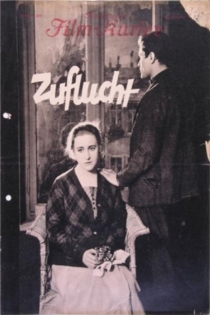
Zuflucht
Carl Froelich
Henny Porten, Francis Lederer
After eight years in exile Martin returns to Berlin. He was involved in the German Revolution of 1918/1919 and had to leave the country as a result. Impoverished and lonely, he struggles on alone until the market saleswoman Hanne offers him shelter, although she does not have much money either. They fall in love and Martin even finds work on the construction site for the subway through Tempelhofer Feld. One day, however, he collapses there, whereupon the pregnant Hanne tries to nurse him back to health.
Refuge
Die wunderbare Lüge der Nina Petrowna
Hanns Schwarz
Brigitte Helm, Francis Lederer
This silent-screen classic, like many others produced near the end of the silent era, was both a theatrical extravaganza boasting an original orchestral score and an item which languished in obscurity for many years. When Carlo Piccardi took what was left of the score by Maurice Jaubert and re-created it, the existing footage was restored and paired with a new orchestral performance which was shown in Paris in 1988. The film's story concerns the travails of a woman who has been living quite comfortably as the mistress of a colonel in the Tsar's army in Russia. However, she eventually encounters a penniless young lieutenant and falls madly in love with him, as he does with her. Despite her best intentions of remaining with the colonel, and his intention to avoid trouble with his fellow soldiers, they cannot forswear this relationship, and tragedy is the inevitable result. The title refers to a moving incident in the story, and translates as "the wonderful lie of Nina Petrovna."
The Wonderful Lies of Nina Petrovna

Die große Sehnsucht
Steve Sekely
Camilla Horn, Theodor Loos
During lunch break at the movie studio, the extras rush to the canteen Hans Adalbert Schlettow, Maria Paudler and Luis Trenker are chatting. Eva von Loe a beautiful young extra rushes past; she is looking for her fiancé, Paul Wessel, who is also an extra. She has to return to the set where the famous director Regisseur Hall is shooting a scen. He is dissatisfied with his star, Carla Marventa, who is wrong for the scene he must photograph. Hall notices Eva, but laughs at her desire to replace Marventa. At that moment Conrad Veidt comes on the scene and assumes that Eva is the star.
The Great Longing
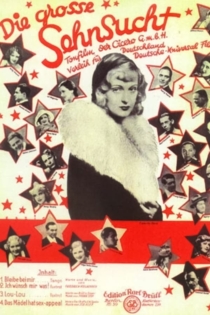
Ihre Majestät die Liebe
Joe May
Otto Wallburg, Francis Lederer
Fred von Wellingen is a wealthy industrialist, part of a large family-owned corporation. Fred has fallen for Lia, a comely bartender in the Berlin Cabaret. He proposes to her, much to the horror of his family, which considers Lia and her unsophisticated father far below their caste. The family convinces Fred to give up the girl in exchange for increased position and income in the company. But Fred's lapse is momentary, and he again pursues Lia. But she, by this time, has learned of his erstwhile agreement and has agreed to marry someone else.
Her Majesty Love





The Pursuit of Happiness
Alexander Hall
Francis Lederer, Joan Bennett
Lederer is a Hessian soldier who defects to the Americans during the Revolutionary War.He falls in love with a Yankee girl, but a thuggish local militiaman jealously makes things hard for him while he's a prisoner of war.
The Pursuit of Happiness

Romance in Manhattan
Stephen Roberts
Francis Lederer, Ginger Rogers
Karel Novak is an incredibly naive Czech immigrant who is taken under the wing of streetwise New York chorus girl Sylvia. With the help of lovable cop-on-the-beat Murphy, Sylvia hides Karel from the immigration authorities and ultimately falls in love with him. In addition to Karel's illegal-alien status, the plot is complicated by a crooked lawyer and a group of well-meaning welfare workers who endeavor to place Sylvia's kid brother Frank in a foster home.
Romance in Manhattan