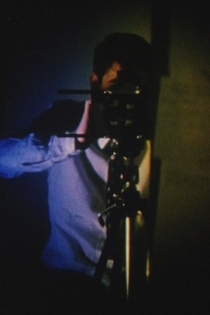
Tom Chomont
2021Galaxie
Gregory J. Markopoulos
Parker Tyler, Storm De Hirsch
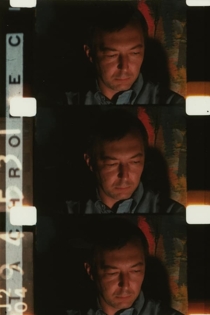
In March and April of 1966, Markopoulos created this filmic portrait of writers and artists from his New York circle, including Parker Tyler, W. H. Auden, Jasper Johns, Susan Sontag, Storm De Hirsch, Jonas Mekas, Allen Ginsberg, and George and Mike Kuchar, most observed in their homes or studios. Filmed in vibrant color, Galaxie pulses with life. It is a masterpiece of in-camera composition and editing, and stands as a vibrant response to Andy Warhol's contemporary Screen Tests.
Galaxie
Panic Bodies
Mike Hoolboom
Moucle Blackout, Jason Boughton
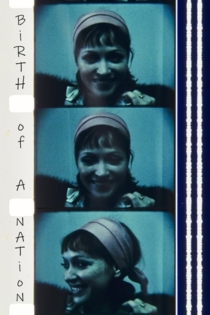
"Panic Bodies is a 70-minute, six-part exploration of the ways we experience the body's betrayals: disease, decline and death. The film is a panorama of emotionally charged recollections of strange relatives and estranged siblings, staged recreations of fast-fading pasts and personal mythologies, and reflections on the anxious states created by the body's fragile claims on time and space. It's about being a stranger in your own skin. Panic Bodies perfects the phantom quality of any good work about mourning, but it is not reducible to that. It is also enlivened by the intimacy that comes from having made a spectacle of personal secrets." (Kathleen Pirrie Adams, Xtra)
Panic Bodies
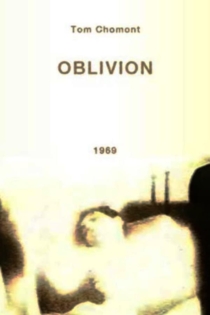
Oblivion
Tom Chomont
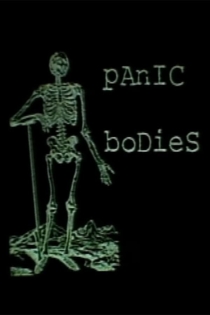
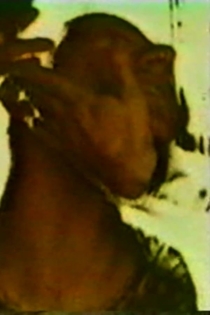
“Approximately thirty images comprise Oblivion. Most obsessively repeat themselves. Although the images appear to be solarized, the film was actually contact-printed, combining high contrast black and white negative with a colour positive of the same image. The high contrast accounts for the tendency of shots to flood. Images in the film swell and contrast, often disappearing into pure colour… Oblivion employs extremely rapid cutting. Some of the images last as briefly as two frames. The fact that we see so few frames, that a shot is representationally ambiguous, or shown upside down and sideways, often causes the viewer to project his/her own fantasies… When Jean Genet was asked to what end he was directing his life he responded, “To oblivion.” (J.J. Murphy, “Reaching for Oblivion”) (mikehoolboom.com)
Oblivion
Phases of the Moon: The Parapsychology of Everyday Life
Tom Chomont
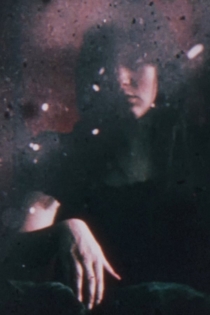
“I usually avoid the term ‘film poem,’ because it was overused in the ‘40s and ‘50s. But somehow it fits Phases of The Moon; it is a film poem and nothing else. A small, miniature film poem, a jewel, if the word masterpiece is too stuffy.” (Jonas Mekas, 1973)
Phases of the Moon: The Parapsychology of Everyday Life
Space Time Studies
Tom Chomont
"De eevwigheid duurt een oogwenk./ De ti jd duurt maar door." – A. Roland Holet. "This film is in several short sections. Most are set in a single location or 'space'; the editing introduces a temporal element into that space. In the third section, for example, the setting is a European cafe; Chomont cuts between different shots that seem to be adjacent to each other in this single space, but various cues–such as the change in characters' positions–tell us that the shots were taken at different times. Chomont is exploring here a fundamental paradox of cinema: that time and space are interdepent, that one camera can film space in a way that make different parts of it seem simultaneously present, cut this simultaneity is an illusion – the time of the filming and of the strip of film in projection is always moving forward." – Fred Camper, The Chicagoan, March, 1978.
Space Time Studies
Morpheus In Hell
Tom Chomont
"I, Prolugue, II, The Angel Morpheus/The Major Arcana, III, Jeu de la main. The title refers to (a) quote attributed to Stan Brakhage regarding the avant-garde artist: 'Orpheus has been too long in Hell.' Part II alludes both to the sixth strophe of the Third Song of 'Les Chants du Maldoror' by le Comte de Lautréamont (Isador Ducasse) and to 'Sirius Remembered' by Brakhage. Occult imagery and romantic narrative are reformed by repetition and the element of chance." (Tom Chomont)
Morpheus In Hell
Early Monthly Segments
Robert Beavers
Robert Beavers, Gregory J. Markopoulos
Early Monthly Segments, filmed when Beavers was 18 and 19 years old, now forms the opening to his film cycle, "My Hand Outstretched to the Winged Distance and Sightless Measure." It is a highly stylized work of self-portraiture, depicting filmmaker and companion Gregory J. Markopoulos in their Swiss apartment. The film functions as a diary, capturing aspects of home life with precise attention to detail, documenting the familiar with great love and transforming objects and ordinary personal effects into a highly charged work of homoeroticism. (Susan Oxtoby, Toronto International Film Festival).
Early Monthly Segments