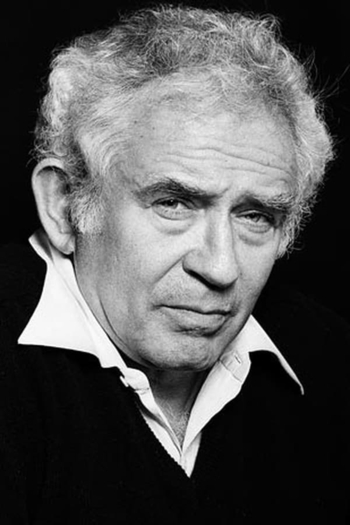
Norman Mailer
1923 - 2007His novel The Naked and the Dead was published in 1948 and brought him early renown. His 1968 nonfiction novel Armies of the Night won the Pulitzer Prize for non-fiction as well as the National Book Award. His best-known work is widely considered to be The Executioner's Song, the 1979 winner of the Pulitzer Prize for fiction.
Mailer is considered an innovator of "creative non-fiction" or "New Journalism", along with Truman Capote, Joan Didion, Hunter S. Thompson, and Tom Wolfe, a genre which uses the style and devices of literary fiction in factual journalism. He was a cultural commentator and critic, expressing his views through his novels, journalism, frequent press appearances and essays, the most famous and reprinted of which is "The White Negro". In 1955, he and three others founded The Village Voice, an arts and politics-oriented weekly newspaper distributed in Greenwich Village.
In 1960, Mailer was convicted of assault and served a three-year probation after he stabbed his wife Adele Morales with a penknife, nearly killing her. In 1969, he ran an unsuccessful campaign to become the mayor of New York. Mailer was married six times and had nine children.
Description above from the Wikipedia article Norman Mailer, licensed under CC-BY-SA, full list of contributors on Wikipedia.
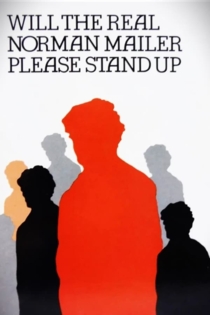
Will the Real Norman Mailer Please Stand Up?
Dick Fontaine
Merv Griffin, Norman Mailer
Portrait of Norman Mailer at the time of the Pentagon demonstrations in 1967, documenting Mailer's involvement and arrest, together with two TV appearances and shooting on the set of his second film 'Beyond the Law'.
Will the Real Norman Mailer Please Stand Up?


When We Were Kings
Leon Gast
Muhammad Ali, George Foreman
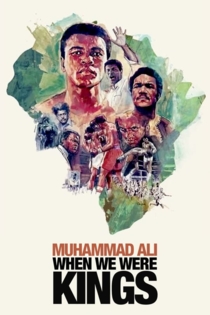
It's 1974. Muhammad Ali is 32 and thought by many to be past his prime. George Foreman is ten years younger and the heavyweight champion of the world. Promoter Don King wants to make a name for himself and offers both fighters five million dollars apiece to fight one another, and when they accept, King has only to come up with the money. He finds a willing backer in Mobutu Sese Suko, the dictator of Zaire, and the "Rumble in the Jungle" is set, including a musical festival featuring some of America's top black performers, like James Brown and B.B. King.
When We Were Kings

Empire City
Michael Blackwood
Donald Trump, Ed Koch
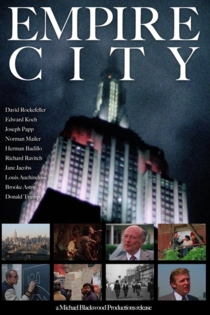
Guided by seasoned New Yorkers, political figures, and cultural connoisseurs, "Empire City" examines Manhattan and its surrounding boroughs in order to paint a portrait of the ever-evolving metropolis. Appearing to be both adaptable and stubbornly stagnant, New York is a city of juxtapositions. As our narrator notes, "The city is too big, too diverse, and too complex for anyone to comprehend. New York is many cities interlaced with one another, each in constant independent motion."
Empire City
Norman Mailer: The American
Joe Mantegna
Norman Mailer, Muhammad Ali
A provocateur, a rebel, a performer, and a true American, Norman Mailer never stopped giving people something to talk about. This documentary goes beyond the Mailer of the bookshelves and NY Times best seller list to Mailer the social critic, family man, filmmaker, and lover. Here's a look into the life of a complex, intellectual, working class hero. With never before seen footage of Adele Morales Mailer's startling revelations after being stabbed by her husband. Featuring unseen footage and interviews from wives and lovers, enemies and admirers, his children and the man himself.
Norman Mailer: The American
Keep the River on Your Right: A Modern Cannibal Tale
Laurie Gwen Shapiro, David Shapiro
Tobias Schneebaum, Norman Mailer
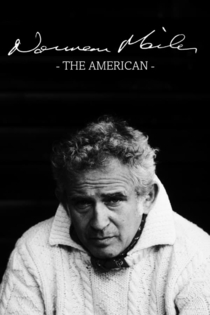
In 1955, Tobias Schneebaum disappeared into the depths of the Peruvian Amazon. He had no guide, no map, and only the vaguest of instructions: Keep the river on your right. A year later Schneebaum emerged from the jungle…naked, covered in body paint, and a modern-day cannibal. Titled after Schneebaum’s 1969 cult classic memoir about his formative experiences living in the Amazon, Keep The River On Your Right is the extraordinary stranger-than-fiction story of Schneebaum’s return to the jungle, 45 years after his original visit, to reunite with the very tribesmen he loved and who gave him nightmares for nearly half a century. A deeply affecting and searing portrait, sibling filmmakers Laurie and David Shapiro capture a man in utter conflict, a fearless adventurer, and one of the most charming, enigmatic, and perplexing men ever captured on screen.
Keep the River on Your Right: A Modern Cannibal Tale
Inside Deep Throat
Randy Barbato, Fenton Bailey
Dennis Hopper, Peter Bart
In 1972, a seemingly typical shoestring budget pornographic film was made in a Florida hotel, "Deep Throat," starring Linda Lovelace. This film would surpass the wildest expectation of everyone involved to become one of the most successful independent films of all time. It caught the public imagination which met the spirit of the times, even as the self appointed guardians of public morality struggled to suppress it, and created, for a brief moment, a possible future where sexuality in film had a bold artistic potential. This film covers the story of the making of this controversial film, its stunning success, its hysterical opposition along with its dark side of mob influence and allegations of the on set mistreatment of the film's star.
Inside Deep Throat
The 50 Year Argument
Martin Scorsese, David Tedeschi
Michael Chabon, Norman Mailer
Follows the waves of literary, political, and cultural history as charted by the The New York Review of Books, America’s leading journal of ideas for over 50 years. Provocative, idiosyncratic and incendiary, the film weaves rarely seen archival material, contributor interviews, excerpts from writings by such icons as James Baldwin, Gore Vidal, and Joan Didion along with original verité footage filmed in the Review’s West Village offices.
The 50 Year Argument
Cremaster 2
Matthew Barney
Norman Mailer, Matthew Barney
CREMASTER 2 (1999) is rendered as a gothic Western that introduces conflict into the system. On the biological level it corresponds to the phase of fetal development during which sexual division begins. In Matthew Barney's abstraction of this process, the system resists partition and tries to remain in the state of equilibrium imagined in Cremaster 1 ...
Cremaster 2