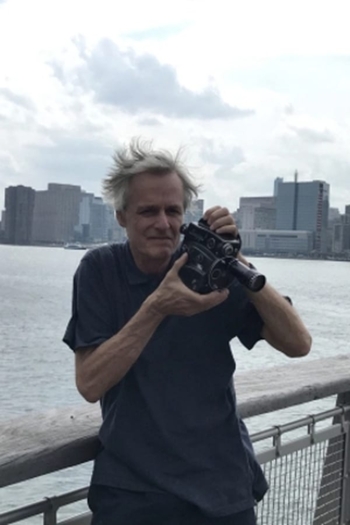
Jim Jennings
2021Jackson Heights
Jim Jennings
“Jackson Heights” was filmed in a Queens, New York, neighborhood, fondly called “Jai Kissan Heights” (“Long Live Krishna Heights”) by its predominantly Indian residents. The silence of the film seems ironic in that much of “Jackson Heights” was filmed in an area named “Speaker’s Corner,” where members of the public voice their religious and political opinions as they hand out leaflets to passersby.
Jackson Heights
Day Dream
Jim Jennings
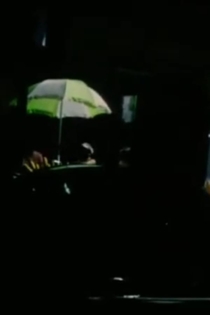
"In a way, making street films is daydreaming with a camera. It's capturing a fantasy you're having when you're wide awake and life is going on around you. There is, of course, a similarity between daydreaming and making any kind of art because they both spring from that narrow groove between the subconscious and the conscious. That's when self-expression and technical problem-solving both flow together in an almost mystical way. For me this film represents that mental state. I shot it in late July 2001 but put it away for some forgotten reason. It's very much about everyday life–a nondescript New York neighborhood on a calm Sunday afternoon, garbage cans piled high, feet reading here and there . . . but it's also about the magic I can see in that world when I free my subconscious. I made this film so effortlessly (I just cut out one brief shot) because I was so fully in that mindset, which, I think, shows in the nature of the images."
Day Dream
Fashion Avenue
Jim Jennings
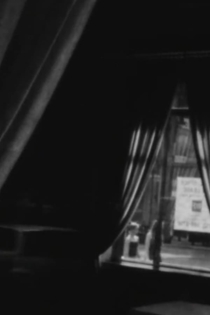
Filmed in New York's Garment District, Fashion Avenue uses mirrors to reflect something more beautiful than the world of glamour: the everyday lives of working people. The filming of reflections creates the effect of printed fabrics, and the often jagged shapes resemble sleeves and lapels on the cutting-room table.
Fashion Avenue
Wall Street
Jim Jennings
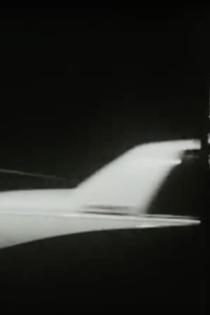
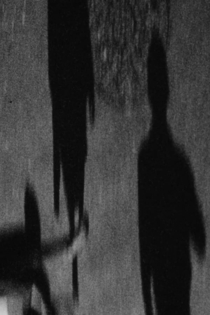
Shot at high noon in New York’s financial district, Wallstreet is much like a vertical tickertape, charting the existence of typical office workers. The film’s elongated shadows suggest these workers’ depersonalized, neuter, nearly uniform lives, which flow by without any solid or stable element that might provide definition.
Wall Street
Prague Winter
Jim Jennings
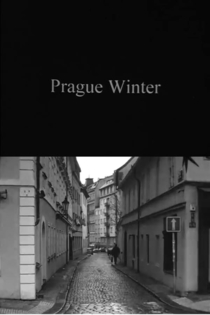
So part of what's so surprising about Prague Winter is that it feels so lived in, so thoroughly grounded. It's not so much that Jennings makes Prague look like Manhattan (although there are commonalities in terms of architecture and the gaps of light between it). But the film restricts itself to sights on and around the tram, which provides an uncharacteristic linearity to the film. What's more, Jennings' status as a guest observer seems to bring out a humanism in his work, as he fixates on the elderly and, implicitly, the history to which they've been subjected. The post-Communist malaise hardens into grim acceptance, and this, along with the physical traces of Prague's history as manifested in the built environment, is what fascinates Jennings here. His camera is tender and unobtrusive, as you would expect from a filmmaker of his sensitivity.
Prague Winter
Edge
Jim Jennings
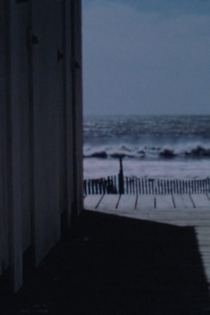
When Jim Jennings was a student at Bard College, his professor, Ernie Gehr asked the students in his class to form a frame with their hands, by joining thumbs to forefingers. They were told to walk around “framing” scenes in that manner. Jennings was struck by the simplicity and effectiveness of the lesson and produced this film as a result.
Edge
Refraction
Jim Jennings
“In “Refraction,’ the camera is set so that the leaves of a large tree fill the frame. Green ordinary leaves which move in their baroque ways under the wind. In a sense it is shocking to put on film such ordinary things, things which could be so easy to dismiss. Yet this undemanding, pleasant image hides something. The image IS of what one hypnotically stares at in forgotten moments, amd from which one wakes, when shapes make themselves up in it. These furtive possibilities confront the delimiting, all-eyes-cinema. The intimate sensation is made to bear on the public circumstances of film, provoking new readings of the moving leaves. As the image presses its quiet offerings on the viewer, a subtle interaction occurs between changes of speed in the camera and wind as they, in different ways, accentuate or diminish the speed of the fluttering leaves."
Refraction
Bruges
Jim Jennings
“Bruges” depicts life in a hotel room in a quaint, Belgian tourist town. Residents are also depicted walking and cycling to work on one of the city’s many canal bridges, as wildlife experiences its own reality in the waters below. A fine example of Jennings’ skillful editing.
Bruges
The Minibike Ride
Jim Jennings
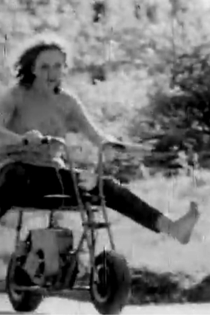
Says Karen Treanor of the film: “The Minibike Ride” is Jim Jennings’ oldest extant film, shot when he was a student at Oakwood Friends’ School. For years, it was shown at Danbury High School (CT), until the print of it disappeared". Also screened shortly after completion for members of the avant-garde clique-- the film was called 'intriguing' by Nathaniel Dorsky.
The Minibike Ride
Train of Thought
Jim Jennings
The film flips subway rushes in various directions and quick cuts to provide a whole line study of broadway (Queens) boogie-woogie that only occasionally syncopates into rhythms, while giving the wet apparitions of the metro--graffiti, rust, people's crowded, fleeting faces . . . (David Phelps)
Train of Thought