Anouk de Clercq
2021Oops Wrong Planet
Anouk de Clercq
Oops wrong planet shows an attractive, rolling landscape from a different planet. An attempt is made to establish contact. Long-distance communication is possible, albeit with some interference on the line. Clear contact appears impossible, though. The static appears like a veil that clouds the picture. The soundtrack of Scanner reinforces the static between distance and vicinity even further. There’s the temptation to look behind the picture, so as to bypass the interference and get to a clear picture. Oops wrong planet permanently switches between what seems possible and impossible in terms of contact. It’s a grope in the dark, in search of the place where real contact can be possible, beyond time and space. source: https://augusteorts.be/catalogue/1/oops-wrong-planet
Oops Wrong Planet
Atlas
Anouk de Clercq
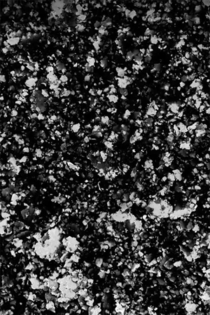
Exploring the surface of a single frame from a black and white 16mm film through an electron microscope, Anouk De Clercq ponders over ways of seeing and the nature of cinema. Spatiality being one of the key concepts in the work of Anouk De Clercq, in Atlas she wants to go as deep into space as possible, at the tiniest scale, and see what insights we get from this other perspective on things. This atlas is a guide in a macroscopic tale of the world.
Atlas
Swan Song
Anouk de Clercq
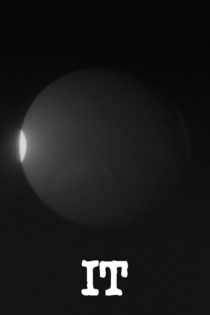
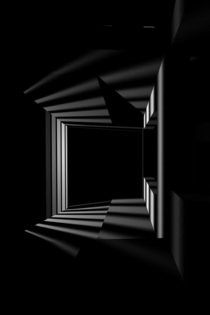
Swan Song is a metaphorical phrase for a final gesture, effort, or performance just before death of retirement. The phrase refers to an ancient belief that the swan is completely silent during its lifetime until the moment just before death, when it sings one beautiful song. What song does a pixel sing before it fades away?
Swan Song
We’ll Find You When the Sun Goes Black
Anouk de Clercq
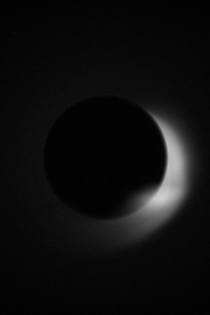
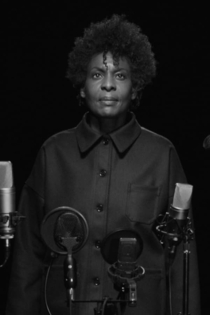
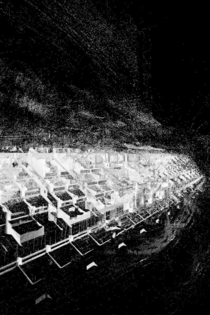
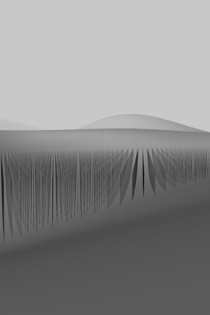
The film is inspired by the terella—a small magnetized model ball representing the Earth, used by scientists since the late sixteenth century. Three centuries later, in the year of the birth of cinema, Norwegian physicist Kristian Birkeland used the terella to study the aurora borealis, while in the 1930s, Bertolt Brecht wrote in exile: “In the dark times / Will there also be singing? Yes, there will also be singing / About the dark times.” Resembling a terella, the dark planet depicted on the screen is surrounded by pulsating light, invoking both hope and despair.
We’ll Find You When the Sun Goes Black