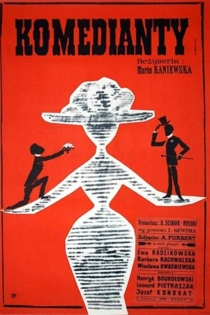
Henryk Boukołowski
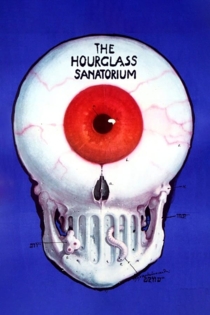
1937 - 2020Sanatorium pod klepsydrą
Wojciech Has
Jan Nowicki, Tadeusz Kondrat
A young man named Josef visits a dilapidated Sanatorium to see his father Jakob. On his arrival, a sinister doctor informs him that his father had stopped breathing but hasn't died yet, perhaps due to Josef's arrival which may have halted time in the sanatorium. Josef undertakes a strange journey through the many rooms of the sanatorium, each which conjures worlds composed of his memories, dreams and nightmares.
The Hourglass Sanatorium
Orzeł
Leonard Buczkowski
Wienczysław Gliński, Aleksander Sewruk
Based on a true story of Polish submarine "Orzel" (The Eagle): September 1939, "Orzel" is coming to Estonian neutral harbor in Tallin. Under pressure from Germany Estonians have intern the ship. Commander Grabinski decides to escape to England through the Baltic Sea, without any maps that has been confiscated and with only small amount of fuel on board.
Orzel

Awatar czyli zamiana dusz
Janusz Majewski
Wanda Koczeska , Jan Machulski
Count Olgierd Łabiński lives with his beloved wife in Paris in a beautiful palace. The Countess recalls her stay in Florence and her insistent admirer Octavius de Saville. Soon, Octavius, arrives in Paris and calls for the famous Dr. Cherbonneau, suspected of being a charlatan. Citing the teachings of the East, Cherbonneau offers the patient an "avatar", a reincarnation of the soul, which takes a different body...
Avatar: The Exchange of Souls
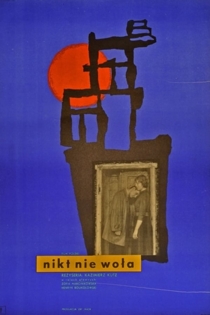
Nikt nie woła
Kazimierz Kutz
Zofia Marcinkowska, Henryk Boukołowski
"In 1960 Kazimierz Kutz' second film NIKT NIE WOLA / NOBODY'S CALLING, based on a Jozef Hen novel that was never published in Poland, described the fate of Poles on the Eastern Front. Kutz used the film to explore new formal solutions, collaborating closely with cinematographer Jerzy Wojcik to reveal the psychological landscape of a pair of lovers who are strongly affected by wartime events. The camera recorded the couple's inner experiences, contrasting their muted intimacy against the surrounding scenery of a ruined town. The film did not win over critics at the time of its release. It was not until later that critics recognized Kutz's effort to experiment with aesthetics in a manner akin to that pursued by filmmakers of the new wave. NOBODY'S CALLING came to be compared with Michelangelo Antonioni's THE ADVENTURE, which was produced around the same time."
Nobody's Calling
Linia opózniajaca z cyklu 'Opowiesci weekendowe'
Krzysztof Zanussi
Bartosz Opania, Tadeusz Bradecki
A young TV producer struggles with his conscience when he becomes convinced that his TV program is covering up a lie, but the more he tries to reveal the truth the more uncertainty he discovers.
Weekend Stories: Dilatory Line

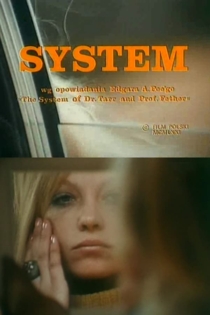
System
Janusz Majewski
Jerzy Przybylski, Krzysztof Kalczyński
An alternately restrained and outrageous adaptation of Edgar Allen Poe’s “The System of Dr. Tarr and Professor Fether” that like OKNO ZABITE DESKAMI before it was updated to the modern world. It features a young man and a lady friend driving to an insane asylum whose overseers the woman knows. Weirdness is evident before they even reach the place, in the form of a ranting maniac in a tree. More crazies are found freely wandering the grounds of the asylum, they being participants in an apparently revolutionary new system instituted by the asylum’s director. But the director seems just as nutty in his own way as the patients...
System
Kamienne tablice
Czesław Petelski, Ewa Petelska
Krzysztof Chamiec, Laura Łącz
The film is set in 1956 in India. John Tokarski has an affair with the beautiful Margit . He is close to abandonment of wive and children, who were in the country. But one day, while in the cinema, he watches a newsreel of the shocking riots in Poznan. Deeply moved by the events that are taking place in the country John is faced with a fundamental problem of the determination of his own nationality.
Kamienne tablice