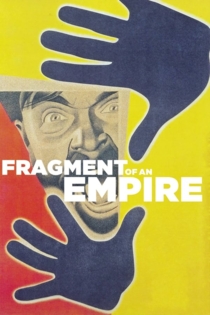
Emil Gal
2021Обломок империи
Fridrikh Ermler
Fyodor Nikitin, Lyudmila Semyonova
Director Frederick Ermler’s last silent feature and the last of four collaborations with actor Fiodor Nikitin. Nikitin plays an officer who spends a decade after the Great War as a shell-shocked amnesiac, until a glimpse of a woman through a train window sparks the return of his memory. He makes his way back to St. Petersburg, now Leningrad, a man out of time who struggles to make sense of the new society brought about by the revolution.
Fragment of an Empire
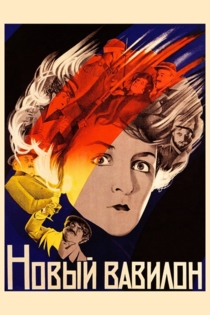
Новый Вавилон
Leonid Trauberg, Grigori Kozintsev
Yelena Kuzmina, David Gutman
In the short-lived Commune of Paris, a conscripted soldier falls in love with a Communard saleswoman. As the army cracks down on the revolutionaries, the soldier is forced to fight against the Commune, and the pair's love is put to the test.
The New Babylon
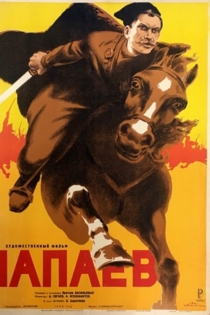
Чапаев
Sergey Vasilev, Georgi Vasilyev
Boris Babochkin, Leonid Kmit
This film is based on the book about Vasili Ivanovich Chapaev (1887 - 1919) who was in real life the Commander of the 25th Division of the Red Army. Chapaev is an uneducated peasant and a decorated hero in the World War I and later in the Russian Civil War, that followed the Russian revolution. This man of action is fighting on the side of the poor people. His troops consist of peasants, just like him. Unable to write, he can brilliantly demonstrate various battle tactics by moving potatoes on the table. He is street smart. He never lost a battle against the experienced Generals of the Tzar's Army.
Chapayev
Граница
Mikhail Dubson
Nikolai Cherkasov, Elena Granovskaya
Жители местечка Старое Дудино, расположенного в четырех километрах к западу от советской границы, находятся в полной зависимости от богача Новика, интересы которого защищают местная полиция и духовенство. Новик усиленно раздувает национальную рознь между еврейской беднотой и польскими рабочими. В момент совершения традиционной церемонии «черного венца» (обряд венчания старика и старухи) группа фабричных рабочих, возглавляемая коммунистом Гайдулем, объединившись с еврейской беднотой, нападает на полицейских и освобождает Бориса Бернштейна, приговоренного к смертной казни.
Granitsa
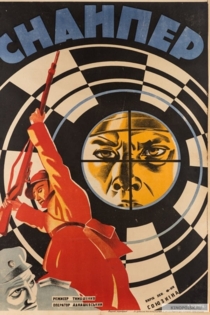
Снайпер
Semyon Timoshenko
Boris Shlikhting, Pyotr Sobolevsky
During World War 1 a Russian soldier (Pyotr Sobolevsky) serves in Russian Expeditionary Force in France where he is chosen for his marksmanship and trained as a skilled sniper. After the Russian revolution the soldier returns home while his commander (Boris Shlikhting) fights against the Soviet Russia. In 1930 the former soldier works on a factory and also he is the instructor in shooting club. Once the town that is near the Soviet border is attacked by foreign troops (the hostile state isn't named but the uniform of the soldiers resembles Finnish). The character meets againt with his former commander who serves in invading forces.
Sniper
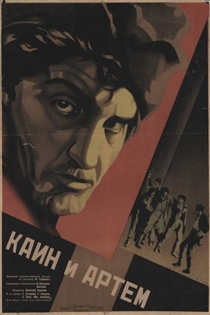
Kain i Artem
Pavel Petrov-Bytov
Emil Gal, Nikolai Simonov
Pavel Petrov-Bytov was an enfant terrible of the highbrow Leningrad Sovkino film factory. He was notorious for his article “We Have No Soviet Filmmaking,” in which he criticized all the achievements of the Soviet avant-garde. In spite of his beliefs and his scandalous struggle with “bourgeois” and “formalist” filmmaking, Petrov-Bytov directed an aesthetically refined work, shot entirely on set with masterful chiaroscuro lighting: a perfect example of “Soviet expressionism.” Based on a Maxim Gorky story, the plot of Cain and Artem provides a wake-up call to the Russian people to overcome alcoholism and religious factionalism, as it spotlights the (many) drunken denizens of a typical village and their disregard for the Jewish shoemaker Cain.
Cain and Artem