Wolfgang Sawallisch
1923 - 2013The Greatest Love and the Greatest Sorrow
Christopher Nupen
Daniel Barenboim, Jaqueline du Pré
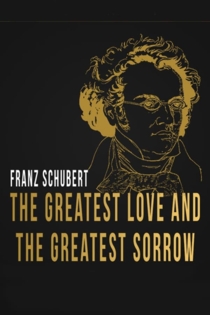
The Greatest Love and the Greatest Sorrow is a film which sets out to bring the viewer closer, not to the details of Schubert's life, but to the spirit of what he was trying to express with what he called his creative gift and with which he tried "to brighten the world". The film begins with the funeral of Beethoven, at which Schubert was a torch-bearer, His story is told almost entirely in music written in the twenty months that remained to him after that date, together with quotations from Schubert's letters, diaries and the words that he chose to set in some of his songs. Includes personal introductions by Christopher Nupen and Jacqueline du Pré and features the legendary 1969 performance of The Trout with Daniel Barenboim, Itzhak Perlman, Jacqueline du Pré, Pinchas Zukerman and Zubin Mehta.
The Greatest Love and the Greatest Sorrow
The Trout
Christopher Nupen
Daniel Barenboim, Jacqueline du Pre
Christopher Nupen's record of the concert given by five young musicians in the new Queen Elizabeth Hall at London's South Bank, in 1969. The Trout is an exuberant explosion of youthful enjoyment in music: first from Schubert himself, who wrote his famous Trout quintet when he was 22 years old, and then from five young artists of the highest rank. They pick up the spirit of Schubert's music magnificently, both in preparation and rehearsal, and in their 1969 performance of the work, which has become one of the most remembered ever given. Includes personal introductions by Christopher Nupen and Jacqueline du Pré and features the legendary 1969 performance of The Trout with Daniel Barenboim, Itzhak Perlman, Jacqueline du Pré, Pinchas Zukerman and Zubin Mehta.
The Trout
Don Carlos
Gustaf Rudolf Sellner
James King, Pilar Lorengar
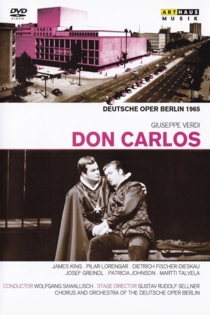
This performance, taped for TV in 1967, has many of the most famous singers in the German orbit of the time, mostly in prime form, in roles that suit them, a great conductor in his prime, and is a well thought out production. Don Carlos is given in German, in the four act version with the usual cuts of that era and some extra cuts (the royal procession in the first scene is gone, the middle of the garden scene is gone, cuts are made in all the ensembles in the auto da fe scene, there is a snip -- not the biggest I've heard -- in the final Carlos/Elisabetta duet -- and finally the very end is rewritten by unknown hands -- the Grand Inquisitor grasps Carlos, Elisabetta faints (so no Friar, identification of the Friar as Charles V, and no final B flat.)
Don Carlos