
Adam Beckett
1950 - 1979Evolution of the Red Star
Adam Beckett
Music: Carl Stone. Colored pen-and-ink drawings, like topological maps of biomorphic objects, grow and evolve from the red star. Once the master image is formed, this continuously throbbing, pulsating sight is used to ring changes based on years of optical work. Music and picture work together to create a mood of ecstatic tranquility. The bright colors, beautiful music, surprise at the end, etc. make this a good film for young children. Awards: Sinking Creek Film & Video Festival, 1973; Washington National Student Film Festival, 1974; Brooklyn Independent Filmmakers Exposition, 1974; Vanguard Int'l Competition of Electronic Music for Film, 1974; Humboldt Film Festival, 1974.
Evolution of the Red Star
Heavy-Light
Adam Beckett
This is one of those abstract animated films in which colored, richly textured light moves in a black, three-dimensional space. The pictures and the electronic score are unified in a strict structure made of three main sections which progressively develop three subsections. This film may look like it was made using computers or video to the uninitiated, but only animation and much optical printing are to be seen herein.
Heavy-Light
4 Fragments
Adam Beckett
Sequence digitally photographed and animated by Pamela Turner in 2009 from Beckett's original drawings; these untitled images may have been intended for use in Life in the Atom. Also included, Every Other, is a unique version of an animated "exquisite corpse" and is a delightful study of the two artists' drawings. Beckett and Kathy Rose took turns contributing segments to a sequence, each animating 24 frames, passing their final image to the other to continue. These 336 were discovered amongst Beckett's many drawings and were digitally recorded by his biographer, Pamela Turner, in 2010. - Pamela Turner
4 Fragments
Quacked Jokes/Early Animations
Adam Beckett
The animation referred to as Early Animations or Quacked Jokes is an anomaly among Beckett's films. It was probably not intended to be shown outside of his sphere of friends, being a collection of early experiments and directions. While lacking the sophistication and artistry that is found in his six finished works, this film provides invaluable insight to his first attempts at animation and clues to some of his later work. - Pamela Turner
Quacked Jokes/Early Animations
Sausage City
Adam Beckett
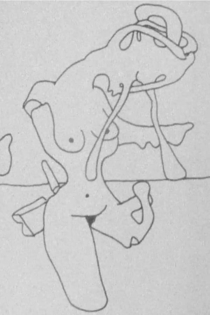
Sausage City illustrates Beckett's additive cycle process. Constantly evolving rectangular shapes provide a foundation for an environment inhabited by mutating blobs - or sausages. Sounds and shapes create a moving space that teeters on the edge between control and chaos. The ending is somewhat mystifying, pulling us out of the surreal environment and revealing its origins.
Sausage City

Life in the Atom
Adam Beckett
Life in the Atom was never completed but the existing version was digitally restored in 2009. The film depicts an ever-changing world inhabited by a man and woman engaged in surreal, erotic contortions. Their bodies are in a constant state of metamorphosis, as if to indicate psychological states or inner reflection as they contemplate their connection; they are being transported, transcending, merging and melting. - Pamela Turner
Life in the Atom


The Letter
Adam Beckett, James Gore
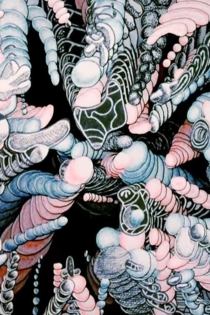
A collaborative piece by Gore and Beckett, the film begins with one of Gore's characters composing a letter, to eventual mail it. Beckett's animation takes over at this point, transforming the envelope into a looping, cascading form that seems to be perpetually turning itself inside out. A brief Gore finale bookends the piece, which is one of only two extant examples of Gore's unique animation work. This film is usually appended to Gore's own Dream of the Sphinx. [Source: Mark Toscano]
The Letter