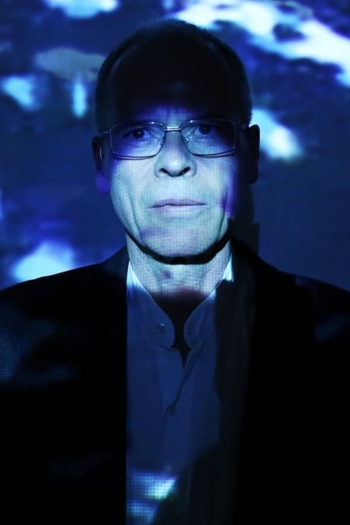
Christian Lebrat
2021Since 1976 he has created over twenty experimental films, videos, and film performances, along with a formidable body of photographic work. In the last ten years he has had over a dozen major retrospectives of his films in different international cities. He began working in photography in 1978 and has been exhibiting regularly since 1982. Recent solo exhibitions in Marseille, Pantin (France),TorontoandItalyshow new works in film, video, photography, and sculpture. His works are in several public collections, such as: Musée national d'art moderne (Centre Pompidou), FNAC, FRAC Champagne-Ardenne, Bibliothèque nationale de France.
In 1985 he founded Paris Expérimental (http://paris-experimental.asso.fr), a publishing company entirely devoted to publishing theoretical and historical texts on avant-garde and experimental cinema. He has published several essential books on the subject and edited the monumental anthology on French avant-garde film, Jeune, Dure et Pure! Une histoire du cinéma d'avant-garde et experimental en France (2001). He has also published a collection of essays and lectures on his own films (Between images, Paris Expérimental, 1997) and a compilation of his texts (Radical cinema, Paris Expérimental, 2008). As a curator he has also organized several retrospectives, amongst them Jeune, dure et pure! Une histoire du cinéma d'avant-garde et expérimental en France (Cinémathèque française, Paris, 2001), Le Cinéma visionnaire: l'avant-garde américaine (Paris and Rome, 2002), and Maurice Lemaître et le cinéma (Paris, 2005).
His most recent recognition include: 2007 Prize of the MoCCA (Museum of Contemporary Cinema, in Madrid) for Ultra, film performance for 2 x 16 mm projectors and loops. His video V1 (Vortex) has been acquired in 2008 by the Fonds National d'Art Contemporain (French public collection) and most recently his "historical" film Organisation I and performance Liminal Minimal have joined the Centre Pompidou Collection.
Cinématon
Gérard Courant
Gérard Courant, Alain-Alcide Sudre
Cinématon is a 156-hour long experimental film by French director Gérard Courant. It was the longest film ever released until 2011. Composed over 36 years from 1978 until 2006, it consists of a series of over 2,821 silent vignettes (cinématons), each 3 minutes and 25 seconds long, of various celebrities, artists, journalists and friends of the director, each doing whatever they want for the allotted time. Subjects of the film include directors Barbet Schroeder, Nagisa Oshima, Volker Schlöndorff, Ken Loach, Benjamin Cuq, Youssef Chahine, Wim Wenders, Joseph Losey, Jean-Luc Godard, Samuel Fuller and Terry Gilliam, chess grandmaster Joël Lautier, and actors Roberto Benigni, Stéphane Audran, Julie Delpy and Lesley Chatterley. Gilliam is featured eating a 100-franc note, while Fuller smokes a cigar. Courant's favourite subject was a 7-month-old baby. The film was screened in its then-entirety in Avignon in November 2009 and was screened in Redondo Beach, CA on April 9, 2010.
Cinématon

Reseaux
Christian Lebrat
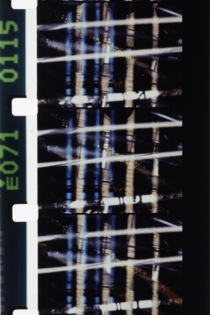
The densest film of the divided-frame group is the aptly titled 1978 Networks, which includes as many as 20 exposures of the same roll of film. Here only one slit was used, but Lebrat combines within one image many narrow strips taken at diverse Paris locations, sometimes seen through colored filters. The enclosed, even claustrophobic space of the strips contrasts with Lebrat’s superimposition of them and with the movement within the strips and by the strips within the frame... (Fred Camper)
Networks
Autoportrait au Dispositif
Christian Lebrat
"In the 1990 text on his film Autoportrait au dispositif (1981), Lebrat wrote that all his films are in fact self-portraits, including those that are abstract colour films, and the Rothko's painting are the most beautiful examples of self-portraiture in twentieth century art. lebrat notes that the impetus behind self-portraiture comes out of his desire to create another image of his body, which does not necessarily have to be its representation but can suggest another satte of being, for example the infinite and transcendent state aims at overcoming the problem of corps morcelé and mortal flesh." Izabella Pruska-Oldenhof
Self-portrait with the Device
Trama
Christian Lebrat
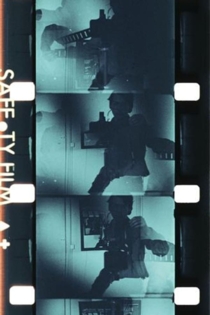
"In Trama, Lebrat divides a surface vertically to be filmed in six equal segments of color (yellow, red, blue, green, violet, orange). The composition stays exactly the same all the way through the film. The filmmaker puts a band on the side of every two or three frames. Constructed step-by-step, using ten bands, the optical mixture of color induces strange pulsating effects." Raphaël Bassan
Trama
V4 (It Could Happen to You)
Christian Lebrat, Giovanna Puggioni
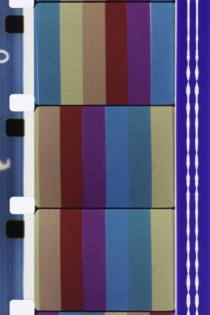
Filmed unexpectedly on the port of Genoa, the jazz music resonates with the lights of the city. The video loop, multiplied and worked on during the editing, induces in the spectator a kind of spatio-temporal hypnosis reinforced by the light patterns that change status and the "depth" of the sound recorded live...
V4 (It Could Happen to You)
Film Numero Deux
Christian Lebrat
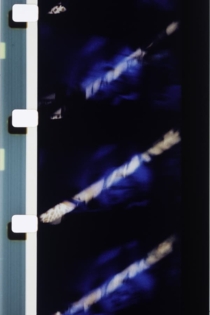
For the films in which Lebrat divided the screen he placed a piece of paper with one or more slits in it in front of the lens, allowing only a narrow strip of imagery to register. He then exposed the film multiple times, layering images. The initial effect is confusion—it’s often hard to identify from these moving slits what we’re seeing. But soon the eyes acclimate, and when one does recognize fragments of a nude woman (Lebrat’s wife) in a landscape in Film Number Two (1976), she has the quality of an apparition. Shown in a different way than thousands of years of nudes have led us to expect, this woman is charged with a vital, surprising erotic energy. (Fred Camper)
Film Numero Deux
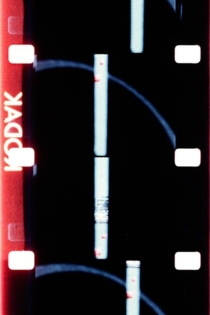
Liminal Minimal (I & II)
Christian Lebrat
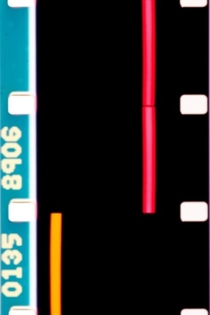
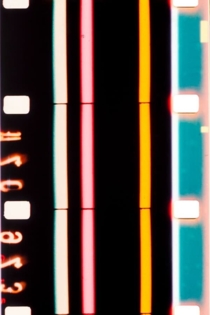
To come back to abstraction, I have a feeling that colour varies in my work between two aspects: the colour-object that comes from the sensation of an object, in this case the film strip, and the opening. This colour-object permits the transporting of objects into space, to explore the space of the screen in the theatre; this is what allowed me to develop Liminal Minimal (1977) by enlarging the space of projection with two projectors and, taking into account that the vertical strips evolve on a black background comparable to the darkness of the theatre, I was able explore the whole space of the projection with the coloured strip
Liminal Minimal (I & II)