Robert Huot
2021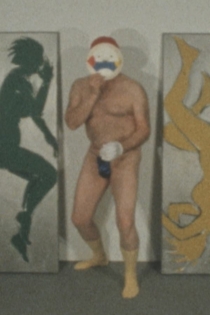
Nude Decending the Stairs
Robert Huot
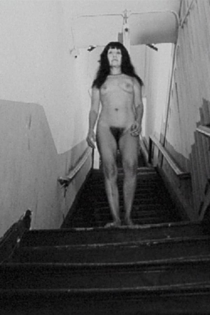
The motif of having people slowly approach the camera first appears in Nude Descending the Stairs, an interesting minimalist work made up of three single-take, single-angle black and white silent rolls during each of which one person - in one instance, Huot dressed in a white painter's jumpsuit; in the others, a naked woman (Marie Antoinette) - slowly descends a four storey staircase toward the camera. Because of the camera's upward angle, the descents are translated into level forward motions during which the two people grow larger with each step they take. The film's concern with the manipulation of space and with the details of human motion through it, accounts for both the title and the inscription 'for Duchamp and Muybridge.
Nude Decending the Stairs
Zorns Lemma
Hollis Frampton
Robert Huot, Rosemarie Castoro
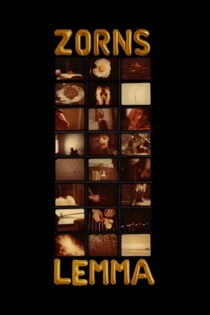
Zorns Lemma is a 1970 American structuralist film by Hollis Frampton. It is named after Zorn's lemma (also known as the Kuratowski–Zorn lemma), a proposition of set theory formulated by mathematician Max Zorn in 1935. Zorns Lemma is prefaced with a reading from an early grammar textbook. The remainder of the film, largely silent, shows the viewer an evolving 24-part "alphabet" (where i & j and u & v are interchanged) which is cycled through, replaced and expanded upon. The film's conclusion shows a man, woman and dog walking through snow as several voices read passages from On Light, or the Ingression of Forms by Robert Grosseteste.
Zorns Lemma
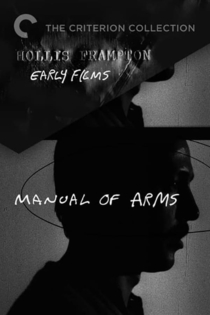
Beautiful Movie
Robert Huot
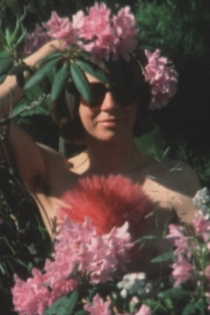
"Beautiful Movie" is a filmic cameo during which a passage of blue film leader and clear film painted red introduces a lovely image of a woman, naked from the waist up, sitting on a brass bed, combing her hair. When we first see the woman, she is well out of focus, but during the following minute or so she slowly becomes clear. As soon as the image is completely clear, however, Huot dissolves to an image of himself sitting in a similar position, combing his own hair. This image quickly goes out of focus, and the viewer sees the original passage of leader and painted film, this time in reverse, forming the other half of a filmic frame. "Beautiful Movie" is a quietly feminist work; Huot revised the traditional tendency to worship female beauty by suggesting that, yes women are lovely, but there is no physical reason why men cannot be lovely in the same way.—Scott MacDonald, “The Films of Robert Huot: 1967 to 1972”, Quarterly Review of Film Studies, Summer 1980.
Beautiful Movie

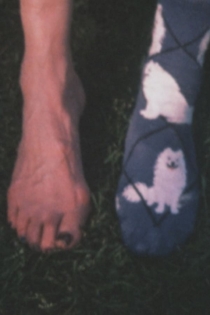
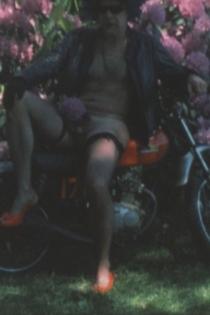
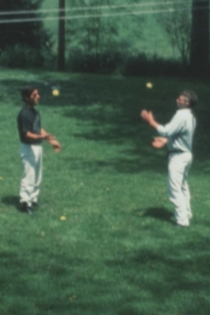
Cross-Cut–A Blue Movie
Robert Huot
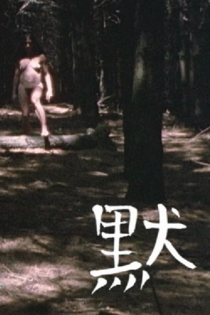
In CROSS-CUT--A BLUE MOVIE, Huot presents a minimal passage of intercutting between found footage of a hoochy-coochy dancer and a blue leader, organized as a pair of inversely related geometric progressions. The resulting film is amusing (because of the pun in the title, the speed of the editing, and the funny fast-motion shimmy of the dancer); highly rhythmic (both because of the intercutting itself, and because of the rhythms added by the dancer's movements, the flutter of dust particles on the blue leader, and the waver of scratch marks on the footage of the dancer); and formally interesting because of Huot's creation of a montage which so energetically goes nowhere.
Cross-Cut–A Blue Movie
Fades and Close-Ups
Robert Huot
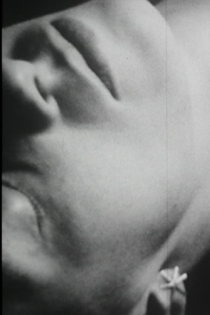
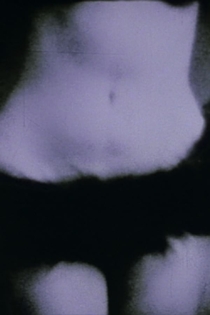
…was shot in black and white Super 8mm and is accompanied by a soundtrack of drumming and deep breathing. The camera fades in and out on a symmetrical series of lovely, grainy close-ups of the naked, apparently sleeping forms of a male and a female (Huot himself and Carol Kinne). The film is closely related to, and would be especially interesting screened with Willard Maas’ Geography of the Body, Tara Iimura’s Love, and Yoko Ono’s Fly.
Fades and Close-Ups