Gary Hill
2021Skaterdater
Noel Black
Michael Mel, Melissa Mallory
The film tells a story with no dialogue. The group of boy skaters are suddenly at a point when one of the boys sees a young girl, and becomes interested in her. This causes a rift with the other boys, who challenges him to a skating duel that goes down a hilly street. The young boy loses. However, he gets the girl, and shortly, a few other girls are seen and become interested in the boys, too. The film was nominated for an Oscar for Best Live Action Short Film.
Skaterdater
Incidence of Catastrophe
Gary Hill
In the video, Thomas the protagonist is played by Hill which confounds the self-reflexive nature of the book’s relationships all the more, making the video something of a “transcreation.” The “reader” begins in the liquidity of the text almost as if he were waking from drowning. Images of the sea ravishing the shore – small cliffs of sand eroding and collapsing – are inter-cut with extreme close-ups of text and the texture of the page and book itself being flooded with ocean waves. In scene after scene the reader attempts to re-enter the book only to find himself a part of intense dreams and hallucinations.
Incidence of Catastrophe
Mirror Road
Gary Hill
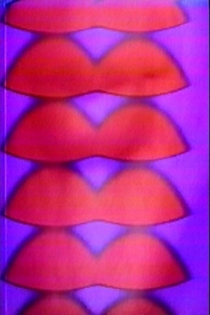
In Mirror Road, Hill uses the camera and image processing devices to explore the malleability of electronic colors and image density. Amorphous structures move across the monitor like drifting clouds, changing color and direction. From time to time structures of fantastic color landscapes move past one another in the lower and upper halves of the picture (the rearview mirror takes up the upper half of the frame), only to be recombined into an amorphous unity.
Mirror Road
Tale Enclosure
Gary Hill
George Quasha, Charles Stein
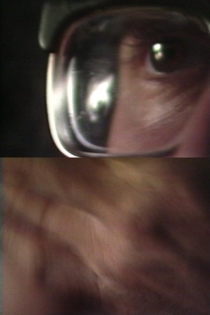
Returning to the primal source of language, Hill explores the physical and subconscious origins of speech. In a continuous shot of a rhythmic, linguistically inspired chant-performance by George Quasha and George Stein, the camera wanders from mouth to face to hands to figure in an open-ended visual search. The performers use the body as an acoustic instrument of sound and abstract utterances.
Tale Enclosure
Why Do Things Get in a Muddle? (Come On Petunia)
Gary Hill
Kathy Bourbonais, Charles Stein
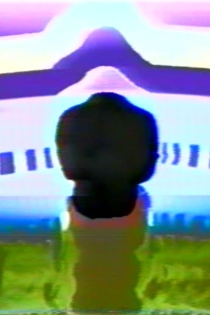
This tape is the first of Hill’s works for which he deliberately wrote a screenplay. The title defines the piece’s starting point: Alice in Wonderland asks her omniscient father why things get in a muddle. They then talk on a metalinguistic level. A glimpse through the looking glass reveals an inversion of the customary order of things. The father ingests the smoke from his pipe, Alice does not so much blink her eyelids momentarily open as stare wide-eyed, and the playing cards fall out of the air in an orderly manner into the girl’s hand. (Gary Hill: Selected Works and catalogue raisonné, edited by Holger Broeker)
Why Do Things Get in a Muddle? (Come On Petunia)
Earth Pulse
Gary Hill
A humanoid form strikes its body while making primal guttural sounds. At times the form is “stopped” and “started” using the pause of a reel-to-reel video player—a frozen line of noise (an asynchronous frame) cuts through the image reinforcing the sense of physicality. The sounding form is eventually set in an electronically generated landscape with temple-like forms of undulating feedback. Further processing of the voice and additional rhythmic electronic sounds are suggestive of ritual.
Earth Pulse
Site/Recite (a prologue)
Gary Hill
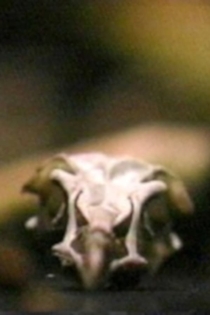
With startling precision, Site/Recite moves across and around a table-top graveyard — bones, butterfly wings, egg shells, seed pods, crumpled notes, skulls — in a series of seamless edits that present a continuous flow of detailed close-ups. This taxonomy of dispossession, "little deaths that pile up," is juxtaposed to a narration on the linkage between semantic self-consciousness and visual experience. Through the window of this text, the objects on the table come to model how consciousness affixes itself to material manifestations and how memory is constituted by the collection of empty vessels. Site/Recite is a prologue for Which Tree, an interactive videodisc installation that presents viewers with a maze of interconnected branch points, allowing them to wander through its forest of images and words to discover the "texts" of their own thinking patterns.
Site/Recite (a prologue)
Soundings
Gary Hill
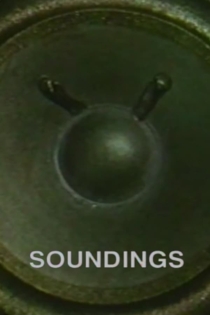
Two color video cameras, two microphones, Dave Jones prototype modules (input amplifiers, variable soft/hard keyers, output amplifier, analog-to-digital converter, bit switch, digital-to-analog converter), assorted speaker cones, enclosed speaker, sand, large spike nails, lighter fluid, lighter, amplifier, wire, and water.
Soundings
Primarily Speaking
Gary Hill
This work is the single-channel version of a multi-channel installation of the same name. The picture plane is divided into a left and a right half. A changing background is formed by colorful, highly graphic patterns reminiscent of TV test signals and various monochrome surfaces. Two smaller rectangles appear on the surface, in which video sequences are running. The two image strands show landscapes, interiors, objects, graphical images and text that are sometimes used in contrast, and on other occasions the same image can be seen mirrored in each rectangle. They are accompanied by Hill’s recitation of a long text, whose syllabic sequence determines the rhythm of the images (the screen changes with each uttered syllable). His voice comes alternately out of the left and right stereo channels functioning like a dialogue. This is broken into sections by a singing, but electronically altered, voice.
Primarily Speaking
Videograms
Gary Hill
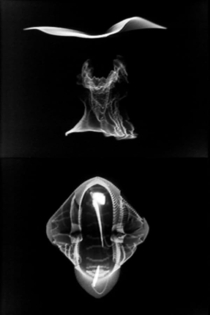
1980-81, 13:27 min, b&w, sound Videograms is an ongoing series of text/image constructs or syntaxes using the Rutt/Etra Scan Processor, a device that enables Hill to sculpt electronic forms on the screen. Each "videogram" relates literally or conceptually to Hill's accompanying spoken text, which is visually translated into abstract shapes. Hill writes, "The vocabulary and precision of this tool allowed me to expand the notion of an 'electronic linguistic' through textual narrative blocks created specifically for the electronic vocabulary inherent in the Rutt/Etra device."
Videograms
Electronic Linguistic
Gary Hill
The work’s images appear as visualizations of electronically generated sounds. Initially, small pulsating pixel structures occasionally appear on the black screen. These monadic forms become larger, ultimately filling the picture plane and pulsating ever more intensely.
Electronic Linguistic
Primary
Gary Hill
The artist’s mouth fills the whole image plane. Silently the words “red,” “blue,” “green” are slowly and repeatedly articulated. The color of the screen switches from red to blue to green at a quickened rate. Utilizing the same rate, the spoken words, “red,” “blue,” and “green,” are cut together into syllabic combinations of the three words making up the asynchronous sound track. The individual words, barely intelligible as spoken, are more easily “read” on the uniformly moving lips. (Quasha, George and Charles Stein. An Art of Limina: Gary Hill’s Works and Writings. Barcelona: Ediciones Polígrafa, 2009, p. 589)
Primary
Windows
Gary Hill
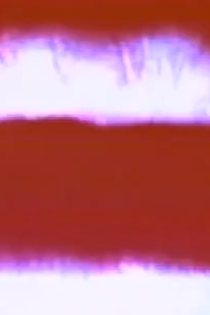
Silent or with minimal sound, Hill's early formalist works explore the manipulation of electronic color and image density through the camera obscura and image processing devices. Of these tapes, Hill has written that "much of the subject matter and the expressionistic method of working underline and in some sense parody the traditional medium of painting." In Windows, the image of windows in a darkened room is digitized, densely layered, and otherwise abstracted in a series of graphic compositions.
Windows