Rei Hayama
2021
A.D.A.M.
Vladislav Knežević
Thomas Johnson, Rei Hayama
The expansiveness of empty landscapes that call attention to their subtle forms in a dynamic macro-perspective, and densely built urban ensembles combined with fragments of dry instructions and inconspicuously urgent communications to create a reserved fictional meditation on the relationship between man and machine.
A.D.A.M.

A Child Goes Burying Dead Insects
Rei Hayama
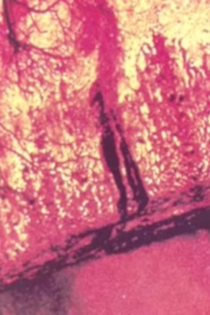
The repeated sequence of "a girl appearing in the woods, burying dead insects and then leaving" is made without a camera. With each repetition, the film images are broken down and the color is fading. The girl is performed by the filmmaker herself, channeling media as a medium. This film is structural but also has a narrative.
A Child Goes Burying Dead Insects

同線上にあり、水に反射する
Rei Hayama
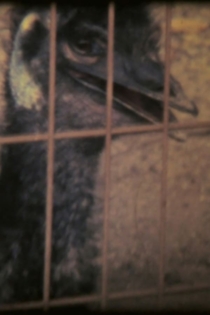
The filmmaker talks about what she sees while she's staring at the projected image of a face of the caged Emu (bird), which is one of a filmmaker's own archive shot by herself at the zoo. In one moment, there's a drop of tear falls from the eye of emu. Even if this one drop of tear has been merely a physiological phenomena to removing dust from its eye, yet the tear touches human mind. The eye of Emu and the tear are not only to make us perceive a human figure in the reflection, but it shows something farther beyond.
On the collinear and reflected on the water
1/8
Rei Hayama
Comparing the number of photoreceptor cells in eyes of human and hawk, hawk has about 8 times more photoreceptor cells than human. The title of the film is about human eyes. Figure of flying bird in sky as a small black dot is the intimation of things that human can not see. Human has been following the black dot by the desire to fly. On the other hand, bird has been distorted by human as an image or a sign.
1/8
Space Noise Calling
Rei Hayama
Rei Hayama collaborated with Takashi Makino's "Space Noise", and there this "Space Noise Calling" was made. Hayama introduced an old rotary phone to the performance, which is disconnected and the microphone is built-in. Whilst the bells of the disconnected phone is ringing, image of penguins which walking on the artificial ice at zoo, which is visible through the glass, appears and it mixed with Makino's original image of "Space Noise".
Space Noise Calling
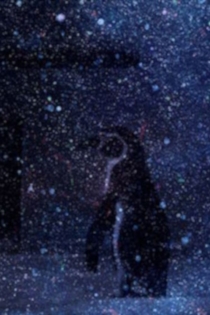
聴こえない足音
Rei Hayama
Footsteps of horses and sheep. I run to the forest in a hurry. But I never reach to the forest of my destination. I'm remain in the original place, the place before the tale. After the destination (forest) disappears gradually, aimless footsteps are left on the stage. "Being on the way to somewhere" becomes a story of film in itself. The white light placed in the center of picture is continuously changing its role and prolongs the tail of the tale.
Inaudible footsteps
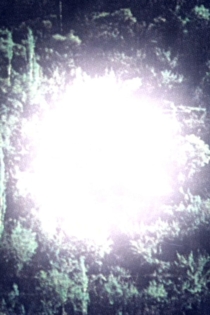
The Pearl of Tailorbird
Rei Hayama
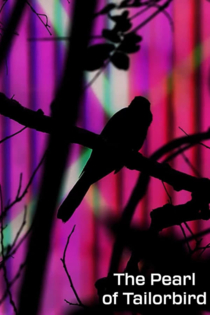
The essence of "The Pearl of Tailorbird" lies in the fortuitous poetry generated through the process of multiple translations – avian to human, phonetic to semantic, textual to visual – in which the latent porosity of language helps give birth to multi-layered resonances. For Hayama, this kind of whimsical linguistic deconstruction underscores the central role of language in the process of anthropocentric world-building – and offers a method for transforming hegemonic modes of knowing into ones perhaps more sensitively attuned to our own origins in the natural world. Coaxing a depth of associative meaning from the rhythmic interplay of sound, text, and imagery, The Pearl of Tailorbird perhaps most resembles lyric poetry – or a hermeneutic puzzle – given spatial form. (www.emptygallery.com)
The Pearl of Tailorbird
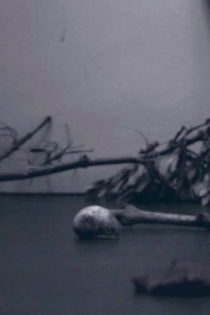
土地からやって来る、ある小ささ
Rei Hayama
The story flowing under this film has certain parallels to the theory of bird's hibernation and transformation advocated by Aristotle which is already dated today. In the land, ash snow is falling. The land's flag is fluttering in the blowing wind. And the quail slowly transforms into some other species. When listening to the voice of soil, there is no border in the land.
SOME SMALLNESS COMING FROM LAND
still life composition 'an accompaniment for life'
Rei Hayama
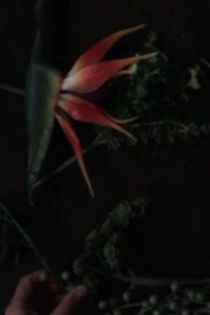
Artificial flowers and plants are kept changing its composition. An imitation of shapes of life, water drops, light from rechargeable hand light, endless accompaniment (climb every mountain.) The scenery reminds tiny grave or a small funeral for dead animals and other small creatures. However, this state of scenery gradually changes by the endless composition.
still life composition 'an accompaniment for life'
THE FOCUS
Rei Hayama
Film THE FOCUS is constructed from rephotographed images collected from old pictorial books of volcano, nomad's culture, war , mountains, some texts and simple color screens that are inserted between images. Nathaniel Hawthorne’s short story “The Earth’s Holocaust” is there as a background of this film.
THE FOCUS